
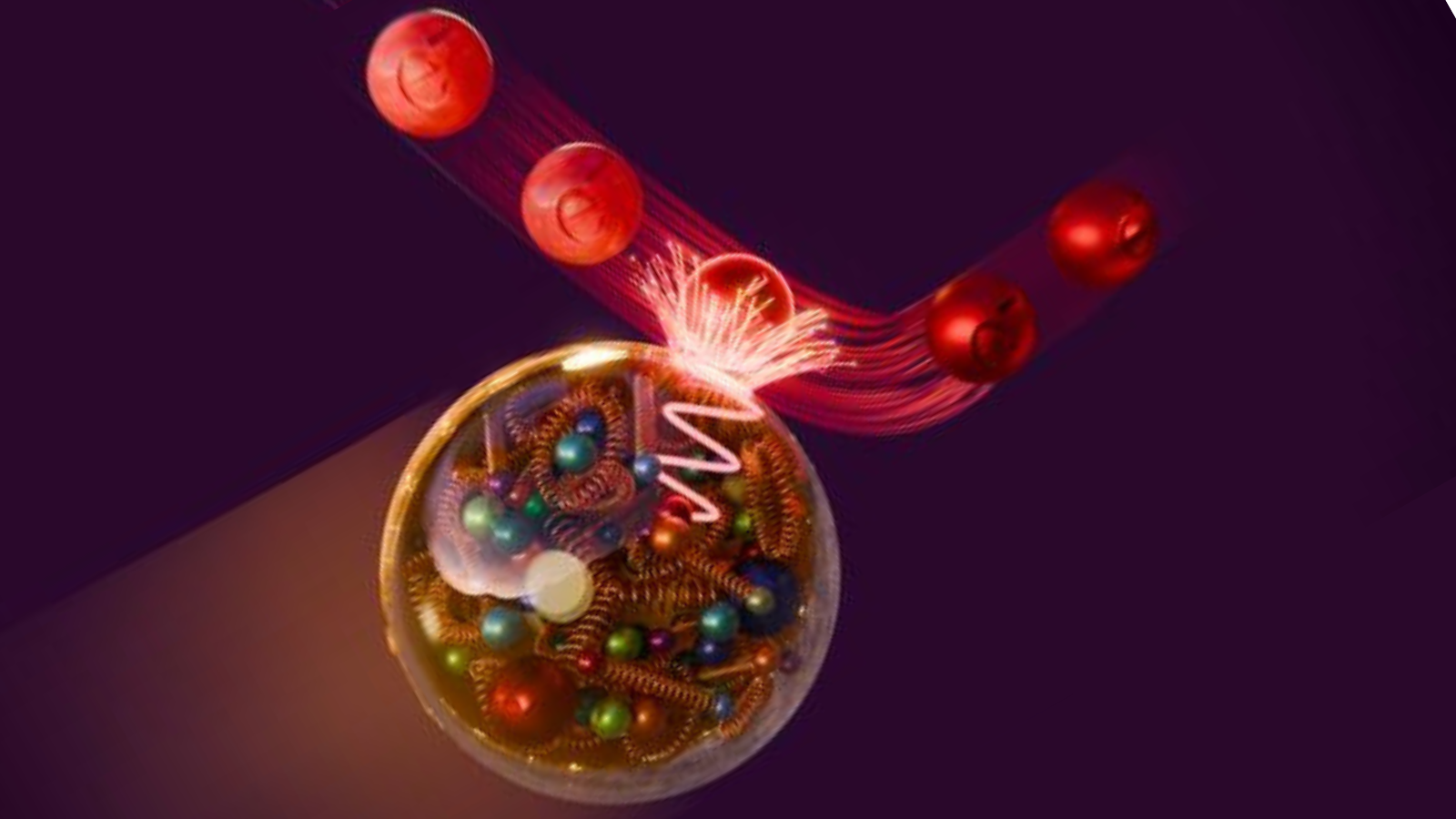
Scientists have used high-energy particle collisions to peer inside protons, the particles that sit inside the nuclei of all atoms. This has revealed for the first time that quarks and gluons, the building blocks of protons, experience the phenomenon of quantum entanglement.
Entanglement is the aspect of quantum physics that says two affected particles can instantaneously influence each other's "state" no matter how widely separated they are — even if they are on opposite sides of the universe. Albert Einstein founded his theories of relativity on the notion that nothing can travel faster than the speed of light, however, something that should preclude the instantaneous nature of entanglement.