Get all your news in one place.
100's of premium titles.
One app.
Start reading
The Conversation
The Conversation
Amy J. Williams, Assistant Professor of Geology, University of Florida

Scientists detected a potential biosignature on Mars – an astrobiologist explains what these traces of life are, and how researchers figure out their source

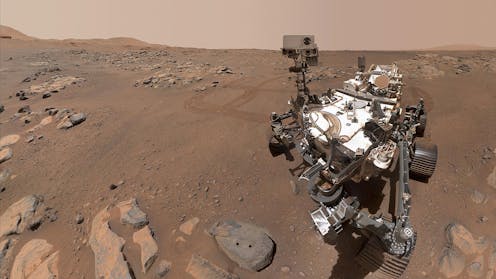
NASA’s Perseverance rover explores Mars' Jezero Crater. NASA/JPL-Caltech/MSSS, CC BY-NC

As the Perseverance rover traversed an ancient river valley in Mars’ Jezero Crater back in July 2024, it drilled into the surface and extracted a sample from of a unique, striped rock called Chevaya Falls. The rover’s instruments then analyzed the sample, which is called Sapphire Canyon, and surveyed the surrounding rock.

When scientists started looking into the data, they found two types of iron-rich minerals arranged on the rock in a distinctive, spotted pattern. Both these minerals are associated with life on Earth. One is found around decomposing organic matter on Earth, while the other is produced by certain microbes.

Sign up to read this article
Read news from 100's of titles, curated specifically for you.
Already a member? Sign in here
Related Stories
Top stories on inkl right now
One subscription that gives you access to news from hundreds of sites
Already a member? Sign in here
Our Picks
Fourteen days free
Download the app
One app. One membership.
100+ trusted global sources.