
Get all your news in one place.
100’s of premium titles.
One app.
Start reading
LiveScience
LiveScience
Tia Ghose

Science history: Iconic 'Lucy' fossil discovered, transforming our understanding of human evolution — Nov. 24, 1974

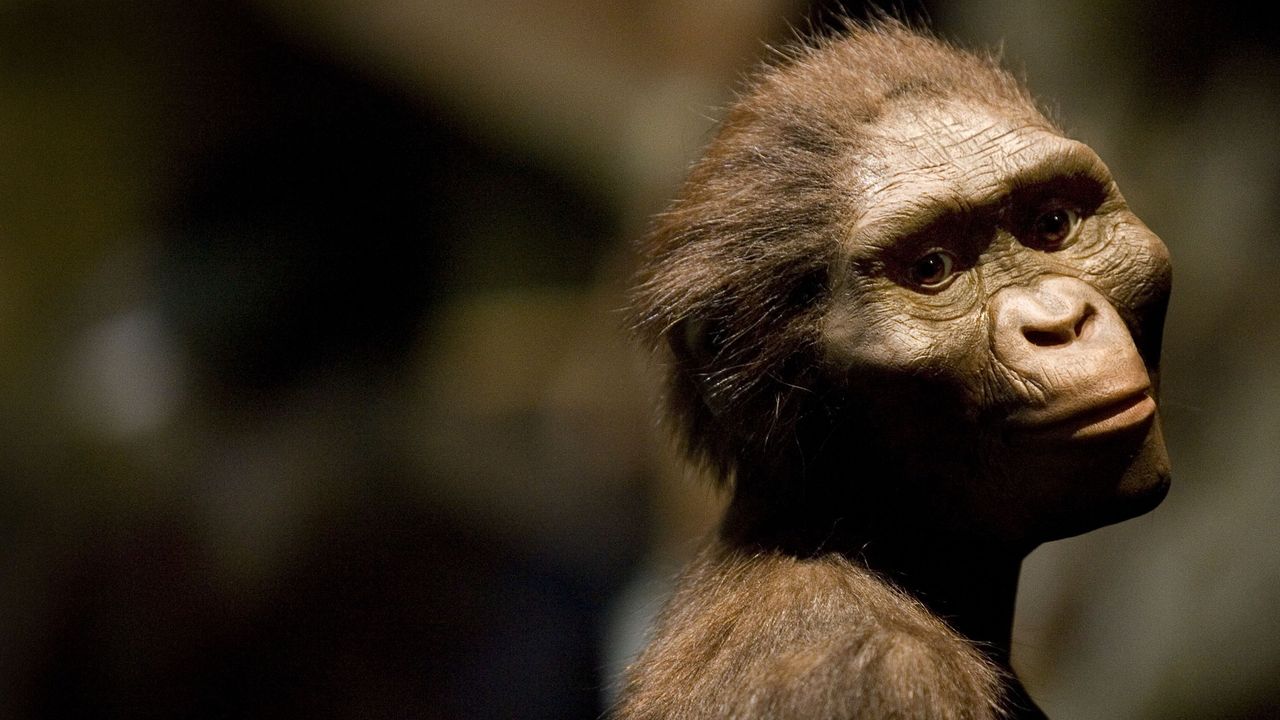
A rendering of Lucy.
QUICK FACTS

Milestone: Fossil "Lucy" discovered

When: Nov. 24, 1974

Where: Hadar, Ethiopia

Who: Anthropologists Donald Johanson and Tom Gray

More than 50 years ago, two anthropologists were digging in Hadar, Ethiopia, when they spotted something glinting in a gully. What they found would transform the story of human evolution.

Donald Johanson, then a curator at the Cleveland Museum of Natural History, was leading an excavation in the Awash Valley because of some millions-of-years-old stone tools that had been found there. He and graduate student Tom Gray had set out early that morning to hunt for fossils. The object they'd spotted turned out to be a fossil of a human ancestor, and when they looked around the site, they found others from the same individual.

Later that night, the team excitedly discussed the find as the Beatles song "Lucy in the Sky with Diamonds" played in the background. Team member Pamela Alderman suggested the fossil be named "Lucy."

"And it just became iconic," Johanson told Live Science in 2024. "A moniker that everybody knew."

Over the next several weeks, the team would dig up parts of the skull, rib cage, pelvis and limb bones of a 3.2 million-year-old human ancestor — at the time, the oldest and most complete skeleton of a human ancestor ever found. It would become known as Australopithecus afarensis — and would transform our knowledge of human evolution.

"Lucy" was so complete that you could almost see her staring out at you across the eons. We've learned much about her life over the years: that she had massive leg muscles for walking and climbing trees; that she would have been a bad runner due to differently shaped tendons and muscles in her calf; and that she likely used tools.

"Lucy" also settled a debate that had been brewing in the field. Lucy lived at the "halfway point" in human evolution — about equidistant in time from both apes and modern Homo sapiens. At the time, many anthropologists thought big brains evolved before upright walking. But the diminutive, small-headed "Lucy" was clearly adapted to walking on two legs. Most anthropologists now think A. afarensis represents a direct human ancestor.

(Image credit: Anadolu via Getty Images)

Lucy's discovery set the stage for the identification of even older archaic hominins, including the famous Ardipithecus ramidus fossil known as "Ardi."

"The discovery of Lucy really hit the start button for looking in older and older sediments in Africa," John Kappelman, a paleoanthropologist at the University of Texas at Austin, previously told Live Science.

Over the years, scientists have unearthed more than 500 A. afarensis fossils spanning a million years of evolutionary history, from sites in Tanzania, Kenya and Ethiopia. And we have learned a lot about how Lucy herself lived and died, and can even re-create her last day on Earth.

We have also discovered that Lucy's kind lived in a world teeming with other human ancestors and relatives. Thus far, anthropologists have identified several Australopithecus species, as well as other related genera.

Thanks to fossils like Lucy and her relatives, anthropologists are now realizing that human evolutionary history is more like a braided stream than a family tree.

Sign up to read this article
Read news from 100’s of titles, curated specifically for you.
Already a member? Sign in here
Related Stories
Top stories on inkl right now
One subscription that gives you access to news from hundreds of sites
Already a member? Sign in here
Our Picks
Fourteen days free
Download the app
One app. One membership.
100+ trusted global sources.