
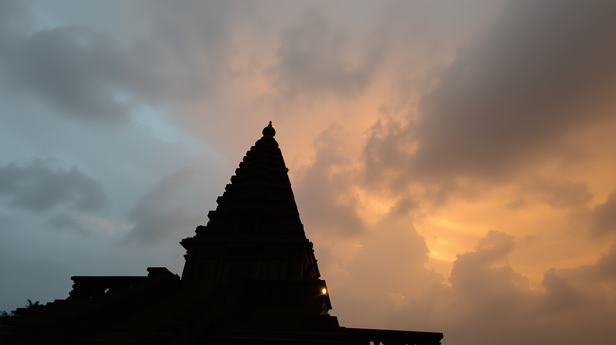
Somnath Temple, Prabhas Patan, Gujarat
The first jyotirlinga stands at the edge of the Arabian Sea, and the waves have been breaking against it since before the temple was rebuilt the last time, and the time before that. Somnath has been destroyed and reconstructed at least six times, the current structure was consecrated in 1951, and that history of erasure and return is itself a form of devotion. During Sawan, the sanctum receives a continuous stream of abhishek with milk, honey, and Gangajal. The sea wind carries the sound of the conch into the courtyard before you reach the main entrance. Arrive before sunrise if you can bear the queue; the light off the water at that hour is something the afternoon cannot replicate.

Kashi Vishwanath Temple, Varanasi, Uttar Pradesh
The Vishwanath corridor opened in 2021 and changed how pilgrims move through the lanes of the old city, but the jyotirlinga itself is unchanged, a black stone set in a silver plinth in a sanctum so small that the crowd and the incense and the chanting compress into a single sensation. Sawan Somwar here is unlike any other Monday in India. Kanwariyas carrying Gangajal from Har Ki Pauri in Haridwar arrive on foot, sometimes after walking hundreds of kilometres, to offer the water directly. The Ganga Aarti at Dashashwamedh Ghat the same evening completes what the morning began. Book the VIP darshan slot through the official portal well in advance; the general queue during Sawan can stretch past four hours.
Trimbakeshwar Temple, Nashik, Maharashtra
This jyotirlinga sits at the source of the Godavari river, in the Brahmagiri hills, and the geography is not incidental, the temple's power in the Shaiva tradition is tied directly to the river that begins here. The lingam at Trimbakeshwar is unusual: it holds three faces representing Brahma, Vishnu, and Shiva within a single stone, and is kept submerged in water most of the time, visible only during specific rituals. Entry to the inner sanctum is restricted to men in traditional dhoti; women worship from the outer hall. The Nashik Kumbh Mela uses Trimbakeshwar as one of its principal sites, and the infrastructure around it reflects that scale. During Sawan, the temple conducts Rudrabhishek ceremonies throughout the month.
Mahakaleshwar Temple, Ujjain, Madhya Pradesh
Mahakaleshwar is the only south-facing jyotirlinga, and in the Shaiva cosmology that orientation makes it the lord of time, Mahakala, the one before whom even death must wait. The Bhasma Aarti here begins before four in the morning and uses ash as the central offering, a ritual that has no direct equivalent at any other major Shiva temple in India. Sawan amplifies this: the temple conducts special Rudrabhishek, the Sawan Somwar queues begin the night before, and the city of Ujjain organises a Sawan Mela along the Shipra riverbank. The Simhastha Kumbh also centres on Ujjain, which means the temple administration is experienced with very large crowds. Register for Bhasma Aarti online; walk-in access to it during Sawan is effectively impossible.
Kedarnath Temple, Rudraprayag, Uttarakhand
Kedarnath sits at 3,583 metres in the Garhwal Himalayas, and the walk from Gaurikund, roughly 16 kilometres on a mountain path, is part of what makes the darshan feel earned. The temple opens each May after winter and closes in November before the snows return; Sawan falls in the middle of that open season, when the high meadows are green and the Mandakini runs loud below. The stone structure is believed to be among the oldest in the Char Dham circuit, with the current temple attributed to Adi Shankaracharya. The main lingam here represents the hump of the bull Nandi, according to the Shaiva Puranas. Helicopter services from Phata and Sersi reduce the trek to minutes, but the booking windows fill within hours of opening; plan at least six weeks ahead.
Bhimashankar Temple, Pune District, Maharashtra
Bhimashankar stands in the Sahyadri hills inside a wildlife sanctuary, which means the approach through the forest is unlike any other jyotirlinga. The temple is smaller and quieter than Trimbakeshwar, the architecture is Hemadpanthi stone, and the Bhima river originates from a spring near the shrine. During Sawan, the forest around the sanctuary is in full monsoon growth, the trail from Khed or from Shidi Ghat arrives wet and steep and, if the clouds are low, almost completely silent except for the water. The Giant Indian Squirrel, Ratufa indica, is endemic to this forest and is the state animal of Maharashtra; it is common on the trail. The combination of a jyotirlinga and an intact forest makes Bhimashankar unusual among major Shiva pilgrimage sites.