Get all your news in one place.
100's of premium titles.
One app.
Start reading
The Times of India
The Times of India
World
TOI World Desk

Saudi money, Chinese weapons, American patronage: Can Pakistan balance all three?

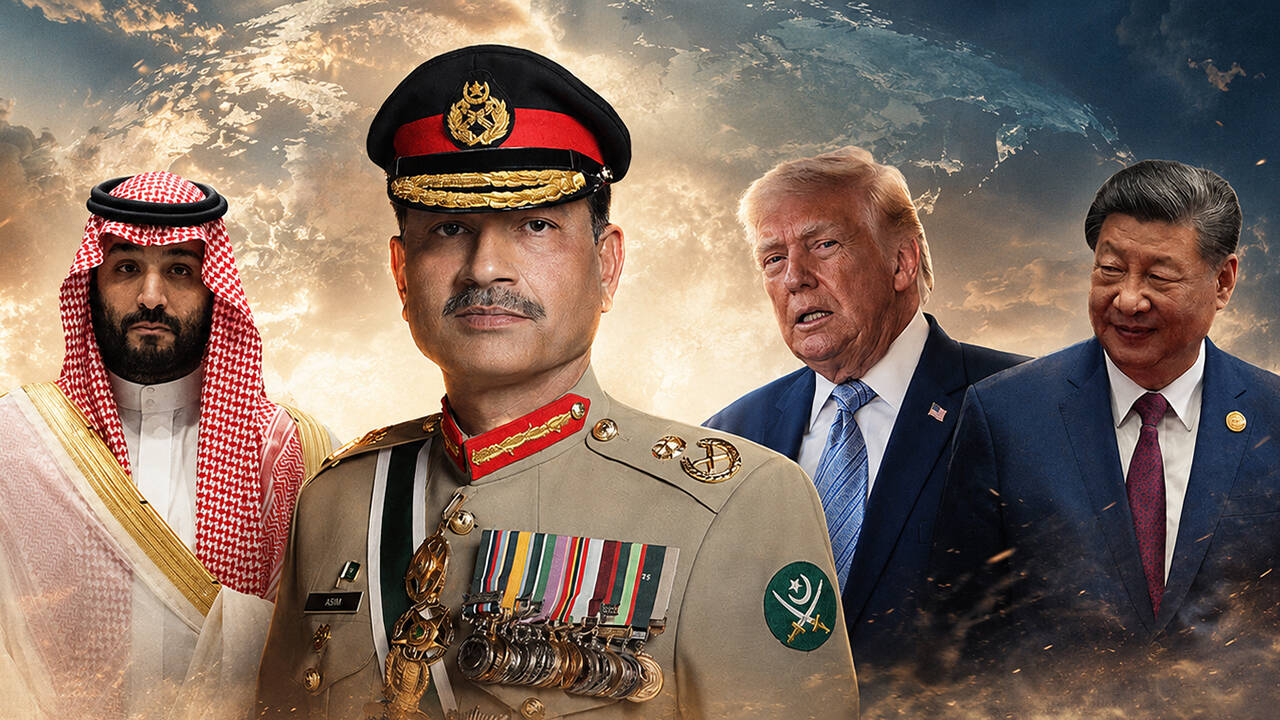
NEW DELHI: Pakistan is attempting one of its most ambitious foreign policy balancing acts in decades, seeking to simultaneously preserve its strategic partnership with China, deepen security ties with Saudi Arabia, rebuild relations with US President Donald Trump's administration, mediate between Washington and Tehran, and strengthen coordination with Turkey and Egypt, according to a detailed Financial Times report.

Get breaking news anytime, anywhere. Download the TOI app now!

The report says Pakistan's military leadership under Field Marshal Asim Munir believes the country's geopolitical location and longstanding relationships across competing power centres have created a rare opportunity to elevate Islamabad's diplomatic profile despite mounting economic and security challenges at home.

According to the report, Pakistan's efforts have become particularly visible during the recent Middle East crisis, with Islamabad attempting to position itself as a regional mediator while simultaneously expanding defence cooperation with Gulf monarchies and maintaining its decades-old strategic partnership with Beijing.

However, analysts quoted by the newspaper warn that Pakistan's expanding diplomatic ambitions are unfolding against the backdrop of a fragile economy, worsening militancy and growing political repression, raising questions about whether Islamabad can sustain such an ambitious foreign policy.

Pakistan's foreign policy paradox: Punching above its weight while struggling at home

According to the report, Pakistan today finds itself pursuing an unusually complex foreign policy that requires it to balance sometimes competing strategic relationships.

The newspaper says Islamabad is simultaneously:

  • Mediating between Iran and the United States;
  • Deepening defence ties with Saudi Arabia;
  • Maintaining its strategic partnership with China;
  • Rebuilding relations with Donald Trump's administration; and
  • Coordinating closely with Turkey and Egypt on regional security issues.

Former Pakistani brigadier Feroz Khan, quoted by the FT, says Pakistan has increasingly relied on diplomacy and military influence to compensate for its domestic weaknesses.

"Given its deep economic and political weaknesses, [Pakistan's] nuclear bomb, its conventional military forces and diplomacy are all it has to punch above its weight as a middle power," says Khan, who now teaches at the Naval Postgraduate School in California.

According to the newspaper, Pakistan's military establishment believes the Middle East offers Islamabad greater strategic space than South Asia, where India's economic and military strength limits Pakistan's regional influence.

"As a south Asian power, Pakistan is permanently number two to India, the wealthier, stronger and more useful nation to the US in that region," Khan says. "But in the Middle East, it believes it can come into its own, with the blessing of US Central Command and Saudi Arabia."

The report says Islamabad's diplomatic outreach has coincided with efforts by Saudi Arabia, Egypt and Turkey to play larger roles in shaping the region's post-war security architecture.

According to analysts cited by the newspaper, this emerging grouping could eventually serve as a counterweight to growing military cooperation involving the United Arab Emirates, Israel and India.

How Saudi Arabia reportedly sought Pakistan's military support

According to FT, one of the clearest illustrations of Pakistan's growing role came shortly before Islamabad hosted talks involving the United States and Iran earlier this year.

The newspaper reports that on April 10, Saudi Finance Minister Mohammed al-Jadaan visited Islamabad and met Pakistan's military chief Field Marshal Asim Munir at the Prime Minister House.

Citing two people briefed on the discussions, FT says Saudi Arabia requested Pakistan's military support as the kingdom came under missile and drone attacks allegedly launched by Iran.

According to the report, Riyadh had already signed a mutual defence agreement with Islamabad in 2025 and wanted Pakistan to provide personnel and military equipment.

The newspaper says Pakistan's leadership was initially reluctant because such a move could complicate its planned mediation efforts between Washington and Tehran and trigger domestic political criticism from sections of Pakistan's population sympathetic to Iran.

However, according to the report, Pakistan was also under severe financial pressure.

The report says that only days earlier, the United Arab Emirates had unexpectedly demanded repayment of $3.5 billion in loans, equivalent to roughly one-fifth of Pakistan's foreign exchange reserves at the time.

According to the newspaper, Pakistan eventually agreed to Saudi Arabia's request.

The FT, citing people familiar with the matter, reports that Munir dispatched a squadron of fighter aircraft, air force personnel and a Chinese-made HQ-9 air defence system to a Saudi military base overlooking Iran's coastline.

The report further claims that Saudi Arabia extended a $3 billion loan to Pakistan the following week.

Pakistan's military spokesperson Lt Gen Ahmed Sharif Chaudhry rejected any suggestion that the deployment and the loan were linked.

"This is a special, decades-old relationship based on a very strong religious foundation and mutual respect," Chaudhry told the FT.

Munir's attempt to redefine Pakistan's global role

The Saudi episode reflects a broader effort by Field Marshal Asim Munir to reshape Pakistan's international standing.

According to the newspaper, Munir has sought to leverage Pakistan's longstanding relationships with China, Saudi Arabia and the United States while simultaneously presenting Islamabad as a credible diplomatic intermediary in regional crises.

The report says Munir hopes to transform Pakistan into what he calls a "hard state" capable of restoring internal stability, defeating militancy, attracting foreign investment and projecting greater influence abroad.

One former US diplomat who dealt extensively with Munir told the FT that the army chief "rules Pakistan with a 'massive chip on his shoulder'" and is determined to strengthen the country's security apparatus.

"Munir aspires to turn Pakistan into what he calls a 'hard state' and rules Pakistan with a 'massive chip on his shoulder'," the former diplomat said.

According to the newspaper, Munir has increasingly concentrated power within Pakistan's military establishment since becoming army chief in November 2022.

The Pakistan's parliament has granted him expanded authority, including extending his tenure and giving him greater oversight over the armed forces while critics accuse the government of weakening judicial independence and restricting political dissent.

Analysts quoted by the newspaper argue that Munir believes tighter military control is necessary to restore order after years of political instability and economic decline.

Yet, according to the report, Pakistan's growing diplomatic activism abroad contrasts sharply with the challenges confronting the country at home, including rising militant violence, slowing investment, mounting debt and increasing dependence on external financial assistance.

China, Saudi Arabia and US: The three pillars of Pakistan's diplomacy

According to the FT, Pakistan's current foreign policy rests on maintaining close ties with three major powers whose interests often diverge: China, Saudi Arabia and the United States.

The newspaper says Beijing remains Islamabad's largest defence supplier and one of its most important strategic partners, while Saudi Arabia has become Pakistan's principal financial backer. At the same time, Pakistan has worked to rebuild ties with Washington under US President Donald Trump, despite decades of fluctuating relations.

Pakistan military spokesperson Lt Gen Ahmed Sharif Chaudhry told the Financial Times that Islamabad's relationships with Beijing and Riyadh differ from conventional diplomatic partnerships.

"There are two countries with whom Pakistan has a special relationship: China and Saudi Arabia," Chaudhry said. "With them, there is never a quid pro quo."

According to FT report, China has invested more than $30 billion in Pakistan through infrastructure, transport and power projects, including development of the strategically important Gwadar Port under the China-Pakistan Economic Corridor (CPEC). Beijing has also played a central role in Pakistan's nuclear, missile and defence programmes over several decades and continues to be its largest supplier of military equipment.

Saudi Arabia, meanwhile, remains Pakistan's biggest financial lifeline, according to the report. Besides repeated loans and deferred payment facilities, Riyadh has frequently rolled over debt repayments to help Islamabad avoid a balance-of-payments crisis.

The Pakistan currently owes Saudi Arabia around $8 billion, equivalent to nearly 46 per cent of the country's central bank reserves, making the Gulf kingdom one of Islamabad's most important creditors.

Rebuilding ties with Washington under Trump

The FT report says Pakistan has also sought to restore relations with the United States after years of strained ties.

According to the newspaper, Islamabad nominated Donald Trump for the Nobel Peace Prize in June last year for what it described as his "decisive diplomatic intervention" during Pakistan's brief military conflict with India.

The report notes that Trump, who had once accused Pakistan of giving the United States "nothing but lies and deceit", has since publicly referred to Asim Munir as his "favourite field marshal", reflecting what the newspaper describes as one of the warmest periods in US-Pakistan relations in recent years.

Accroding to the report, Washington also gave Pakistan greater diplomatic space during the recent Middle East crisis.

Asfandyar Mir, senior fellow for South Asia at the Stimson Center in Washington, told the newspaper Munir had taken a considerable political gamble by placing Pakistan at the centre of diplomatic efforts.

"Munir took a significant risk by staking his standing on diplomacy that could easily have backfired," Mir said.

"But Trump, in a departure from the India-centric consensus that has defined American policy for a decade, allowed Pakistan to make its play."

According to the report, Pakistan viewed improved ties with Washington as essential not only for regional diplomacy but also for maintaining access to Western financial institutions at a time when the country's economy remains heavily dependent on IMF support.

Pakistan's role as mediator between Washington and Tehran

According to the Financial Times, Pakistan attempted to use its relationships with both Iran and the United States to position itself as a neutral intermediary during the recent conflict.

The newspaper reports that Asim Munir chaired marathon discussions between US Vice President JD Vance and Iranian representatives that eventually laid the groundwork for what the report describes as the "Islamabad Memorandum of Understanding", a 14-point ceasefire agreement.

However, according to the Financial Times, those diplomatic gains proved short-lived after President Trump later declared the ceasefire "over" following renewed Iranian attacks on commercial shipping and authorised fresh military strikes.

The newspaper says Tehran responded with missile and drone attacks against Gulf states while once again disrupting shipping through the Strait of Hormuz, a critical route through which most of Pakistan's imported oil passes.

Despite the renewed conflict, Pakistan's military insists Islamabad continues to pursue diplomacy.

"Pakistan has a clear interest in peace in the larger Muslim world, and particularly the Gulf," Chaudhry told the Financial Times. "The countries of the Gulf know this and are therefore more comfortable dealing with us as a security partner and honest broker."

The military spokesperson also said Pakistan had remained engaged with all major regional stakeholders.

"Pakistan has been working with all of the stakeholders in the Gulf as well as Iran to ensure that this war should not spiral and should not expand," Chaudhry said.

Growing security cooperation with Saudi Arabia

The Financial Times says Pakistan's mediation efforts have coincided with rapidly expanding military cooperation with Saudi Arabia.

According to the report, the two countries signed a mutual defence agreement in September 2025 that has not been made public but was approved without parliamentary debate.

The newspaper says official statements from both governments described the agreement as stating that "any aggression against either country shall be considered an aggression against both."

According to a person briefed on the discussions, cited by the Financial Times, Islamabad and Riyadh are also exploring the creation of a joint aerial defence system following vulnerabilities exposed during attacks on Saudi infrastructure.

The newspaper says closer defence cooperation also serves Pakistan's own economic interests.

More than 5.5 million Pakistanis work across Gulf countries, sending home over $20 billion annually in remittances that remain one of Pakistan's largest sources of foreign exchange.

Umer Karim of the Riyadh-based King Faisal Centre for Research and Islamic Studies told the Financial Times that Saudi Arabia has repeatedly acted as Pakistan's financial backstop.

"In Saudi Arabia, you have a state which will always at least try to provide you with a degree of financial cushion in moments of great need," Karim said.

Balancing act comes with growing risks

The Financial Times says Pakistan's increasingly close relationship with Saudi Arabia also exposes Islamabad to new strategic vulnerabilities.

According to the report, Pakistan remains heavily dependent on Saudi financial assistance while also sharing deep religious, cultural and historical ties with neighbouring Iran.

The newspaper notes that Pakistan is home to one of the world's largest Shia populations, estimated at around 40 million, making any perceived tilt towards Riyadh politically sensitive.

According to the Financial Times, tensions became particularly evident after the assassination of Iran's Supreme Leader Ayatollah Ali Khamenei earlier this year, which reportedly triggered riots in several Pakistani cities that left at least two dozen people dead.

The report also says Pakistan faced additional financial pressure when the United Arab Emirates demanded immediate repayment of $3.5 billion in loans, reflecting what analysts describe as growing geopolitical competition within the Gulf.

Karim warned that Pakistan's dependence on Saudi Arabia could eventually leave it with limited diplomatic flexibility.

"Considering Pakistan's indispensable financial dependence on Saudi Arabia, it essentially won't have much of a choice," he told the Financial Times.

The newspaper concludes that Pakistan's attempt to simultaneously retain Chinese strategic support, Saudi financial backing and improved relations with Washington represents one of the most complex balancing acts in its modern diplomatic history.

However, analysts quoted throughout the report caution that sustaining such a strategy will ultimately depend on Islamabad's ability to stabilise its economy, improve internal security and reduce its dependence on foreign creditors.

Domestic troubles threaten Pakistan's global ambitions

While Pakistan has attempted to expand its diplomatic influence abroad, the Financial Times says the country's domestic challenges remain severe and could ultimately limit Islamabad's ability to sustain its ambitious foreign policy.

According to the newspaper, Pakistan's economy continues to struggle under mounting debt, repeated balance-of-payments crises and dependence on international lenders. The country of around 255 million people has received 25 IMF bailout programmes, while official poverty climbed to a decade high of 29 per cent last year.

The Financial Times says Pakistan also continues to battle a deteriorating security environment. Security forces are fighting Baloch separatist groups and the Tehrik-i-Taliban Pakistan (TTP), both of which have intensified attacks in the country's western regions, disrupting plans to develop mineral-rich provinces and attract foreign investment.

Critics quoted by the newspaper argue that Islamabad's growing diplomatic profile cannot compensate for deep-rooted domestic weaknesses.

"What good is a bigger voice on the world stage if the house is on fire?" former Pakistani ambassador to the United States and the United Kingdom Maleeha Lodhi told the Financial Times.

"Pakistan needs to fix the cracks within."

Munir's 'hard state' vision

According to the Financial Times, Field Marshal Asim Munir has sought to address Pakistan's internal instability by transforming the country into what he describes as a "hard state."

The newspaper says Munir believes stronger military control is necessary to restore law and order, eliminate militancy, end years of political instability and create conditions for economic recovery.

One former US diplomat who dealt extensively with Munir described the army chief's governing style in stark terms.

"Munir aspires to turn Pakistan into what he calls a 'hard state' and rules Pakistan with a 'massive chip on his shoulder'," the former diplomat told the Financial Times.

According to the report, Munir, who became Pakistan's army chief in November 2022, has steadily expanded the military's influence over civilian institutions.

The Financial Times says Pakistan's parliament has extended his tenure, granted him greater authority over the armed forces and backed legislation that critics say has weakened judicial independence and curtailed public criticism of the military.

The newspaper notes that Munir and his supporters blame years of civilian-led governments for Pakistan's political instability and economic decline.

Economic fragility limits strategic ambitions

The Financial Times says Pakistan's diplomatic ambitions ultimately depend on economic strength that the country has yet to achieve.

According to the World Bank data cited by the newspaper, Pakistan spends substantially less than comparable lower-middle-income countries on health and education, leaving around 25 million children out of school. Nearly 78 per cent of children are unable to read at the expected level by the age of 10, while around 40 per cent suffer from stunted growth.

Although the IMF recently praised Pakistan's implementation of its $7 billion bailout programme, the Financial Times says the country's debt burden remains overwhelming.

According to Fitch Ratings, interest payments alone are expected to consume around 40 per cent of government revenues by the financial year ending June 2027.

The newspaper reports that Pakistan has also sought $10 billion in financial assistance from Washington to strengthen its foreign exchange reserves.

Despite official projections of 3.7 per cent economic growth, Pakistan's trade deficit has widened to a four-year high of $39.6 billion, driven by weak exports, rising imports and higher global commodity prices linked to the conflict in the Gulf.

Stefan Dercon, an Oxford professor advising Prime Minister Shehbaz Sharif on economic reforms, warned that policymakers recognise the urgency of the situation.

"There's a small group of decision makers... that realise if they don't fix this economy, they will fall off the cliff of a deep economic and even political crisis," he told the Financial Times.

Sign up to read this article
Read news from 100's of titles, curated specifically for you.
Already a member? Sign in here
Related Stories
Top stories on inkl right now
Our Picks
Fourteen days free
Download the app
One app. One membership.
100+ trusted global sources.