Get all your news in one place.
100’s of premium titles.
One app.
Start reading
LiveScience
LiveScience
Harry Baker

Saturn's largest moon may actually be 2 moons in 1 — and helped birth the planet's iconic rings

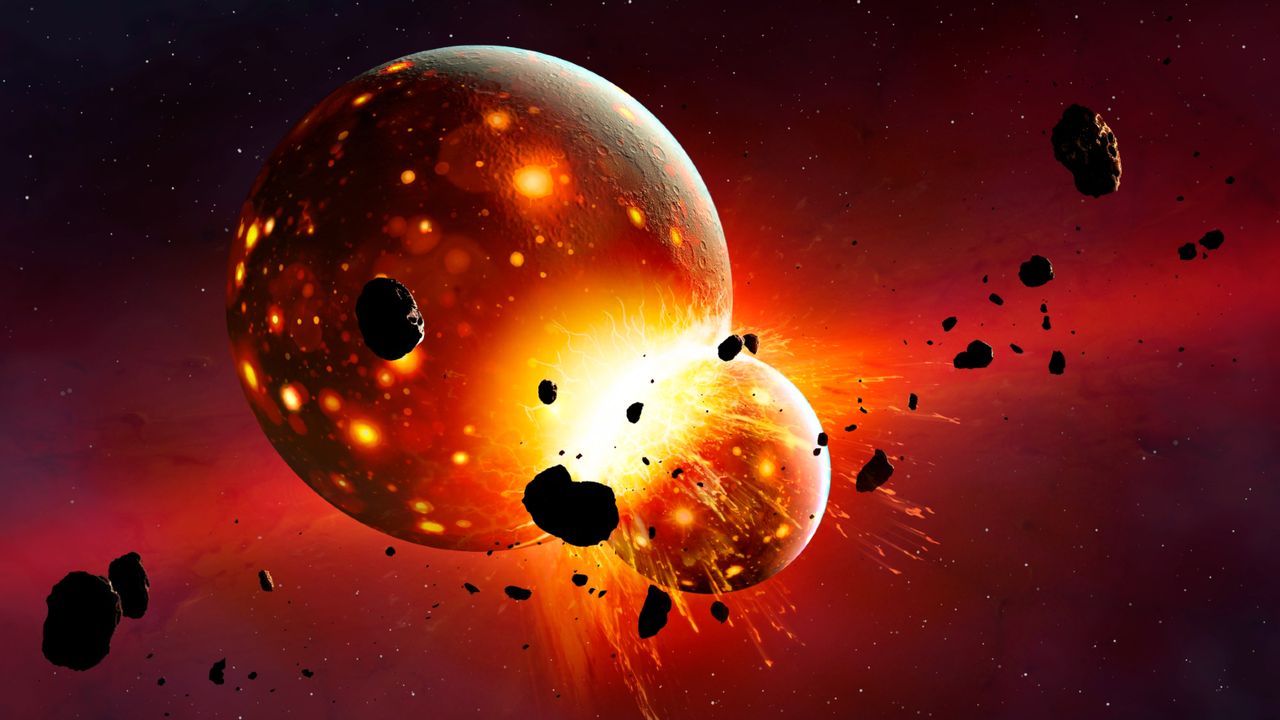
Illustration of two moons smashing into one another.

Saturn's largest moon, Titan, may be made of two different moons that smashed together hundreds of millions of years ago, a new study suggests. If confirmed, this epic collision could also help to solve several long-standing mysteries surrounding the gas giant, including how its iconic rings formed.

Titan is the solar system's second-largest moon, behind Jupiter's Ganymede. It is around 3,200 miles (5,150 kilometers) across, which is roughly 1.5 times wider than Earth's moon and around 5% wider than Mercury.

Aside from its immense size, Titan is notable for its dense atmosphere, which consists mainly of nitrogen and is around 1.5 times thicker than Earth's atmosphere. It is also the only solar system body, other than Earth, that has confirmed liquid on its surface, in the form of methane — making it a potential candidate for hosting extraterrestrial life. The European Space Agency's Huygens probe touched down on Titan in 2005, making it the only moon, other than our own, that a spacecraft has landed on.

Until now, researchers thought that, like most other moons, Titan formed billions of years ago via the gradual accumulation of tiny chunks of rock and dust. But in the new study, uploaded Feb. 9 to the preprint server arXiv and accepted for future publication in The Planetary Science Journal, researchers from the SETI Institute showed that this may not be the case.

Based on data collected by NASA's Cassini probe, which flew past Titan and deployed Huygens to its surface, the SETI team proposes that Titan may have formed around 400 million years ago when two similarly massive moons slammed into each other.

ESA's Huygens probe landed on Titan on Jan. 14, 2005. This image was captured by the spacecraft at an altitude of around 3 miles (5 km) above the moon's surface. (Image credit: ESA/NASA/JPL/University of Arizona)

This collision also may have birthed another Saturnian moon, Hyperion, the researchers argue. This smaller satellite, which is around 84 miles (135 km) wide, likely formed from the debris from the collision, much like Earth's moon did when the protoplanet Theia smashed into Earth around 4.5 billion years ago.

Additionally, the new hypothesis may explain the unusual orbits of several other Saturnian satellites, the team said.

Saturn's missing moon

Saturn has at least 274 moons — the most of any planet — after the recent discovery of 128 natural satellites. However, researchers have long suspected that another massive moon is missing.

Saturn's orbit around the sun is heavily tilted relative to the rest of the planets (excluding its wonky neighbor Uranus), which not only allows us to see the planet's extraordinary rings but also hints that something massive once pulled it out of place. This mystery object was most likely a large moon, which researchers have long suspected was gravitationally slingshotted away from Saturn.

In the new study, researchers explored the possibility that this moon didn't disappear but was instead destroyed.

The new study hints that Titan (left) and Hyperion (right) were both formed by the same massive collision. Both these false-color images were captured by NASA's Cassini probe during its mission to Saturn. (Image credit: NASA/JPL/Space Science Institute)

The "most important clue" that this other moon was destroyed is Hyperion, which is locked in an orbital resonance with Titan, circling Saturn three times for every four of Titan's orbits.

"We recognized that the Titan-Hyperion lock is relatively young, only a few hundred million years old," study lead author and SETI researcher Matija Ćuk said in a statement. "This dates to about the same period when the extra moon disappeared. [So] perhaps Hyperion did not survive this upheaval but resulted from it."

After simulating multiple scenarios from the Cassini data, the team now thinks two massive moons, dubbed "Proto-Titan" and "Proto-Hyperion," smashed into each other, thereby birthing Titan and eventually creating Hyperion from the remnants of the massive collision.

Rings, orbits and automobiles

Hyperion may not have been the only moon created or affected by this potential crash.

The researchers propose that the impact could have birthed several other moons that slowly drifted toward Saturn and collided with other existing satellites, creating a field of debris that eventually settled into Saturn's rings around 100 million years ago. (This hypothesis contradicts a recent study that suggested Saturn's rings are much older than previously realized.)

The study researchers argue that the collision that birthed Titan may have eventually led to the creation of Saturn's iconic rings, as well as altering the orbits of several other Saturnian satellites. (Image credit: NASA/JPL)

The study team also theorizes that the collision could explain the wonky orbits of two other Saturnian moons, Iapetus and Rhea, which are significantly tilted compared with their surrounding satellites and somewhat resonate with Titan's orbit.

In addition, their hypothesis could explain Titan's surprising lack of impact craters: Because it is much younger than previously realized, it has been exposed to fewer meteor strikes. The team proposes that, prior to its creation, Proto-Titan may have been covered in pockmarks, similar to Jupiter's moon Callisto.

NASA is preparing to send its Dragonfly probe to visit and explore Titan. The drone-like spacecraft is scheduled to launch in 2028, which would allow it to reach the moon by 2034. When it arrives, it could potentially confirm the collision hypothesis and unravel more of the moon's remaining mysteries.

Sign up to read this article
Read news from 100’s of titles, curated specifically for you.
Already a member? Sign in here
Related Stories
Top stories on inkl right now
One subscription that gives you access to news from hundreds of sites
Already a member? Sign in here
Our Picks
Fourteen days free
Download the app
One app. One membership.
100+ trusted global sources.