
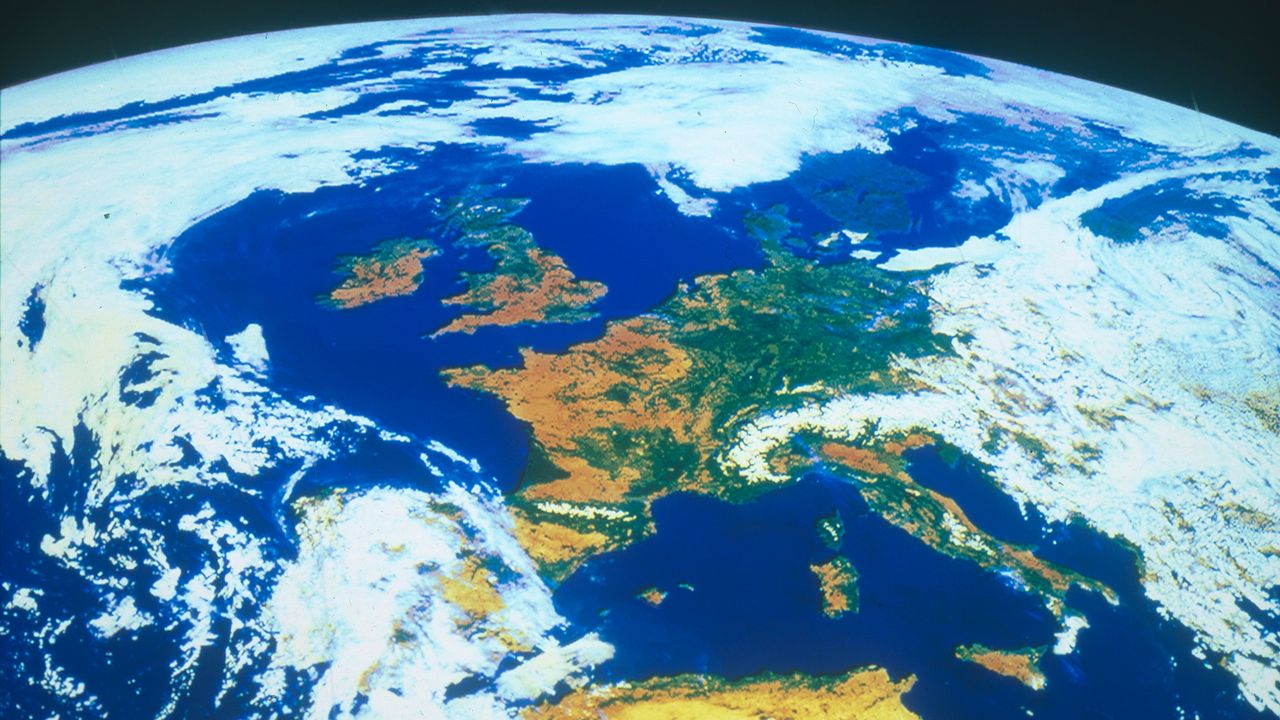
For half a century, scientists have known that Earth's Northern and Southern hemispheres have almost the exact same albedo — the amount of sunlight they reflect back to space. This is true even though the two hemispheres look very different, with the Northern Hemisphere having more land and the Southern Hemisphere having more ocean.
Now, researchers have uncovered another surprising symmetry hiding in the data: Earth's Eastern and Western halves appear to reflect the same amount of sunlight as well, they reported in a study published June 3 in the journal Nature. They found that the dividing line lies along a great circle that wraps around the whole planet. It's made up of two longitude lines: the 27 degrees east and 153 degrees west meridians, which stretch from the North to South Pole through Eastern Europe, Turkey, Central Africa, Norway and Alaska.