
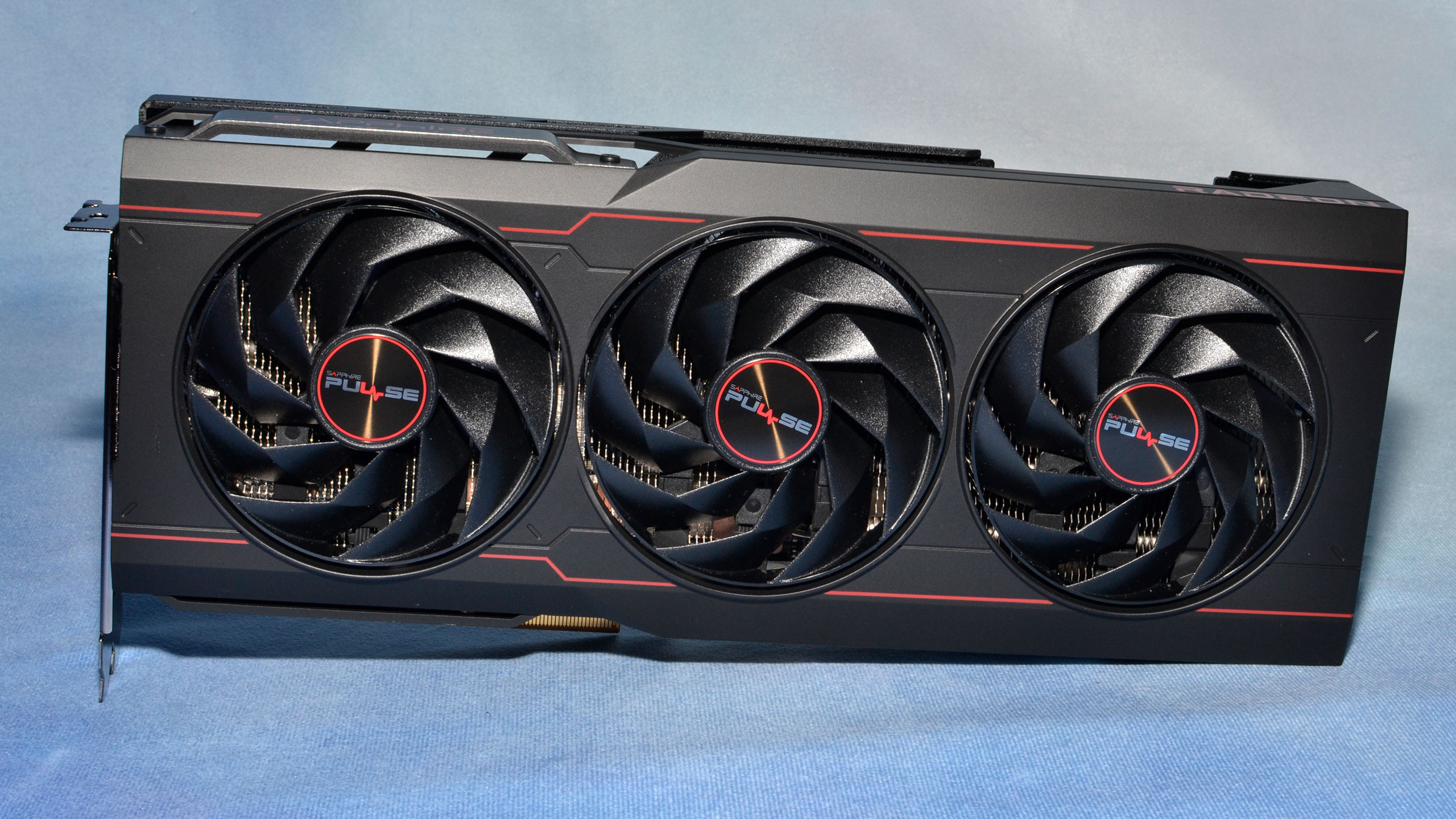
Last December, AMD launched the Radeon RX 7900 XTX and 7900 XT. At the time, we noted that the price gap was far too narrow to warrant getting the "lesser" card. Since then, online prices have dropped over $100, with the Sapphire RX 7900 XT Pulse we're looking at today being one of the prime options. The RX 7900 XT ranks as one of the best graphics cards, and Sapphire looks to improve on the reference card with a larger form factor and better cooling... or at least quieter cooling.
All of the core specs remain unchanged, so you get the same AMD RDNA 3 GPU architecture, with a healthy 20GB of GDDR6 20Gbps memory. That's 67% more VRAM than Nvidia's similarly priced RTX 4070 Ti. Performance, as you might expect, remains largely unchanged. That's true of most third-party graphics cards, since at most you typically get a 3–5 percent factory overclock. In the case of the RX 7900 XT Pulse, it's a 2.1% factory overclock, with a 5.1% increase in TBP (total board power).
Here's the quick overview of the specs table for the Sapphire card along with some competing GPUs.
We already noted the only differences in core specs between the Sapphire RX 7900 XT Pulse and the reference 7900 XT: GPU boost clock and TBP/TGP. Those are the paper specs, however, and there are other differences in terms of card design, aesthetics, and other aspects.
Right now, Sapphire is one of the three least expensive RX 7900 XT cards available, the others being the XFX RX 7900 XT that uses AMD's reference design — an MBA or "Made By AMD" card — and the ASRock RX 7900 XT Phantom Gaming OC. They all cost $779.99, though Sapphire and ASRock cards require an instant rebate at Newegg to get there.
Several other 7900 XT models are available for around $800, while the most expensive options right now can cost as much as an RX 7900 XTX (around $950). Unless you really love the aesthetic of one of those premium cards, we'd recommend stepping up to the faster AMD XTX GPU rather than paying $200 extra, but that's ultimately an individual choice.
Looking at the primary competition, the Nvidia RTX 4070 Ti only comes with 12GB of VRAM, but it also has a lower TGP and gives you the typical Nvidia extras: DLSS, Frame Generation, tensor cores, and improved ray tracing hardware. We'll get to the performance results shortly, but in our current test suite, it's the usual story: Similar overall native resolution performance, AMD leads in rasterization and Nvidia leads in ray tracing.










