Get all your news in one place.
100's of premium titles.
One app.
Start reading
Tom’s Guide
Tom’s Guide
Technology
Nick Pino

Samsung's 40,000-nit micro-OLED is real — and it's coming to these gadgets first

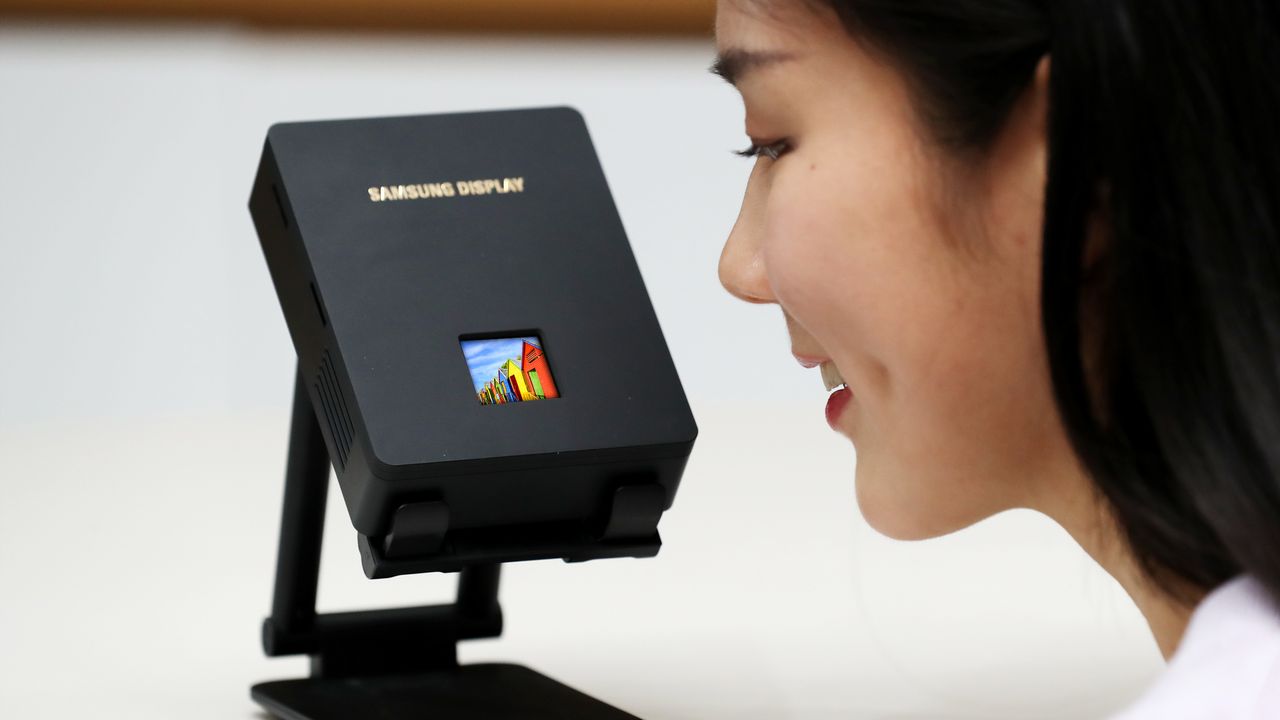
A Samsung Display RGB OLEDoS.

Displays for TVs, monitors and laptops have only gotten brighter over the last few years, but one day they could reach an unprecedented 40,000 nits thanks to a technology that’s being developed by Samsung Display.

It’s called RGB OLEDoS — a.k.a. Red Green Blue Organic Light-Emitting Diodes on Silicon or micro-OLED — and Samsung Display has recently designed one that trounces even the best TVs.

The problem? The display in question is only 1.3 inches across and was designed more for mixed-reality headsets like the Apple Vision Pro rather than the next iteration of the Samsung S95H.

Micro-OLED is still a ways off, but it’s still worth caring about

OLEDoS works slightly differently than the OLED you may already own where, instead of depositing the organic materials onto glass, the material goes directly onto a silicon wafer.

RGB OLEDoS takes the already futuristic concept one step further: "Unlike white OLEDoS, RGB OLEDoS does not require a color filter, enabling higher light efficiency and longer lifespan. These advantages make it highly suitable for delivering excellent color reproduction and high brightness," said a Samsung Display representative (via FlatpanelsHD).

(Image credit: Tom's Guide)

While we sadly won’t have a 40,000-nit 65-inch TV in our home anytime soon, RGB OLEDoS is a significant shift forward for display technology. Like TVs, mixed reality headsets need additional brightness to make content look more realistic — because the display sits so close to your face, you’ll notice discrepancies in brightness and colors more quickly.

Or, as the Samsung spokesperson more eloquently put it: “RGB OLEDoS is considered an optimal solution for XR devices, which require sharp image quality in compact and lightweight form factors."

That doesn’t mean OLEDoS won’t ever be practical for TVs — it’s just not the ideal solution right now.

That doesn’t mean OLEDoS won’t ever be practical for TVs — it’s just not the ideal solution right now.

Instead, we’ve got Mini-RGB, a technology that replaces white Mini-LED backlights with smaller, more vibrant RGB LEDs, and QD-OLED that places a quantum dot filter in between the front screen and the OLED substrate. The latter also enables higher brightness and color accuracy, but we’re talking around 2,500 to 3,000 nits — not 40,000.

What TVs currently use QD-OLED and RGB Mini-LED?

(Image credit: Tom's Guide)

We've seen a few iterations of QD-OLED technology before (starting first in the Samsung S95D OLED) but RGB Mini-LED is pretty much brand-new for 2026.

You can find the latter in the new Hisense UR9 as well as the Samsung MR95F Micro-RGB TV while the former can be found in the Samsung S95F and Sony Bravia 8 II.

While it's not quite the same as RGB Mini-LED, TCL's new Super Quantum Dot TVs like the TCL X11L offer bonkers brightness and vibrant color without the help of RGB-colored LEDs.

We'll keep you posted about the future of micro-OLED technology, but in the meantime any of the aforementioned TVs will be a huge step up from the first generation OLEDs we saw from LG and Samsung a decade ago. And some of them are still on sale this week after last week's Amazon Prime Day event...

More from Tom's Guide

Sign up to read this article
Read news from 100's of titles, curated specifically for you.
Already a member? Sign in here
Related Stories
Top stories on inkl right now
One subscription that gives you access to news from hundreds of sites
Already a member? Sign in here
Our Picks
Fourteen days free
Download the app
One app. One membership.
100+ trusted global sources.