
Stepping up
Samsung's base models have shipped with smaller screens than Pixels and iPhones for years, but that's officially changing. The new version has a 6.3-inch screen, an upgraded Snapdragon 8 Elite Gen 5 processor, and a larger battery. Still, the cameras and lack of Qi2 magnetic support leave much to be desired.
Pros
- Bigger 6.3-inch AMOLED 2X display
- Snapdragon 8 Elite Gen 5 in North America, China, and Japan
- 4,300mAh battery capacity
- Taller and wider design with oval-shaped camera bump
Cons
- More expensive than the Pixel 10
- No significant camera upgrades
- Lacks built-in Qi2 magnets
The starter Android
Google was the first to add Qi2 magnets, making the base Pixel 10 a surprisingly-great alternative to iPhones. It also gained a telephoto camera lens and other improvements, stepping up to Samsung's level.
Pros
- Large battery with full Qi2 support
- Telephoto lens adds 5x optical zoom
- Tensor G5 is a notable improvement
- Full suite of Gemini and Google AI features
Cons
- Gaming performance still isn't great
- Key feature omissions, like Wi-Fi 7
- Aggressive battery throttling

Samsung just launched a new lineup of Galaxy phones, and the Galaxy S26 is the entry-level offering. It's a refreshed a 6.3-inch handset arriving just in time to compete with the Google Pixel 10. However, the Galaxy S26 is likely the first of many phones in 2026 to come with a price hike, which gives the Pixel 10 an early advantage.
Google's Pixel 10 series challenges competitors like Samsung in major ways. Specifically, an upgraded camera system and Qi2 magnets put the ball in Samsung's court to respond with the Galaxy S26. Anyone in the market for a base-model Android flagship will be choosing between these two phones. Unfortunately, Samsung may not have met the moment, as the Galaxy S26 may be too similar to its predecessor to stand out.
Here's how the Galaxy S26 stacks up against the Pixel 10, and which one is right for you.
Samsung Galaxy S26 vs. Google Pixel 10: Pricing and availability

Samsung debuted the Galaxy S26 series at a Galaxy Unpacked event on Feb. 25, 2026. The Samsung Galaxy S26 is available for pre-order now, starting at $899.99 for the base 256GB variant. The old 128GB storage option is no more, and the price is higher as a result. While the Galaxy S26 is more expensive than even the 256GB Galaxy S25, it's priced identically to the matching 256GB Pixel 10. Of course, Google does offer a $799, 128GB Pixel 10 to give buyers more flexibility.
The Samsung Galaxy S26 will be generally available March 11 in Cobalt Violet, Sky Blue, Black, and White colorways. You can snag Silver Shadow or Pink Gold variants as exclusives on Samsung's online store.
Meanwhile, the Google Pixel 10 was revealed on Aug. 20, 2025, and became officially available on Aug. 28. The smartphone is priced at $799 for the base model with 128GB of storage, and a 256GB configuration costs $100 more. You can pick from Indigo, Lemongrass, Frost, and Obsidian colorways.
Samsung Galaxy S26 vs. Google Pixel 10: Design and display

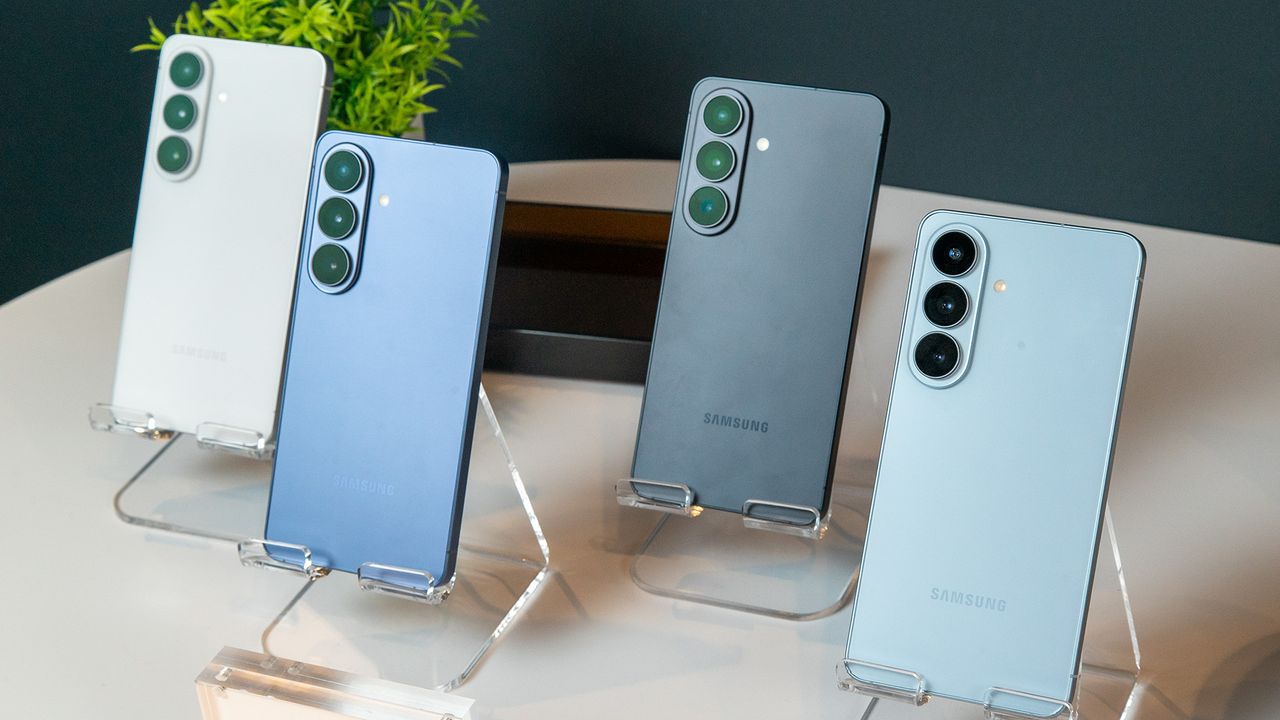
Samsung is officially caving to consumer trends that show buyers prefer larger phones. The Galaxy S26 sports a 6.3-inch screen, matching competitors like the Google Pixel 10. As a result, the Galaxy S26 is bigger than its predecessor, measuring 71.7 x 149.6 x 7.2 mm. The smartphone ends up being wider and taller as a result of the change.
This shift also adds weight to the device, but at 162 grams, the Galaxy S25 was already undercutting Pixels in terms of heft. Samsung added five extra grams to the Galaxy S26 in exchange for a larger battery and screen, which is hard to argue with.
The Galaxy S26 looks familiar compared to recent Samsung phones, but takes special inspiration from the newest models, like the Galaxy S25 Edge and Galaxy Z Fold 7. It features a raised, oval-shaped camera platform that houses the three rear camera lenses. This slightly changes the phone's appearance without deviating from Samsung's typical Armor Aluminum chassis and frosted glass back.

Even considering the Galaxy S26's new dimensions, the Pixel 10 is larger by every dimension. The current Pixel 10 measures 152.8mm x 72mm x 8.6mm, making it one of the largest and thickest 6.3-inch phones on the market. It's also one of the heaviest, weighing 204 grams and handily outweighing the Galaxy S26.
The Pixel 10's display is a 6.3-inch Actua OLED panel with a 1080 x 2424 resolution. It supports a variable refresh rate from 60Hz to 120Hz and has a maximum brightness of 3,000 nits. By comparison, the Galaxy S26 offers a 6.3-inch Dynamic LTPO AMOLED 2X panel with 120Hz refresh rates and HDR10+ support.

The Pixel 10 has a glossy back and a pill-shaped camera bar at the top, which protrudes noticeably from the rear. Both phones have an IP68 durability rating against dust and water ingress.
Samsung Galaxy S26 vs. Google Pixel 10: Hardware and specs

Hardware and performance are the biggest differentiators between the Samsung Galaxy S26 and the Google Pixel 10.
While we'll have to test how the new Snapdragon 8 Elite Gen 5 for Galaxy performs in the real world on the Galaxy S26, we do know that the last-gen Snapdragon 8 Elite already beats the Tensor G5 in the Pixel 10. The Tensor G5 may be better optimized, but Snapdragon chips have proved to be the winner in raw performance, gaming, and AI processing of late. In fact, Samsung is touting that it has improved its own optimizations, specifically targeting camera processing, with this year's "for Galaxy" variant.
That doesn't invalidate the Pixel 10's performance improvements. The Google Tensor G5 chip is the best Google system-on-a-chip yet, with a CPU that's 34% faster on average and a TPU that's up to 60% more powerful. It's worth noting that the Pixel 10 feels snappy in daily use for most tasks, but gaming is still a major pain point.
The Samsung Galaxy S26 will get the aforementioned Snapdragon chip in North America, China, and Japan, but uses the Exynos 2600 in all other regions.
Category |
Samsung Galaxy S26 |
Google Pixel 10 |
|---|---|---|
Processor |
Snapdragon 8 Elite Gen 5 for Galaxy |
Google Tensor G5 |
Display |
6.3-inch, Dynamic LTPO AMOLED 2X, 120Hz, Corning Gorilla Glass |
6.3-inch Actua OLED, 1080 x 2424, 422 PPI, 60-120Hz, 3000 nits |
OS |
One UI 8.5 (Android 16), 7 years of OS and security updates |
Android 16, 7 years of OS and security updates |
Storage |
256GB, 512GB |
128GB/256GB |
RAM |
12GB |
12GB |
Security |
Ultrasonic fingerprint sensor |
Connectivity |
5G (sub-6, mmWave), Wi-Fi 7, Bluetooth 6, NFC |
Wi-Fi 6E, Bluetooth v6, NFC, Dual-band GPS, 5G mmWave (NA only), 5G Sub-6, LTE |
Battery |
4,300mAh |
4,970mAh |
Charging |
25W wired, Qi2 15W wireless, 4.5W reverse wireless |
30W wired, 15W Qi2 Pixelsnap wireless |
Dimensions |
71.7 x 149.6 x 7.2 mm |
152.8mm x 72mm x 8.6mm |
Weight |
167g |
204g |
There are also some notable omissions on the Pixel 10, like no support for UFS 4.0 storage on the base configuration, and a downgrade to Wi-Fi 6E. The Galaxy S26 supports Wi-Fi 7 and upgrades Bluetooth connectivity to version 6 match the Pixel 10, which is stellar for longevity. As both phones will get seven years of full OS upgrades, these specs might matter down the line.

This generation, Google added a telephoto camera to the Pixel 10, bringing 5x optical zoom to the base model by way of a 10.8MP lens. That brings the total number of rear cameras on the Pixel 10 to three. Although the other sensors are tweaked, the system is still great, with a 48MP main lens and a 12MP ultrawide camera.
Samsung didn't upgrade the cameras on the Galaxy S26, so we're still using the same hardware as the Galaxy S22. Crucially, the telephoto lens is tipped to remain the same, which gives the Pixel 10 the edge. We're sure Samsung has a few software tricks up its sleeve to improve camera quality without hardware changes, but we'll have to see these improvements for ourselves to make sure they're the real deal.
Samsung Galaxy S26 vs. Google Pixel 10: One UI or Pixel UI?

It's a great time to be in the market for the best Android phones. Following a few years of iterative upgrades, Samsung and Google are starting to challenge each other to make better smartphones. Google shipped the Pixel 10 with a telephoto lens for the first time, matching the Galaxy S25. Now, the Galaxy S26 is here, with a larger screen to match the Pixel 10.
Regardless of whether you pick the Pixel 10 or choose the Galaxy S26, you're going to get an excellent handset. However, the Pixel 10 might still be the one to beat. It has a better camera system, more intuitive software, and Qi2 magnets. On the flip side, the Galaxy S26 has a Snapdragon 8 Elite Gen 5 chip that could run laps around the Pixel 10.
Uphill battle
The Samsung Galaxy S26 will have a tough time competing with the Google Pixel 10. It's $100 more expensive, lacks inbuilt Qi2 magnets, and uses ancient camera hardware. However, it does bring classic Samsung refinement and Qualcomm processing.
For Google fans
The Google Pixel 10 is the starter Android phone, with plenty of exclusive features and a great MagSafe, Qi2, and Pixelsnap accessory ecosystem. It does lack power and polish in some areas, which might make some buyers want to grab Samsung's Galaxy S26 instead.