
Get all your news in one place.
100’s of premium titles.
One app.
Start reading
Android Central
Android Central
Technology
Rajat Sharma

Samsung Galaxy S26 Plus vs. Galaxy S25 Plus: Should you upgrade?

Comparing the Samsung Galaxy S26 Plus side-by-side with the Galaxy S25 Plus.

If you're planning to buy a well-rounded Android flagship, the Galaxy S25 Plus still remains an easy recommendation. From a vibrant high-resolution display to top-of-the-line cameras to all-day battery life, it ticks almost all the boxes. Overall, the Galaxy S25 Plus is the dark horse of the entire Galaxy S25 line-up.

That's all well and good, but it's no longer the newest thing in town, as the Galaxy S26 series has finally been launched. Samsung's latest flagship trio consists of the compact Galaxy S26, the balanced Galaxy S26 Plus, and the stylus-toting Galaxy S26 Ultra, with all three packing in top-tier hardware, feature-laden software, and more.

So, what exactly does the fresh Galaxy S26 Plus bring to the table? Is it really that big of an upgrade over its predecessor, or should you just get the Galaxy S25 Plus and save some cash in the process? Let's compare the Samsung Galaxy S26 Plus vs. Galaxy S25 Plus and find the answers to these questions.

Samsung Galaxy S26 Plus vs. Galaxy S25 Plus: Pricing and availability

Even though the Galaxy S26 line-up is already up for pre-order, the series will be launching in North America on March 11, with a wider rollout to follow in markets around the world soon.

(Image credit: Derrek Lee / Android Central)

However, even if you've been ready to go with your wallet for a while, be prepared to spend a bit more. While the Galaxy S26 Ultra still has the same starting price of $1,299.99 as its predecessor had at the time of launch last year, that's not the case with its siblings. The Galaxy S26 Plus and the Galaxy S26 will cost you $100 extra in comparison to their predecessors, having been introduced with starting prices of $1,099.99 and $899.99, respectively.

(Image credit: Derrek Lee / Android Central)

That's quite a bummer, but these prices are (mostly) in line with what competing flagships from brands such as Google are available at. As you would expect, there are many pre-order deals that you can take advantage of to save some cash.

Samsung Galaxy S26 Plus vs. Galaxy S25 Plus: Design, display, and hardware

The overall design of Samsung's flagships has largely remained the same for the last few years, but that's finally changing with the Galaxy S26 trio. As CAD renders (via OnLeaks / Android Headlines) indicated, the three smartphones come with some visual updates, even if they're really minor.

(Image credit: Derrek Lee / Android Central)

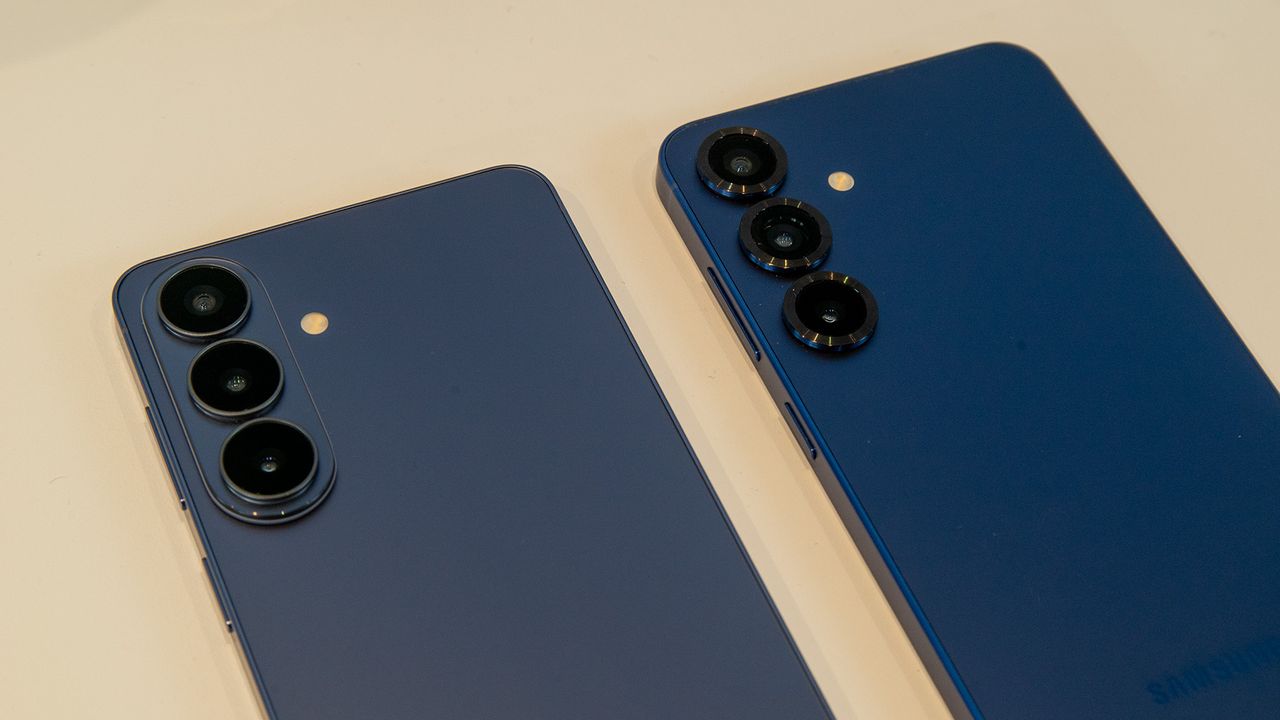
While the Galaxy S26 Plus and the Galaxy S26 have the same vertically arranged camera arrays as the last-gen models, the three individual lenses are now housed in a pill-shaped island, instead of being directly on the back panel as they're with the Galaxy S25 series.

The same design change goes for the Galaxy S26 Ultra as well, though the fourth lens and the laser AF module are still placed directly on the rear panel. Clearly, it's an overhaul inspired from the Galaxy S25 Edge and the Galaxy Z Fold 7.

Other than that, the three smartphones retain their usual boxy construction with flat sides, all-glass front and back panels, and IP68 certification. It's worth noting here that the Galaxy S26 Plus has the exact same dimensions and weight as the previous-gen model. The Galaxy S26 and the Galaxy S26 Ultra, on the other hand, have grown ever so slightly in size in comparison to their respective predecessors.

(Image credit: Derrek Lee / Android Central)

Up front, the three smartphones remain an all-screen affair, with the Galaxy S26 Plus having the exact same 6.7-inch Dynamic LTPO AMOLED panel as the Galaxy S25 Plus. That's a good thing, because this screen is a delight to look at. From the 120Hz adaptive refresh rate to the super-high pixel density of more than 500ppi, it has everything!

Specifications

Category

Samsung Galaxy S26 Plus

Samsung Galaxy S25 Plus

Dimensions

158.4 x 75.8 x 7.3 mm (6.24 x 2.98 x 0.29 in)

158.4 x 75.8 x 7.3 mm (6.24 x 2.98 x 0.29 in)

Durability & Case Material(s)

IP68 rating for dust and water resistance, Corning Gorilla Glass Victus 2 (front and back), Aluminum frame

IP68 rating for dust and water resistance, Corning Gorilla Glass Victus 2 (front and back), Aluminum frame

Weight

190 g

190 g

Display

6.7-inch Dynamic AMOLED (1440x3120 pixels resolution), LTPO, 120Hz variable refresh rate

6.7-inch Dynamic AMOLED (1440x3120 pixels resolution), LTPO, 120Hz variable refresh rate

Chipset / SoC

Qualcomm Snapdragon 8 Elite Gen 5 (for Galaxy) or Samsung Exynos 2600

Qualcomm Snapdragon 8 Elite (for Galaxy)

RAM

12GB

12GB

Storage

256GB/512GB

256GB/512GB

Sensors

Under-display ultrasonic fingerprint sensor, Accelerometer, Gyroscope, Proximity sensor, Compass, and Barometer

Under-display ultrasonic fingerprint sensor, Accelerometer, Gyroscope, Proximity sensor, Compass, and Barometer

Wireless Connectivity

Wi-Fi 7, 5G (mmWave and Sub-6), Bluetooth 6.0, GPS, NFC, UWB, and USB-C 3.2 (with DisplayPort)

Wi-Fi 7, 5G (mmWave and Sub-6), Bluetooth 5.4, GPS, NFC, UWB, and USB-C 3.2 (with DisplayPort)

Other Features

Samsung DeX (wired & wireless), Galaxy AI

Samsung DeX (wired & wireless), Galaxy AI

Battery & Charging

4,900mAh (Li-Ion), 45W (wired) and 20W (wireless) charging, Qi2 Ready

4,900mAh (Li-Ion), 45W (wired) and 15W (wireless) charging, Qi2 Ready

Cameras (Rear)

50MP wide-angle, 10MP telephoto (3x optical zoom), 12MP ultrawide | 8K video recording

50MP wide-angle, 10MP telephoto (3x optical zoom), 12MP ultrawide | 8K video recording

Camera (Front)

12MP wide-angle | 4K video recording

12MP wide-angle | 4K video recording

OS & Update Policy

Android 16 with One UI 8.5 (preinstalled), seven years of OS and security updates

Android 15 with One UI 7 (preinstalled), seven years of OS and security updates

Coming to specifications, there are some improvements. The S-series has always been synonymous with (almost) the best hardware in the business, and the Galaxy S26 Plus is no different. It's powered by the Snapdragon 8 Elite Gen 5 (for Galaxy), which is the latest and greatest SoC from Qualcomm, with some markets getting Samsung's newest Exynos 2600 chipset. Regardless of silicon, the 12GB RAM and 256GB/512GB onboard storage options have been carried forward from the last-gen model.

We can't comment about the smartphone's real-world performance until we put it through its paces, but Qualcomm's new chipset is claimed to deliver a jump of up to 25% in single-core performance and a boost of up to 20% in multi-core workloads. The new SoC from Samsung is expected to pack a punch as well.

(Image credit: Derrek Lee / Android Central)

Of course, this doesn't mean that you should ignore the previous-gen Galaxy S25 Plus, which is still very much capable of powering its way through everything you throw at it. As Android Central's Derrek Lee noted in his Galaxy S25 Plus review, the smartphone stays thermally efficient while handling intense tasks, all thanks to Qualcomm's Snapdragon 8 Elite silicon.

It goes without saying that the Galaxy S26 Plus packs all the modern connectivity and I/O options, including Wi-Fi 7, multi-band 5G, NFC, DeX, and USB Type-C 3.2 with DisplayPort functionality. Of course, the Galaxy S25 Plus has all these too.

(Image credit: Harish Jonnalagadda / Android Central)

As such, the hardware upgrades are minimal at best and shouldn't be your "only" reason to pick the Galaxy S26 Plus. The Galaxy S25 Plus continues to be among the best Android phones money can buy, and it's going to remain so for a very, very long time.

Samsung Galaxy S26 Plus vs. Galaxy S25 Plus: Cameras, software, and battery

It should hardly be a surprise that the Galaxy S25 Plus is among the best Android camera phones available in the market. The triple-lens system is comprised of a 50MP primary sensor, a 10MP telephoto unit with 3x optical zoom, as well as a 12MP ultrawide module.

The setup lets you shoot solid photos with loads of detail and dynamic range, and low-light performance is great too. For videos, you get up to 8K recording as well as Log video capture functionality. Add to it the wide assortment of editing tools and AI-based features, and you have a fabulous everyday camera array.

But even with all that goodness, the camera hardware has stayed the same over the last multiple generations. And unfortunately, the Galaxy S26 Plus continues to recycle the same triple-lens system yet again, with no changes whatsoever.

Sure, the new smartphone might have slightly better camera performance due to its improved processing, but we'll have to test it out in the real world before we can say anything about the same.

(Image credit: Derrek Lee / Android Central)

Talking about software, the Galaxy S26 Plus (and its siblings) run Android 16 out of the box. Samsung began rolling out this version of the operating system to the Galaxy S25 series (even as Google has shifted its focus on Android 17) a while ago.

Samsung's version of Android 16 is spruced up with One UI 8.5, the latest version of its custom UI overlay that continues to be refined steadily over time. It includes features such as AI-based notification summaries, Bixby updates, improvements to the Galaxy AI suite, enhanced customization, and much more.

It goes without saying that all of these features will make their way to the Galaxy S25 Plus (and other eligible devices) in due course of time.

(Image credit: Derrek Lee / Android Central)

When the Galaxy S25 Plus was launched, it impressed us with its amazing battery endurance. The phone can go a full day before needing a top-up, which is quite a feat, given its powerful internals and a rather modest 4,900mAh battery capacity.

The Galaxy S26 Plus comes with the exact same battery size, so (theoretically) it should be able provide a similar endurance, considering its more power-efficient hardware. However, what's disappointing is Samsung's stubborn refusal to adopt silicon-carbon tech for its smartphones for yet another product year, even as the devices from competitors (e.g., Vivo X200 Pro, Motorola Signature) move forward in that direction.

(Image credit: Derrek Lee / Android Central)

The Galaxy S26 Plus carries forward the same 45W wired charging support as the last-gen model, although the 20W wireless charging functionality is a slight (but welcome) improvement over the 15W wireless charging speed of the Galaxy S25 Plus. What's truly baffling, however, is the fact that Samsung's new phone(s) still lack integrated built-in magnets for native Qi2 magnetic charging. Yes, you can get that functionality by using a magnetic case (as is the case—pun intended—with the Galaxy S25 Plus), but you shouldn't have to do so on a 2026 flagship that costs over a thousand dollars. Moreover, devices such as the Google Pixel 10 Pro have full built-in magnetic charging support already. Then there are phones such as the OnePlus 15, which are in a league of their own in terms of charging speeds.

Samsung Galaxy S26 Plus vs. Galaxy S25 Plus: Should you upgrade?

There's no denying that the Galaxy S26 Plus has its share of improvements. It gets a refreshed design, the latest silicon, and faster wireless charging. That's all great, but apart from these handful of upgrades, everything else is the same as it's with the Galaxy S25 Plus. At best, Samsung's latest Plus model (and by extension, the entire S26 series) is just an incremental update. So, the question is, if you've been thinking about buying a new phone for yourself, should you go for the Galaxy S26 Plus, or save some money and get the Galaxy S25 instead?

(Image credit: Derrek Lee / Android Central)

In our opinion, buying the Galaxy S26 Plus only makes sense if you can manage to grab a solid discount by trading in your existing phone, or if you couldn't care less about the price tag and just want the newest from Samsung anyway. You will be getting a high-end device with blazing-fast hardware, AI-powered software, a versatile triple-lens camera array, years of software support, and good battery life.

But here's the thing! You'll get all of these with the Galaxy S25 Plus too, which still remains one of the best Samsung phones out there and is going to serve you for years to come. As such, if all you want is a reliable flagship smartphone that has it all, we suggest you buy the last-generation model and save some dough.

Sign up to read this article
Read news from 100’s of titles, curated specifically for you.
Already a member? Sign in here
Related Stories
Top stories on inkl right now
Our Picks
Fourteen days free
Download the app
One app. One membership.
100+ trusted global sources.