
Get all your news in one place.
100’s of premium titles.
One app.
Start reading
Digital Camera World
Ben Andrews

Samsung EVO Select microSDXC card review

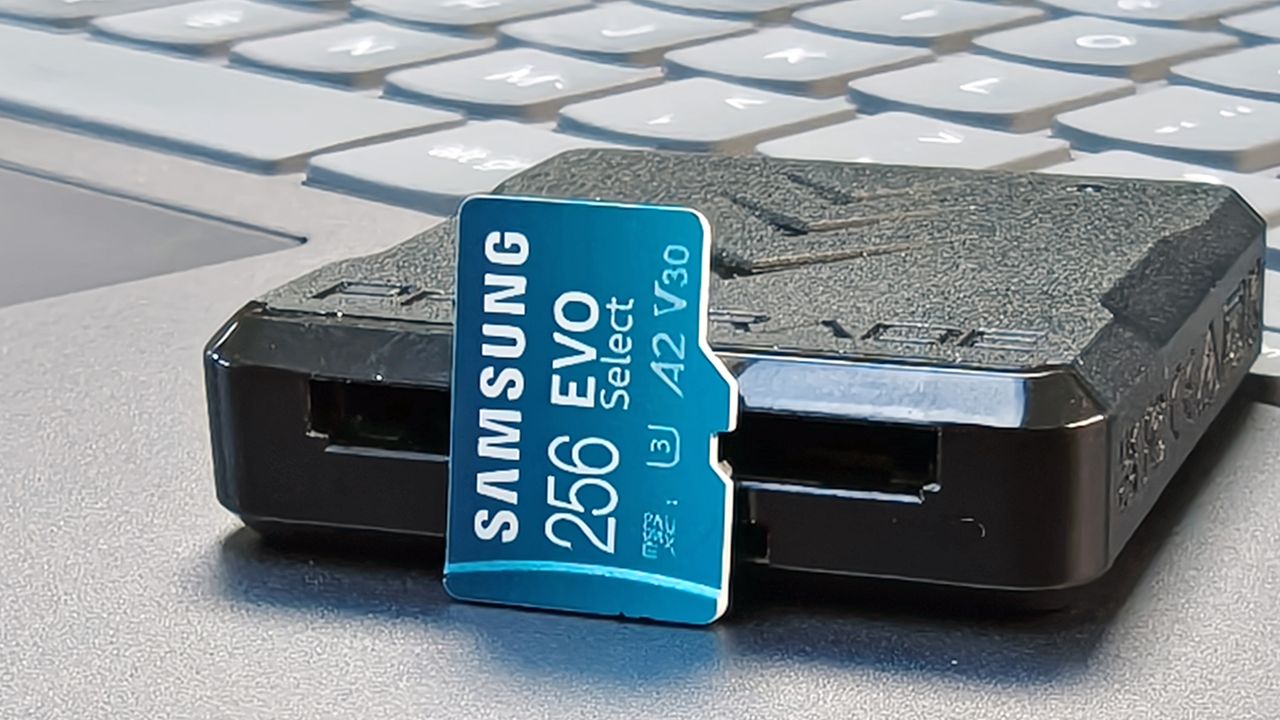
Samsung EVO Select microSD card.

Want a cheap microSD card, but don't fancy ordering by price=lowest and choosing the cheapest no-name brand? The Samsung Evo Select could be the answer. It's very well priced, yet has the reassurance of being from a respected brand. Heck, it's even capable of 160MB/s read speed, which is barely slower than some premium UHS-I microSD cards.

Capacities vary from 64GB up to a generous 1TB, and all are V30-certified, so they can sustain 30MB/s when recording video. That should be enough oomph for capturing compressed 4K video.

You even get an A2 app loading speed rating, which is quicker than the A1 rating you'll find on most budget cards. This signifies that the Evo Select will provide snappy performance if used in an Android phone.

Surely there has to be a catch somewhere? Let's find out...

Read more: the best microSD cards

Performance

Keen memory card enthusiasts (we're a fun bunch, honest) may have noticed that Samsung doesn't quote a maximum write speed for the Evo Select - it only advertises that aformentioned 160MB/s read speed. If you dig into the product specs, it simply says that write speed is "Lower than Read Speed". Not very encouraging. To see just how low, I plugged our 256GB Evo Select test card into a fast USB4 Windows laptop, via a ProGrade Digital PGM0.5 USB 3.2 SD card reader. This hardware set-up has a maximum bus speed of 625MB/s, so there's no chance of anything bottlenecking the Evo Select during testing. I then fired up my trusty storage benchmarking software, CrystalDiskMark.

(Note: we're testing a slightly older version of the Evo Select which is rated at 130MB/s. You can still buy this card, but the newer 160MB/s version is now the more widely-available option)

(Image credit: Future)

At 131MB/s, read speed is right in line with Samsung's claims for our test card. But then we see why Samsung isn't too keen on advertising the write speed of the Evo Select. 34MB/s is pretty slow compared to most of the microSD cards we test, and it only just qualifies the card for its V30 video write speed certification. Even so, I've personally been using this exact microSD card in my 2.7K dash cam for over a year and have had no recording issues, proving that even with a relatively mediocre write speed, it's still possible for a cheap microSD card to work fine in an average use case like this.

(Image credit: Future)

Although this probably isn't a card you'll be using for frequent data transfer to and from a computer, where outright read and write speed matters in the quest for reduced wait times, we always test these real-world transfer speeds anyway.

Real-world transfer speed test

Lab results

Read (peak)

Write (peak)

Large single file

120 (126) MB/s

29.3 (33.7) MB/s

Multiple small files

108 (116) MB/s

27.4 (31.8) MB/s

Sure enough, read speeds are healthy enough, matching those achieved in benchmarking software, as well as Samsung's 130MB/s claim for this generation of Evo Select.

While there's no miraculous boost in write speed past the 34MB/s recorded in CrystalDiskMark, thankfully neither is there a significant drop in write speed, even when writing multiple small image files - traditionally the slowest scenario for write speed - so at least you can expect the card to work at its best, regardless of workload.

Would the newer, 160MB/s read speed Evo Select also have a faster write speed? Maybe, but Samsung still doesn't advertise a write speed figure for this card, so it probably isn't going to be much better.

(Image credit: Future)

Verdict

The Samsung Evo Select isn't going to win any transfer speed races or break any records, but if you just want a well-priced, reliable microSD card for your phone, security camera or dash cam, it's a solid option. Sure, it could be argued that you only need to spend a little more to get a microSD card with a higher write speed, but when the majority of use cases simple don't require a card faster than the Evo Select, why pay more? You'd be better served by spending the equivalent amount on a higher capacity Evo Select.

Sign up to read this article
Read news from 100’s of titles, curated specifically for you.
Already a member? Sign in here
Related Stories
Top stories on inkl right now
One subscription that gives you access to news from hundreds of sites
Already a member? Sign in here
Our Picks
Fourteen days free
Download the app
One app. One membership.
100+ trusted global sources.