Get all your news in one place.
100’s of premium titles.
One app.
Start reading
LiveScience
LiveScience
Skyler Ware

Saltwater crocodiles crossed the Indian Ocean to reach the Seychelles — before humans arrived and wiped them out

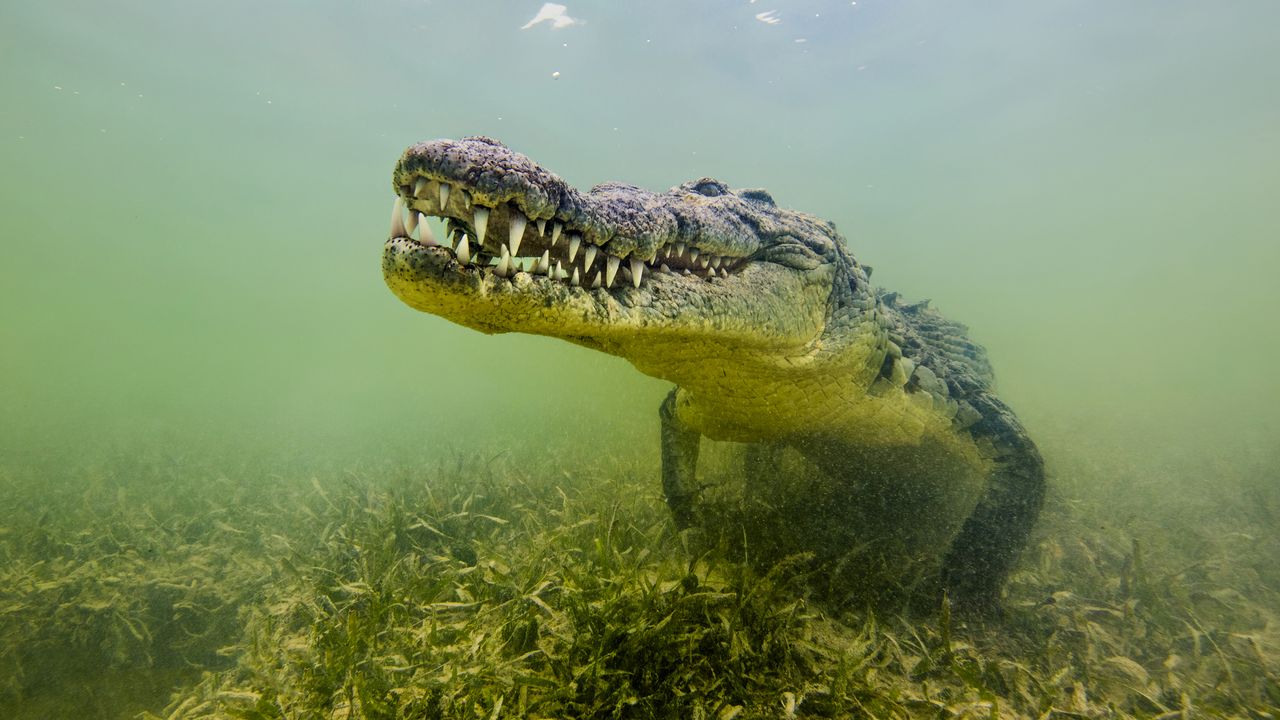
Photo looking head-on at a saltwater crocodile underwater. .

Saltwater crocodiles used to occupy a massive range that stretched across the Indian Ocean to the Seychelles, new DNA research confirms.

The now-extinct population of crocodiles in the Seychelles, an archipelago in the western Indian Ocean, was not a group of Nile crocodiles (Crocodylus niloticus), nor was it a separate species. Instead, it was likely the westernmost population of saltwater crocodiles (Crocodylus porosus), which today live in India, Southeast Asia, Australia and islands across the Western Pacific, researchers reported Jan. 28 in the journal Royal Society Open Science.
"The founders of the Seychelles population must have drifted at least 3,000 kilometers [1,864 miles] across the Indian Ocean to reach the remote archipelago, perhaps even much further," study co-author Frank Glaw, a reptile expert at the Bavarian State Collections of Natural History, said in a statement.

The Seychelles used to be home to a large population of crocodiles, according to expedition notes from more than 250 years ago. But when human settlers arrived in the late 18th century, they wiped out all of the crocodiles on the islands. The remains of a few specimens were kept in museums in the Seychelles, London and Paris.

Initially, Western scientists thought the Seychelles crocodiles were part of a population of Nile crocodiles that had migrated from Africa. But in 1994, researchers reclassified the preserved remains as saltwater crocodiles based on their physical traits.

In the new study, a different team of scientists confirmed that conclusion using genetic material. They collected mitochondrial DNA from the skulls and teeth of several older museum specimens of various crocodile species and then compared that DNA with tissue samples from modern museum specimens and living crocodiles.

Sampling the Seychelles crocodiles. Three incomplete skulls from the Seychelles National Museum are among the few preserved remains of the Seychelles crocodiles. (Image credit: Kathrin Glaw)

The genetic markers of the Seychelles crocodiles matched closely with those of the saltwater crocodiles, the team found. That suggests that saltwater crocodiles' range stretched over 7,500 miles (12,000 km) from east to west before the Seychelles population was exterminated.

"The genetic patterns suggest that saltwater crocodile populations remained connected over long periods and across great distances, pointing to the high mobility of this species," study co-author Stefanie Agne, an evolutionary biologist at the University of Potsdam in Germany, said in the statement.

To spread as far west as the Seychelles, C. porosus would have had to cross thousands of miles of ocean. But the crocodiles are adapted to life at sea, sporting special salt glands on their tongues that let them expel excess salt. That adaptation could have helped the animals spread widely across the Indo-Pacific region and limited further speciation, the researchers wrote in the study.

But future work could still uncover differences among groups of saltwater crocodiles. Mitochondrial DNA is inherited only from the mother, and it might not capture subtle genetic differences driven by male crocodiles. Future studies using DNA from the nuclei of crocodile cells could help unpack any regional differences among populations, the researchers wrote.

Sign up to read this article
Read news from 100’s of titles, curated specifically for you.
Already a member? Sign in here
Related Stories
Top stories on inkl right now
One subscription that gives you access to news from hundreds of sites
Already a member? Sign in here
Our Picks
Fourteen days free
Download the app
One app. One membership.
100+ trusted global sources.