The Briefing:
- Salazar told CBS's Face the Nation that her phone call with Trump was warm, and that he listened without pushing back on her warning about Hispanic voters.
- The nonpartisan Cook Political Report has moved Florida's 27th District from a lock for Republicans to merely favored, warning that Trump's sliding approval among Hispanic voters is dragging on Salazar.
- Doral business owners report sales down by as much as 70% amid immigration raids, and roughly 93,000 Florida workers are caught in the wind-down of Temporary Protected Status.
A "Fantastic" Phone Call
Salazar described the exchange with Trump during her Sunday appearance on CBS's Face the Nation, her first extended remarks since releasing a campaign ad that broke sharply with the administration's enforcement record. Talking with host Margaret Brennan, the Cuban-American congresswoman said she pressed Trump to protect the political capital he built with Latino voters rather than let it slip away, telling him he could "keep the pot of gold that you brought to the GOP in 2024" if he acted now. She called the conversation "a gentleman, very courteous, very receptive" exchange, though she stopped short of saying Trump agreed to change course, instead suggesting unnamed advisers were shielding him from the full picture.
"The Narco and the Nanny": Salazar's Sharpest Line
Pressed on whether Trump distinguishes between violent offenders and undocumented workers holding down jobs in construction, hospitality and agriculture, Salazar delivered her most pointed argument of the interview, saying the average American grasps "the difference between the narco and the nanny and the gangster and the gardener." She argued that Trump, who built much of his career in construction and hospitality, simply "gets it," even as she maintained his inner circle isn't translating that understanding into enforcement policy on the ground.
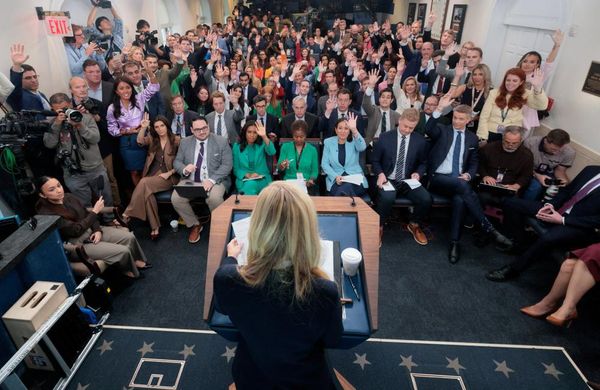
The warmer phone call followed a public pushback just two days before. Asked about Salazar's ad, Trump told reporters at the White House that he still backs her reelection bid but disagrees with her stance on the border, saying flatly: "I'm very strong on the borders, and she isn't." He also credited his own endorsement for her prior win. The bilingual spot at the center of the dispute, filmed outside the White House and released Sept. 17, has Salazar telling Trump his enforcement push has gone "too far" and that Hispanic supporters who backed him in 2024 now feel betrayed.
What the Ad Actually Cites — And Why DHS Pushed Back
The ad's central claim is that half of the roughly 50,000 people ICE detained in July had no criminal record — a figure Salazar says came from "be careful what your advisers are telling you about immigration policy," federal detention data her office obtained through a public-records request, not from newspaper reporting as some secondhand accounts have suggested. Homeland Security Secretary Markwayne Mullin rejected the framing on CNN, insisting entering the country illegally makes someone a criminal by definition and calling Salazar's distinction "that's actually not true." The dispute captures a broader argument playing out inside the GOP over how ICE counts who it arrests.
A Once-Untouchable District Turns Competitive
The clash reflects a genuine shift in Salazar's political footing. Cook Political Report recently moved Florida's 27th District from a comfortable Republican hold to just "likely" Republican, writing that Trump's eroding standing with Hispanic voters "will be an anchor on the congresswoman." The district — covering Miami, Coral Gables, Palmetto Bay and Cutler Bay — is roughly three-quarters Latino, and Trump carried it by close to 15 points (57%-43%) over Kamala Harris in 2024. Nationally, Trump won 48% of the Hispanic vote that year to Harris's 51%, a 12-point jump from 2020, according to Pew Research Center figures Salazar is now openly trying to protect. Democratic challenger Eliott Rodriguez, a former CBS4 anchor, isn't buying the reversal: his campaign accused Salazar in a fundraising email of trying to "distance herself from Donald Trump's policy of cruelty toward immigrants," pointing to her vote for the roughly $75 billion in ICE funding Congress approved through last year's reconciliation package. Separately, Rodriguez said Salazar "refuses to take responsibility" for enforcement she voted to fund.
Doral Feels It First
Salazar's warning mirrors what employers in her own backyard have been reporting for weeks. In Doral, business owners say enforcement activity near commercial corridors has cut sales by as much as 70%. Katia Rios of Pipo Burgers put it plainly: "People are scared to come out. It's affecting us." Farther south, a Miami-Dade palm nursery owner says traffic stops along Krome Avenue have thinned the crews keeping his farm running after losing workers to Temporary Protected Status terminations. According to the report by the Latin Times he raised wages to $25 an hour and still couldn't fill the jobs, warning: "we are going to have to close." The Florida Restaurant & Lodging Association estimates the TPS rollback alone touches roughly 93,000 workers statewide.
What It Means Heading Into November
With the Nov. 3, 2026 midterms approaching, Salazar's strategy of standing by Trump in public while lobbying him in private is a live test of whether Miami's Republican coalition can absorb aggressive enforcement without cracking. Republican strategist Mike Madrid has described this kind of daylight-seeking by Hispanic GOP lawmakers as a "massive five-alarm fire" for the party. Whether Salazar's Hispanic support holds in her own district may say more about the GOP's broader Latino-voter math nationally than any single campaign ad.