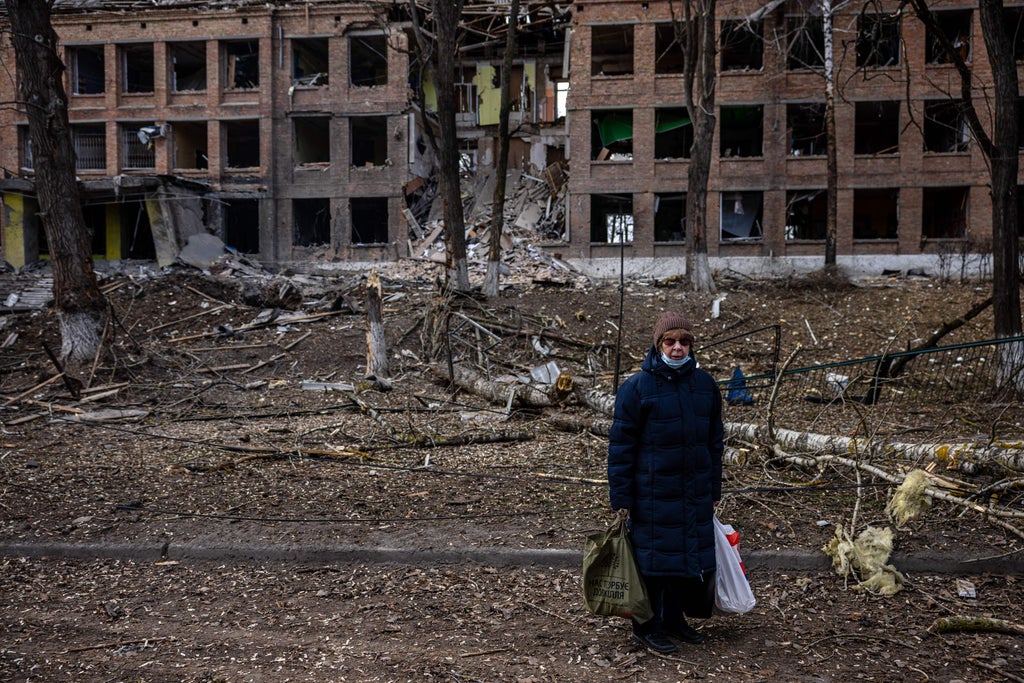
A senior Russian climate scientist apologised for his country’s invasion of Ukraine at a major UN conference on Sunday.
Oleg Anisimov made the unexpected comments during a virtual meeting of 195 delegates from around the world at an Intergovernmental Panel on Climate Change (IPCC) session.
The meeting took place behind closed doors, but two anonymous sources confirmed the comments with the Washington Post.
Mr Anisimov, who works at the state hydrological institute in St Petersburg, said: “Let me present an apology on behalf of all Russians not able to prevent this conflict.”
The veteran climate scientist who has previously authored reports for the IPCC said he had “huge admiration” for the Ukraine delegation, who have continued to work despite the invasion.
His comments came after a speech from his Ukrainian counterpart, Svitlana Krakovska, who said her country will “not surrender” and the “world will not surrender in building a climate-resilient future”
She added: “Human-induced climate change and the war on Ukraine have the same roots – fossil fuels – and our dependence on them.”
Ms Krakovska’s comment is thought to be in reference to Europe’s dependence on Russia’s supplies of gas. Natural gas from Russia accounts for one-third of the continent’s consumption of the fossil fuel.
This vulnerability to the fossil fuel has left Western officials hesitant to implement sanctions against Russia that would interrupt energy supplies.
Italian Premier Mario Draghi drew attention to Europe’s myopia in not looking at alternative sources of energy in parliament on Friday.
He said: “The events of the last days show the imprudence of not having diversified our sources of energy and our providers in recent decades.”
However, in response to the conflict, the German government has frozen the approval process for the already-completed Nord Stream 2 pipeline that would bring gas direct from Russia under the Baltic Sea.