Get all your news in one place.
100's of premium titles.
One app.
Start reading
The Economic Times
The Economic Times
Sneha Kulkarni

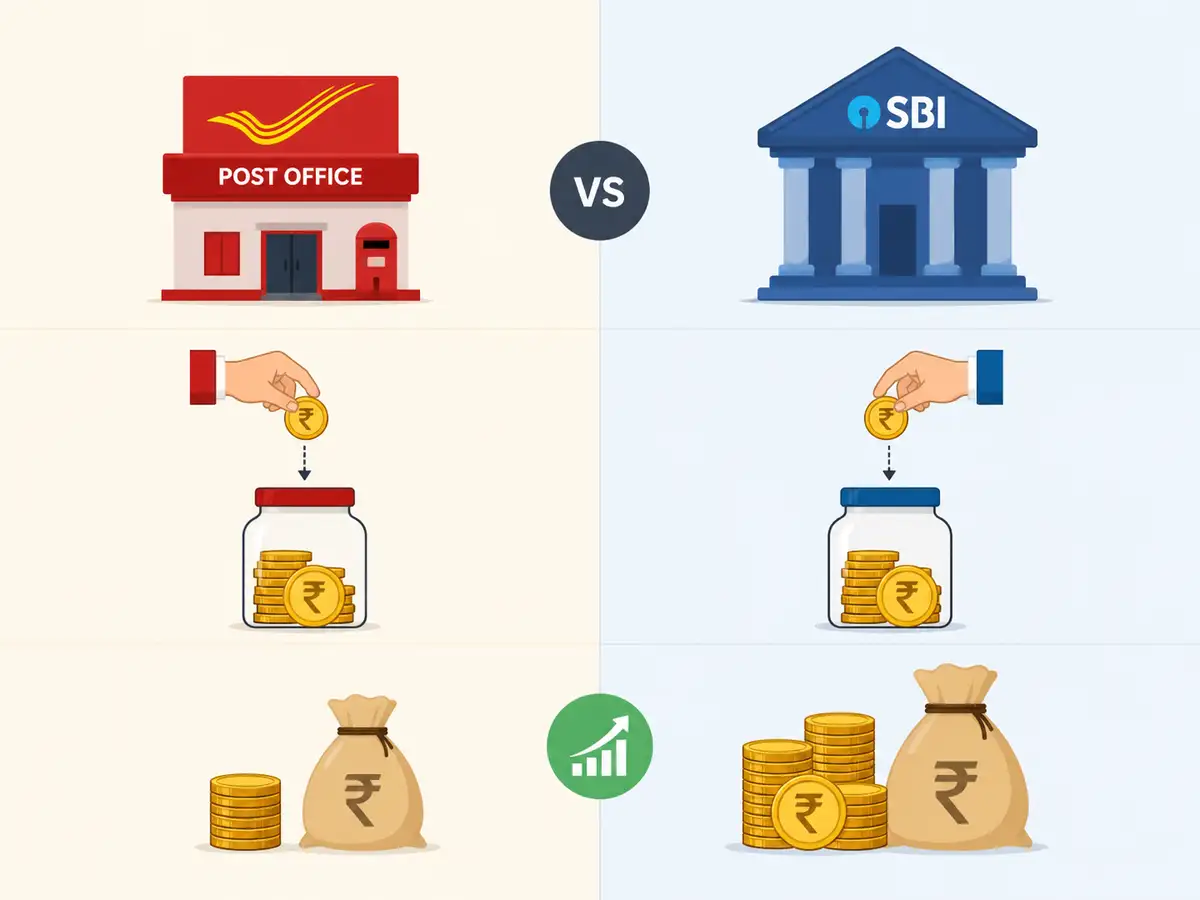
Rs 10,000 monthly investment in post office RD vs SBI RD: Where will you get higher maturity amount in 5 years?

A recurring deposit (RD) account is a great option for those who want to invest a set amount each month for a certain period. Unlike mutual funds or stocks, the returns on an RD are guaranteed and not affected by market fluctuations. This predictability makes it a good choice for conservative investors.

If you invest Rs 10,000 every month for five years into a Recurring Deposit (RD), both the Post Office RD and the State Bank of India (SBI) RD can help you build a sizable corpus. However, the returns will vary due to the different interest rates offered by the post office and SBI. Here's a look at how the maturity amounts compare for a Rs 10,000 monthly investment for five years in a post office RD and an SBI RD.

Particulars Post Office RD SBI RD
Interest Rate 6.7% p.a. 6.05% p.a.
Monthly Deposit Rs 10,000 Rs 10,000
Tenure 5 years 5 years
Total Amount Invested Rs 6,00,000 Rs 6,00,000
Estimated Maturity Amount Rs 7,13,659 Rs 7,01,557
Interest Earned Rs 1,13,659 Rs 1,01,557

Illustrative calculation based on Groww calculator

Also read: Have unclaimed deposits, insurance, mutual funds? Government launches single portal to trace forgotten assets

Which RD gives a higher return- post office or SBI?

As we can see in calculations, a post office RD will provide a maturity amount of Rs 7.14 lakh at maturity, while the SBI RD will help you get Rs 7.02 lakh. It means an investor would earn approximately Rs 12,244 more by choosing the post office RD over the SBI RD.

This calculation is based on current rates. They may change in the future if post office or SBI revise their respective recurring deposit interest rates.

What is a recurring deposit account?

A recurring deposit account allows you to deposit a fixed amount at regular intervals (monthly) for a predetermined tenure.

Post office RD details

A post office Recurring Deposit (RD) account can be opened with a minimum monthly deposit of just Rs 100, and there is no upper limit of investment.

If needed, the account can be closed before maturity, but only after three years from the date of opening. However, if the account is closed even a day before completing the full five-year term, the deposit will earn only the post office savings account interest rate instead of the RD rate.

SBI RD details

An RD account in SBI can be opened with a minimum monthly deposit of Rs 100. Note that a penalty is charged for delayed payments. If someone misses six consecutive instalments, the RD account may be closed prematurely and the balance amount will be paid to the account holder.

For delayed instalments, the penalty is Rs 1.50 for every Rs 100 deposited per month for RD accounts with a tenure of up to five years. For RD accounts with a tenure of more than five years, the penalty is Rs 2 for every Rs 100 per month. These rates may be revised from time to time. However, the total penalty charged cannot exceed the interest earned by the depositor on the account.

Sign up to read this article
Read news from 100's of titles, curated specifically for you.
Already a member? Sign in here
Related Stories
Top stories on inkl right now
One subscription that gives you access to news from hundreds of sites
Already a member? Sign in here
Our Picks
Fourteen days free
Download the app
One app. One membership.
100+ trusted global sources.