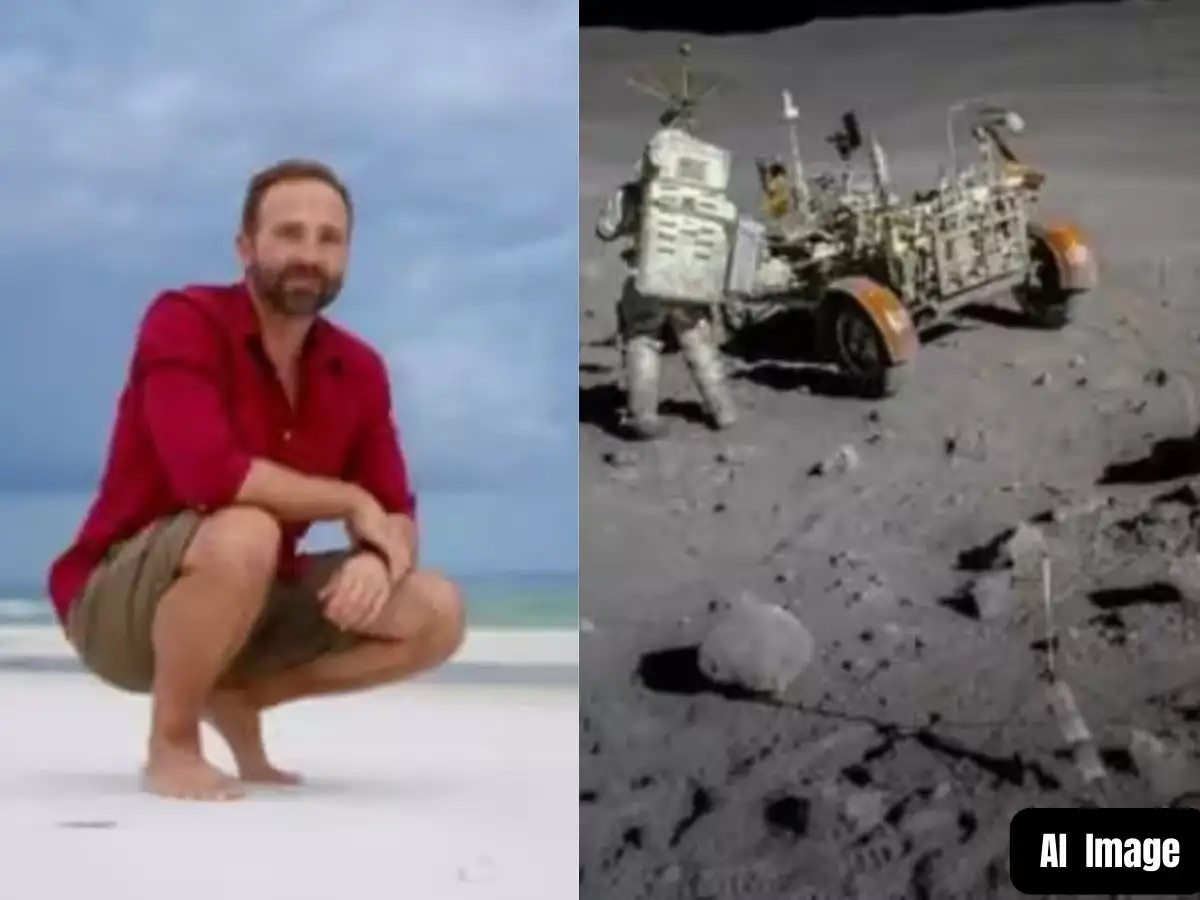
Some guys buy flowers. Thad Roberts decided to steal a piece of the moon instead. In the summer of 2002, Roberts was a 25-year-old intern at NASA's Johnson Space Center in Houston, a triple major in physics, geology and geophysics who'd spent his college years founding an astronomy club and dreaming, quite literally, of becoming an astronaut. Then he met Tiffany Fowler, another NASA intern working in a stem-cell lab. Three weeks into dating her, Roberts had already moved in with her. And somewhere in that stretch, he landed on an idea that no romance novel would have dared write: he'd give her the moon. Not figuratively. Actual moon.
Nasa Interns Stole Moon Rock
Late one night in July 2002, Roberts, Fowler and a third intern named Shae Saur slipped into a secure lab at Johnson Space Center using their real NASA badges. They wore neoprene wetsuits to dodge the room's thermal alarms and rerouted the security cameras before making their move. Inside sat a 600-pound safe holding decades of lunar history, samples collected across every Apollo mission from 1969 to 1972, along with a rare Martian meteorite.
They didn't crack the safe. They carried the whole thing out. By the time NASA staff noticed something was missing, the trio was long gone, and so was roughly 17 pounds of material that would later be valued at $21 million.
Romance on the Moon: What Happened at the Hotel
Here's the part that turned a federal theft case into a story people still can't stop repeating: before the rocks were ever sold, or even hidden properly, Roberts and Fowler took them to a hotel room. And then, according to Roberts' own later retelling, he slid a handful of the lunar samples under the blanket, right there on the bed.
He's since described it, half-joking, half-serious, as something no one else on Earth could claim, a night spent with actual pieces of the moon between the sheets. Whether you find that romantic or borderline unhinged probably depends on how forgiving you're feeling about federal property theft.
The timing made the episode even stranger. July 20, 2002, was the 33rd anniversary of Neil Armstrong and Buzz Aldrin's historic Apollo 11 Moon landing. Roberts and Fowler were in Orlando with the stolen samples, expecting to complete the sale.
Instead, Roberts created his own bizarre version of a Moon landing.
He took some of the lunar rocks and placed them underneath the blanket on the hotel bed. He later told CBS that he and Fowler were intimate with the rocks beneath them, describing it as a symbolic act, essentially, being intimate “on the moon.”
The gesture was apparently connected to the idea that he had promised Fowler the Moon.
The Sale That Never Happened: How FBI tracked them
Stealing the rocks was one thing. Selling them turned out to be the group's undoing.
A fourth person got pulled into the plan, Gordon McWhorter, who posted an ad under the alias "Orb Robinson" on a Belgian mineral-collecting website, offering lunar material for somewhere between $1,000 and $8,000 a gram depending on which account you read. It didn't take long for a real rock collector in Antwerp to get suspicious. He flagged the listing to authorities, and from there, the FBI took over, posing as buyers, stringing along the negotiation, and eventually arranging a meeting at a restaurant in Orlando, Florida, to "finalize the deal."
The deal never got finalized. Agents followed the group back to their hotel, recovered the rocks, and made the arrests in the parking lot. Saur was picked up separately in Houston the same day.
What happened to the NASA intern?
All three interns pleaded guilty to conspiracy and interstate transportation of stolen government property. Roberts, as the ringleader, got the harshest sentence, just over eight years, of which he ultimately served about six before his release in 2008. Fowler and Saur avoided prison entirely, receiving house arrest and community service instead.
There was one more cost, and it wasn't financial. Investigators later said the theft had done real scientific damage: handling the samples outside sterile, controlled conditions, sliding them under bedsheets, for one, had contaminated material that scientists had spent thirty years preserving. Rocks that had survived a trip through space intact came back from a Florida hotel room effectively useless for research.
Roberts never saw Fowler again after the arrest. In interviews years later, he's struggled to fully explain his own reasoning, at one point admitting he still isn't entirely sure what he was thinking when he pulled it off.