
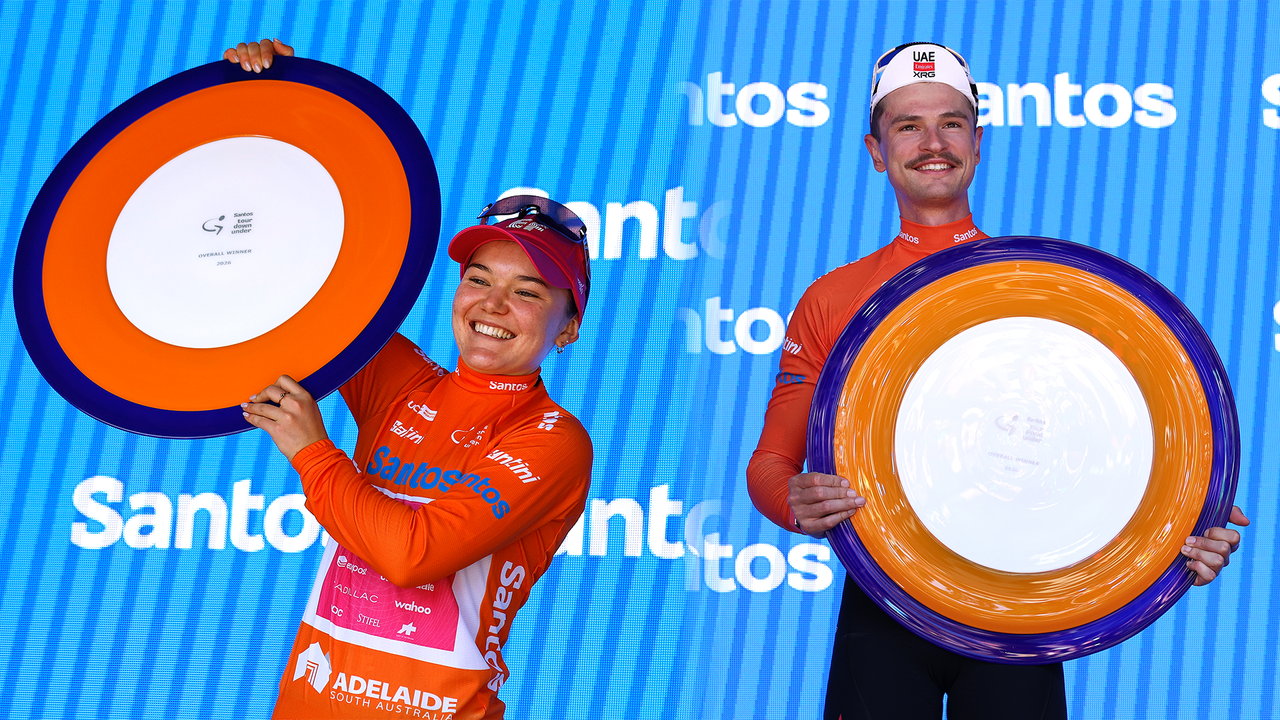
This year, the Santos Women’s and Men’s Tour Down Under delivered nine days of charged racing – plus a bonus 1.Pro one-day event for the women – with fierce competition for podium places and a depth of field that seems to keep growing in every edition.
All 14 Women’s WorldTeams were on the start line for the first time in the Women's Tour Down Under, along with the 18 men's WorldTour teams and Tudor Pro Cycling for the men's event, and an Australian national squad in each race.
From January 17 to 25, there were crushing victories, scorching sprints, race-changing heat, and cruel crashes, including one caused by the chaos of two kangaroos hopping through the peloton. After all that, Noemi Rüegg (EF Education-Oatly) and Jay Vine (UAE Team Emirates-XRG) emerged as the victors.
It was a second title for both, with Rüegg making it two in a row as she kept her cool even when faced with a formidable trio of UAE Team ADQ riders as she headed toward the line completely outnumbered, but not outclassed, in the decisive final stage.
Cyclingnews was on the ground in South Australia, watching it all unfold, while Vine and Rüegg got their time in the spotlight. There were many other stand-out performances, developments, and quirks during the South Australian event. Here are some of the key takeaways from the regular season opener.
No easy wins

Hearing race winners Vine and Rüegg discuss what they had to do to secure victory in the final post-podium interviews really brought home how much the Tour Down Under has grown from a training race to a top-level competition. Vine's victory came through careful planning and training to ensure he was on track to hit the numbers he wanted. He used that form to make his mark with his attack on the Corkscrew on stage 2.
Then Rüegg described how she had struggled on the first time up the pivotal Corkscrew climb on the women's final stage, but then found the strength to fight off a trio of UAE Team ADQ riders, despite being isolated, to claim the victory.
These two riders put everything into their preparations and left everything on the road in pursuit of a coveted prize. Riders are coming to the Tour Down Under fully trained and focused at a time of year when, in past years, they would be well off their best. The race has levelled up.
"There have certainly been some challenges to overcome, dealing with weather and open roads, but the entire team took it up a notch this week, and to see the men's and women's riders lift was awesome," said race director Stuart O'Grady.
"We have increased the difficulty level this year, but as we saw after 170km around Stirling on Sunday, we still had a large bunch come in. It shows how high the quality of the field is and how serious the Santos Tour Down Under has become."
To add to the lustre, Tadej Pogačar's agent Alex Carera turned up on the roadside to watch the final day as the race continued to pursue the star rider.
"I think South Australia's put on a show for him. The weather's gods have come out, the cycling gods came out and put on probably the best Tour Down Under stage I've been a part of," said O'Grady.
Not going quietly

One of the big figures of the race and Australian cycling in general is Amanda Spratt (Lidl-Trek), who earlier announced her retirement at the end of this season. This year will be her last home summer race block as a professional cyclist. There were plenty of fans cheering her on the roadside with carefully put together signs. When "Spratty" went on the attack, the roars of encouragement from the crowd couldn't be missed. They weren't letting the three-time race winner leave without raising their voice in appreciation, and nor was she going to disappear quietly.
"I'm still really motivated for the season ahead to race really well, and I'm training really well," Spratt told Cyclingnews before the first day of racing set off.
It was obvious just how much that training had paid off when, during the more sprint-oriented opening days, she was not far from the front. Then on the final day, she was a constant aggressor, ultimately finishing ninth. That was enough to leave her walking away from her final Tour Down Under with seventh overall. What's more, with the strength the 38-year-old had on display, there is sure to be more reason to cheer through the rest of the final year.
Women's TDU future

The well-worn topic of conversation around the Women's Tour Down Under every year is should it have more stages? The three-day tour which officially started in 2016 has stepped up in many ways in 2026, from the presence of a full contingent of Women's WorldTour squads to a more challenging route. The race was further enhanced by the depth of field and increasing preparedness of those on the start line who turned up ready to race hard early in the season.
The dynamic has not only changed hugely in the women's tour which has run alongside the long-established men's race since it officially kicked off in 2016. The extra ProSeries race also delivered an extra bundle of UCI points for teams on the South Australian trip.
"We're always looking at making our race bigger and better every year," said assistant race director Carlee Taylor at the pre-race media conference, before pointing to the list of steps forward in 2026.
"Increasing and improving, that doesn't go just on race days, but also on many other elements. And we work on how we can do that every year, year on year, in a sustainable way."
In a women's cycling environment where we've seen more than one race come and go, not rushing to change so much that sustainability is jeopardised is a good strategy. But it's hard not to look forward to an era where there might be an extra stage or two to help deliver a a little more of the unfolding tension that a longer GC battle brings.
A goal topping Tour Down Under for Tudor

The 2026 edition of the South Australian race was Tudor Pro-Cycling's first, but the only ProTeam in the peloton would would not have much time to ease itself in. The pressure on the overall contenders began immediately with the opening prologue and then there was only one sprint stage before the crucial point of the race, stage 2 to Uraidla. That was the day of the dual ascents of the Corkscrew climb, a make or break stage for anyone who wanted to do well overall.
With Vine and then Jhonatan Narváez taking off, the rest of the field just had to settle for finding the best spot they could behind them, and one of those riders who managed to get in among the eight man pursuit.was Marco Brenner.
The German rider came over the line in tenth on the stage to move into fifth overall, given his strong opening day. The result gave his squad a bigger dream to chase than they had initially thought possible.
"Top 10 was our goal," said Tudor sports director Marcel Sieberg of what the team was looking for when it entered the race "We knew that at a World Tour stage race there are always good riders. But the start list, UAE having a lot of cards, especially then also with [Adam] Yates. You know, he was giving everything for the other two."
Brenner, however remained a strong card for Tudor too, as even with a crash on the penultimate day of racing, he wasn't giving any time away. When Narvaez crashed out, Brenner moved up to fourth, so deep into the top ten that it was almost a podium.
Being ready to flip the script

Stage 4 of the men’s Tour Down Under led to plenty of tense moments, both on and off the road. On a day where the fire danger hit an extreme level, and the temperatures rolled past 40°C, there was even a question mark over whether there would be a stage at all. One solution meant removing the three ascents of the popular Willunga Hill.
Race organisers have practice at route alterations, but removing the climb entirely and shifting the race forward an hour was a big effort. It clearly shows the work that went into contingency plans, given the way in which the organisation was able to shift gears at short notice.
The teams and riders had to adjust as well, as all of a sudden it went from a climbers' stage to one for the hardiest of sprinters as they tackled the long drag to the finish. NSN Cycling proved to have both the form and adaptability to make the most of the changing nature of the race. For a start, the team not only had to quickly reset from supporting the climbers Nick Schultz and George Bennett but also turned their attention to backing Ethan Vernon in the sprints.
Even then, they had to change course mid-stream when the key lead-out rider, Jake Stewart, crashed and broke a collarbone. However, Brady Gilmore jumped in and filled the role to perfection and NSN won the stage with Vernon, a stage that 24 hours beforehand, they didn't even know they would have.
Watch out for Wollaston

Ally Wollaston (FDJ United-SUEZ) may have been wondering just how her off season training would stack up as she leapt into the first day of racing at the Women's Tour Down Under – knowing that you have done everything to arrive in the best form possible is one thing but testing the progress up against your rivals in a race is another altogether.
When it came to the test, though, she aced it. No one got close, with Wollaston whisking up both of the sprint stages. It's a beginning that doesn't exactly bode well for her rivals as they step into the next block of racing.
Last year, even when the rider from New Zealand was shy of delivering a victory in Adelaide, she went on to take the sweep in Victoria, winning both the women's Surf Coast Classic and Cadel Evans Great Ocean Road Race. Now that the 25-year-old also has momentum on her side to supplement the clearly shining form, it feels like it would be foolhardy to bet against her.
Sharks, spiders, snakes and … kangaroos?

There were plenty of reasons for Jay Vine to feel vindicated at the end of the Tour Down Under, right from the textbook effort on the Corkscrew, which he had identified as a crucial juncture, to the calm and collected way he continued to execute his role as team leader even when so much just kept going wrong for the squad. Still, neither of those outcomes was particularly unexpected, but his take on wildlife may have been, before stage 5 at least.
"All the Europeans ask me, 'What's the most dangerous animal in Australia?' And I always tell them, it's the kangaroos. And they all go, oh, really, the kangaroos ha ha skippy, ha ha. It's like no, no, no, because they wait in the bushes until you cannot stop and then they jump out in front of you," said Vine, finding a brief moment of levity after discussing just how tough the situation was on the riders who fell.
When asked about what happened, stage 5 winner Matthew Brennan (Visma Lease-A-Bike) said, "I just looked to the right, and then I just saw this big animal, and I thought, 'Oh, you are not meant to be here'. But it also surprised me. I think it's a bit of a weird instinct to run towards something that's moving towards you at 60k's an hour. So I don't know what their survival instincts are like."
So with a new perspective, after a less-than-ideal up close and personal encounter, don't be surprised if the visiting peloton is a little less preoccupied with Australia's array of sharks, spiders, and snakes, but instead has fear struck into their heart by the sight of the cute and cuddly looking critter that is the kangaroo.