Get all your news in one place.
100's of premium titles.
One app.
Start reading
The Economic Times
The Economic Times
Shreya Biswas

Rice feeds more than half the world, but 3 toxic metals can travel from paddy soil into its grains; researchers propose changing soil chemistry and reinforcing plant barriers to keep arsenic, cadmium and mercury out

Rice grain contaminated with toxic metals : Rice is one of the world's most important staple foods, feeding more than half the global population. But the soil where it grows can also expose the crop to arsenic, cadmium and mercury, three toxic metals that can make their way into the rice grain, as per a report.

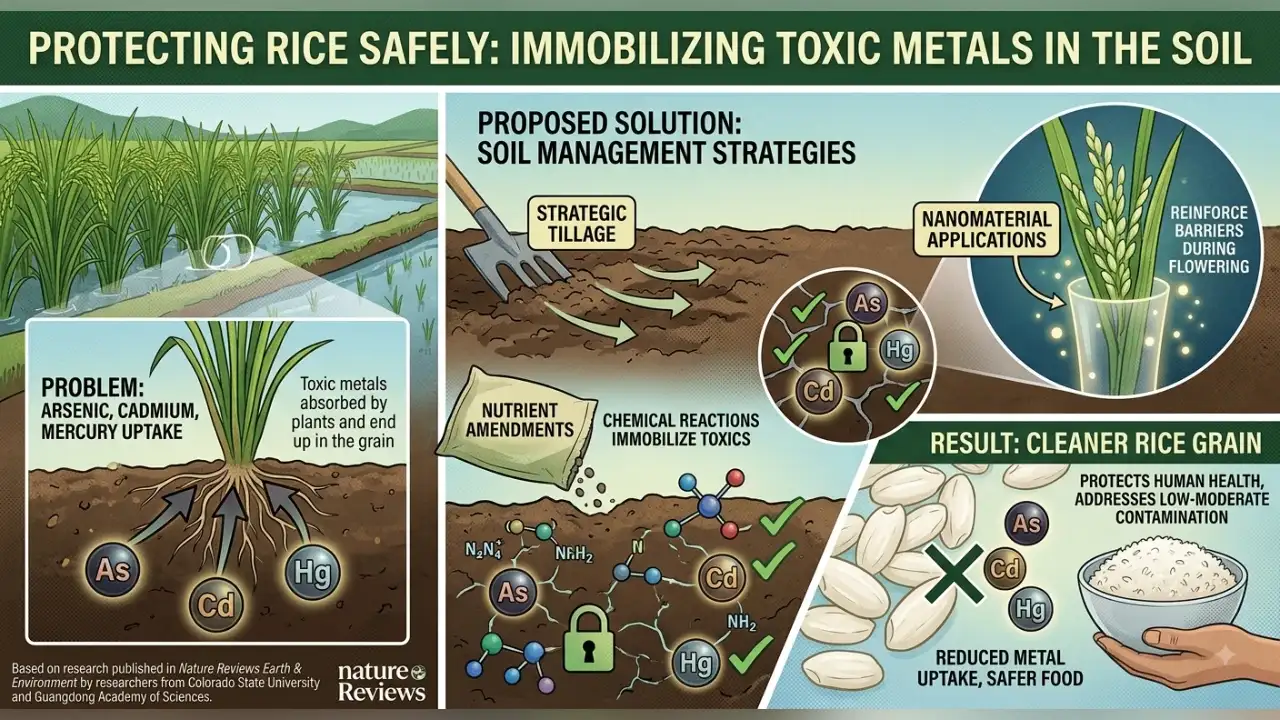
Researchers at Colorado State University are proposing a different way to tackle the problem: change the chemistry of the soil so the toxic metals become immobilized and are less likely to be taken up by rice plants.

In a perspective published in Nature Reviews Earth & Environment, the researchers describe several soil management strategies aimed at stopping the metals before they reach the part of the plant people eat.

The approach is intended to protect human health while addressing contamination in rice paddies without relying on expensive methods that are difficult to use in most fields.

Three toxic metals can threaten rice safety

Arsenic, cadmium and mercury can contaminate rice paddies and potentially threaten the health of millions of people who consume contaminated rice.

Thomas Borch, a professor of soil and crop sciences, said, “Arsenic, cadmium and mercury are potentially threatening the health of millions of people due to contaminated rice,” adding, “Our perspective article lays out a strategy to protect human health by reducing plant uptake of toxic elements via novel soil management strategies,” as quoted by EurekAlert.

The concern is particularly important because rice plays a major role in food security, especially in low-income, food-deficit countries.

READ ALSO: In 1942, Loyalhanna Dam went into operation while Pittsburgh factories produced wartime steel and the army relied on 54,000 pigeons. 84 years later, the dam has prevented more than $658 million in flood damage and its cranes are getting a major overhaul

Researchers want to stop the metals before they reach the grain

For heavily contaminated rice paddies, intensive measures such as physically replacing the soil can be used. But the researchers say these expensive approaches are not suitable for most paddies with low to moderate contamination.

Their proposed strategies instead focus on preventing toxic metals from reaching the rice grain.

The researchers describe ways to stall the toxins during tillage, use chemical reactions involving nutrient inputs to immobilize them and apply nanomaterials to reinforce barriers during the flowering stage.

The aim is to change conditions around the plant so that arsenic, cadmium and mercury are less likely to be taken up and transferred into the grain.

The proposed solution starts with the soil

Rather than physically removing contaminated soil, the researchers want to manipulate its chemistry.

By changing soil conditions, the proposed approach is designed to immobilize toxic elements and reduce their movement into the rice plant.

The strategies include chemical reactions with nutrient inputs and the use of nanomaterials to strengthen barriers at the flowering stage.

The focus remains on the grain because it is the part of the rice plant that people ultimately consume.

READ ALSO: Earlier this year, the U.S. Army Corps tested Chicago's invasive-carp barrier at 3 electrical levels. Now, engineers know how the system behaves when voltage rises to 4.6 volts per inch, helping prepare for a future Great Lakes invasion threat

The approach targets low to moderate contamination

The researchers' perspective addresses a practical challenge: heavily contaminated fields may require intensive remediation, but those methods are not suited to the many paddies with lower levels of contamination.

Their proposed soil management strategies are intended to reduce plant uptake of toxic metals without relying on physical soil replacement.

The perspective was authored by Liping Fang of the Guangdong Academy of Sciences in China, along with Colorado State University researchers Thomas Borch, University Distinguished Professor Jan Leach and postdoctoral researcher Sean Fettrow.

Sign up to read this article
Read news from 100's of titles, curated specifically for you.
Already a member? Sign in here
Related Stories
Top stories on inkl right now
One subscription that gives you access to news from hundreds of sites
Already a member? Sign in here
Our Picks
Fourteen days free
Download the app
One app. One membership.
100+ trusted global sources.