
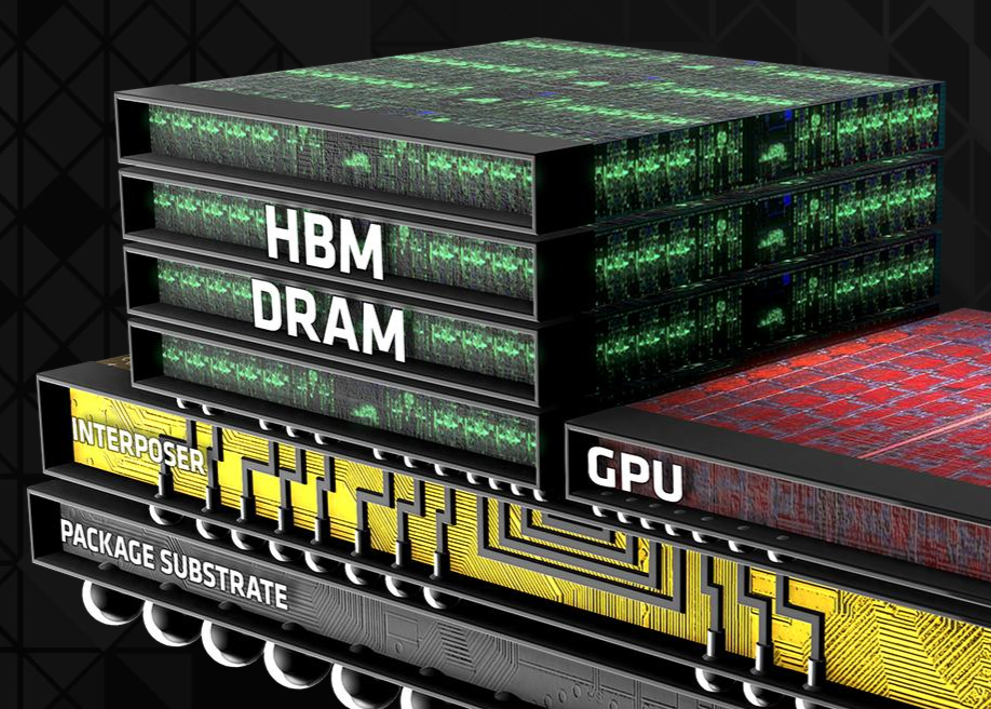
Researchers in Korea and Japan have presented two separate memory-integration proposals that aim to increase HBM (High-Bandwidth Memory) capacity and bandwidth without trapping more heat inside ever-taller DRAM (Dynamic Random Access Memory) stacks, one of the most pressing challenges facing future AI accelerators. Presented at the 2026 IEEE/JSAP Symposium on VLSI Technology and Circuits held in June, the two approaches — V-Die from a Korean research collaboration and MOSAIC from a University of Tokyo-led group — both explore the same broad idea of standing DRAM memory dies on their edges instead of stacking the memory dies only upward like conventional HBM.
The Korean proposal, called Vertical-Die (V-Die), was presented by researchers at the Ulsan National Institute of Science and Technology (UNIST). The design rotates custom DRAM dies upright, drops through-silicon vias to free die area for more memory cells, gives each die its own bottom-edge I/O, and runs liquid-cooling channels between adjacent dies. In simulations against an HBM4 system at equal capacity, the V-Die system reportedly achieved 540 tokens per second on a GPT-3-sized workload, compared to 296 tokens per second for HBM4.














