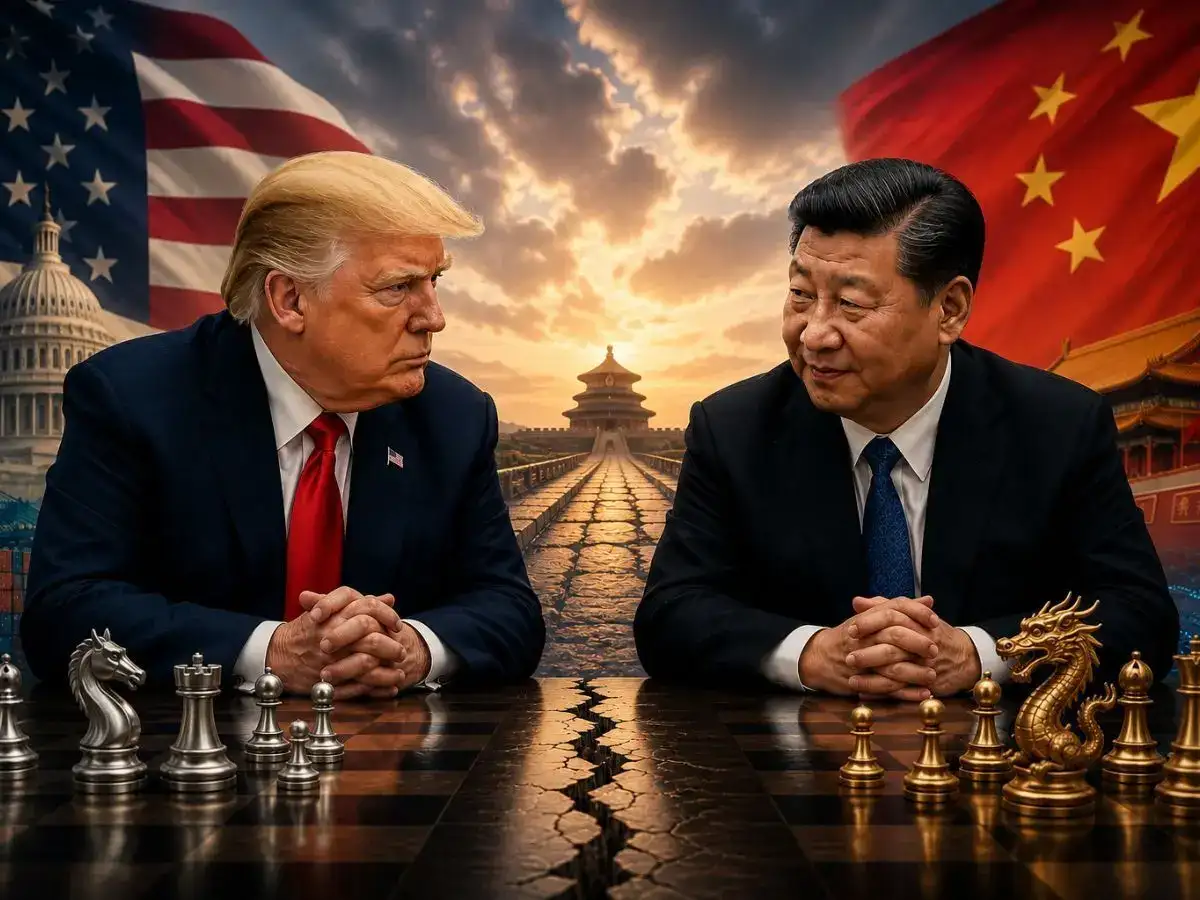
US President Donald Trump’s departure from Beijing on Friday afternoon marked the conclusion of a whirlwind two-day summit that was as visually spectacular as it was substantively hollow. While the visit succeeded in cooling the heated rhetoric that has defined the relationship for long, it failed to produce high-value trade breakthroughs or any diplomatic concessions. Trump returns to the US with a store of personal goodwill and a new framework for "strategic stability," but with almost no progress on the structural issues of trade, technology, and geopolitics.
The summit showed that while personal chemistry can lower the temperature, it remains an insufficient substitute for a formal resolution of the fundamental rivalries between the world's two largest economies.

Also Read: Xi will visit US in fall at Trump's invitation, Chinese foreign minister says
The art of no-deal
Ahead of the trip, the White House and its supporters had framed the visit as a grand opportunity to rebalance the trade deficit and secure massive purchasing commitments from China. However, as Trump left Beijing, the actual wins appeared more like recycled promises or scaled-back agreements. The disconnect between the administration's optimistic messaging and reality led to immediate tremors in the financial markets.
The most prominent win touted by the US team was a deal for China to purchase 200 Boeing aircraft. While a significant figure in isolation, it was viewed as an underperformance given the context of previous summits. Reuters noted that the 200 jets were significantly fewer than the roughly 500 that sources told Reuters had been under discussion. This total also stands in unfavourable contrast to the 2017 visit, where a 300-plane commitment was secured. This trend toward diminished returns suggests that China is no longer as willing to use massive purchase orders as a primary tool for managing the US relationship.
The much-anticipated "double-digit billion" dollar commitment for agricultural purchases, announced by US Trade Representative Jamieson Greer, lacked any formal confirmation from the Chinese side. Treasury Secretary Scott Bessent’s admission to CNBC that there would be no new soybean purchases—as those were covered under a prior October agreement—further deflated the narrative of a new trade bonanza. As Leah Fahy, senior China economist at Capital Economics, warned in a CNN analysis, many past "headline deals" from Trump’s 2017 visit, such as massive investments in West Virginia shale gas, never actually materialised. This history of unfulfilled MoUs continues to cast a long shadow over the administration’s current claims of economic success.
Also Read: Did Xi Jinping make Donald Trump sit on a smaller sofa?
The new Chinese leverage
The lack of substantive deals is not merely a failure of negotiation. It reflects a fundamental shift in the economic leverage between the two nations. When Trump first visited in 2017, the US delegation brought nearly 30 executives who walked away with $250 billion in deals. This time, the 17-person delegation, which included tech titans like Nvidia’s Jensen Huang and Apple’s Tim Cook, found a much more formidable and self-reliant Chinese market.
China has spent the last decade nurturing homegrown champions in electric vehicles, semiconductors, and artificial intelligence, often spurred by the very trade restrictions imposed by the first Trump administration. Tesla, led by Elon Musk, who was part of the entourage, is losing ground to Chinese rival BYD, which has overtaken Tesla as the world’s largest seller of EVs. Similarly, Apple is facing intense pressure from Huawei and Xiaomi, while Nvidia is struggling to gain regulatory approval for its advanced AI chips.
The presence of these CEOs in Beijing was less about securing export deals and more about maintaining access to a market that no longer considers them indispensable. Kent Kedl of Blue Ocean Advisors observed in a CNN report that this year’s cohort prioritised access to the China market and Trump himself over specific export agreements. This shift shows that Beijing is increasingly confident in its ability to resist US economic pressure, leaving Trump with fewer tools to extract concessions.
The Iran impasse
The summit was intended to be a pivotal moment for resolving the US-Iran conflict, which has sent global crude prices to high levels. Trump arrived in Beijing hoping that Xi would use China’s significant diplomatic and economic ties with Iran to force a peace deal. However, the results were a study in diplomatic evasion.
While Trump told the media that Xi had offered to help and pledged not to provide military equipment to Iran, the actual communications from the Chinese Foreign Ministry suggested no change in policy. China’s statement that the conflict should never have happened and has no reason to continue was actually a thinly veiled critique of US policy rather than a commitment to pressure Iran. Analysts suggest that Xi views Iran as a vital strategic counterweight to US influence in the Middle East and is unlikely to abandon that leverage.
Patricia Kim of the Brookings Institution told Reuters there was an absence of any Chinese commitment to do anything specific with regards to Iran. While there were discussions regarding a possible energy deal where China would purchase more US oil to offset its reliance on Iran, no formal agreement was signed. As long as China continues to be a top purchaser of Iranian crude, US hopes for a Chinese-led resolution to the war remain largely a fantasy.
The Taiwan red line
Perhaps the most significant and sobering portion of the summit involved discussions on Taiwan. In a stark departure from the otherwise celebratory tone of the visit, Xi delivered a direct warning to Trump, calling Taiwan the most important issue and a red line that must not be crossed. According to the Chinese readout, Xi warned that mishandling the issue would put the entire relationship in great jeopardy.
Trump’s response was uncharacteristically restrained. Rather than asserting a firm US defence of the island, he spoke of his desire to avoid a war "9,500 miles away" and noted that he was "hearing out" Xi’s opposition to Taiwan’s independence. This ambiguity, while potentially intended to maintain flexibility, has caused concern among those who fear Trump might use Taiwan as a bargaining chip for trade concessions.
However, the personal rapport between the two leaders was undeniable. Trump repeatedly praised Xi’s demeanour, describing him as a "pretty cool guy" who is "all business." This personal connection allowed for the creation of a new bilateral framework—"constructive strategic stability."
Xi pushed a new term by describing the relationship as “constructive strategic stability,” a sharp departure from the framing of “strategic competition” used by former US President Joe Biden, which Beijing disliked, Reuters noted. “Until now, China hasn't proposed an alternative—now they have—if the US side agrees, that is progress,” Da Wei, director of the Center for International Security and Strategy at Tsinghua University in Beijing, told Reuters. While this "strategic stability" may prevent an accidental war, it does little to address the underlying reality of a democratic Taiwan facing an increasingly assertive mainland.
Pomp and pageantry as a strategic tool
The summit was a masterclass in Chinese stagecraft. From the red carpet welcome by Vice President Han Zheng to the military bands and schoolchildren at the Great Hall of the People, every detail was designed to appeal to Trump’s appreciation for optics and respect. The most significant gesture was the private tour of the Zhongnanhai leadership compound, a former imperial garden that is usually off-limits to foreign dignitaries.
By treating Trump as a guest of honour with unprecedented access, Xi was able to project a sense of stability and mutual respect that satisfied Trump’s primary diplomatic requirement. As CNN reported, this meticulous pageantry had the intended effect of "projecting stability" onto a relationship that is, in reality, deeply strained. Trump’s toast with a champagne flute, a rare gesture for the teetotaller, and his deferential behaviour during the tour of the Temple of Heaven showed that the stagecraft successfully charmed him.
However, many analysts warn that these positive atmospherics are a poor substitute for policy breakthroughs. Han Shen Lin of The Asia Group told Reuters that if Beijing does not provide Trump with enough wins to take home to his rural constituents before the midterm elections, the risk of a hawkish pivot remains high. "This will undoubtedly take us on the road to escalation," he warned.
A stabilised stalemate
The Trump-Xi summit will be remembered as a victory for diplomacy through optics but a failure for diplomacy through substance. Trump leaves China with his sagging approval ratings bolstered by images of a respected world leader, and Xi leaves with a stabilised relationship that buys China time to continue its push for self-sufficiency.
The fundamental questions of the era—such as how to handle a rising China, how to protect Taiwan, and how to end the global economic turmoil caused by the Iran war—still remain unanswered. The US business delegation leaves with fewer orders than expected, and global markets remain jittery about the lack of specific trade resolutions.
While the leaders have agreed on a floor for the relationship, that floor is built on the fragile ground of personal rapport rather than the solid foundation of formal treaties or structural reforms. For now, the US and China have moved away from the brink of conflict, but they remain locked in a stabilised stalemate, shrouded in the carefully staged pomp and show.