Get all your news in one place.
100's of premium titles.
One app.
Start reading
Digital Camera World
Tom May

Rebels & icons: why Janette Beckman didn't wait for permission to photograph music history

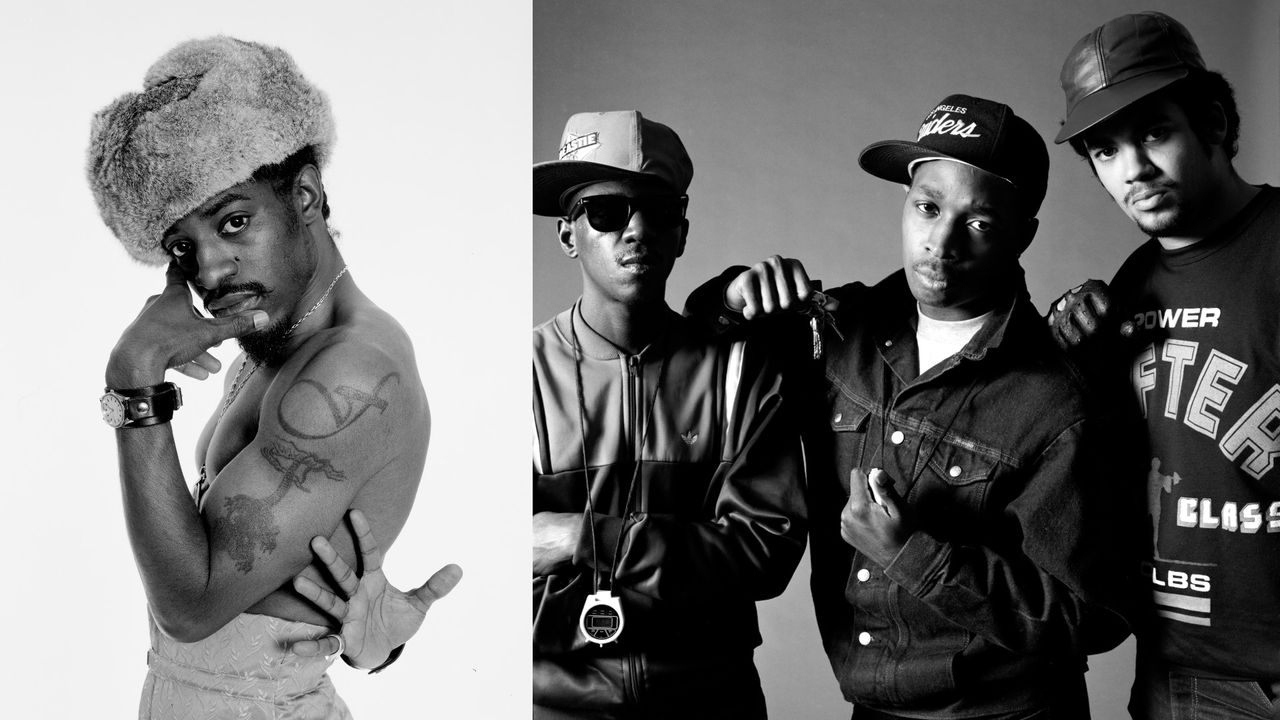
Left: Black and white portrait of a shirtless Andre 3000 wearing a large fur hat, leaning on one arm and looking over his shoulder at the camera. Right: Black and white studio portrait of three members of Public Enemy wearing baseball caps and sportswear, posed close together against a grey background.

There's a specific kind of photographer who doesn't wait to be told something is important. Case in point: British photographer Janette Beckman was in a dressing room in Milan in 1981 when punk frontman Joe Strummer struck a pose that managed to be both absurd and iconic. Another day, in 1987, she was in a New York studio with a hip-hop group that was about to change how America talked about race, power and music (Public Enemy). The lesson isn't complicated, but it is hard: you have to show up before the world catches on.

Now, her impressive body of work – spanning four decades and more than 700 photographs – is the subject of Rebels + Icons: The Photography of Janette Beckman, opening at the Museum of Pop Culture (MOPOP) in Seattle on 15 May. The most comprehensive exhibition of Beckman's photographs assembled to date, it runs through to 8 September 2027 and includes rare archival prints, contemporary collaborations and newly unearthed images.

Right place, right time

Beckman worked in London at exactly the right time, building her reputation shooting the mod revival and early punk scenes, before relocating to New York, where she embedded herself in the emerging hip-hop world.

The two genres were a generation apart in sound but similar in spirit: working class, confrontational, fashion conscious, and deeply suspicious of the mainstream. Beckman's eye recognised the continuity, even when nobody else was drawing the line.

Public Enemy, New York City, 1987 (Image credit: Janette Beckman)
André 3000, New York City, 2002 (Image credit: Janette Beckman)
Chaka Khan, Los Angeles, 2022 (Image credit: Janette Beckman)

The timing of the new exhibition is pointed. 2026 marks the 50th anniversary of punk in the UK, and MOPOP is positioning Rebels + Icons as a meditation on how subcultures are born, how they evolve and, occasionally, how they conquer. For anyone who photographs music, youth culture or street life, her career reads like a masterclass in access, empathy and patience.

Beckman's own description of her working method is free of mysticism. "I've always been attracted to rebel cultures," she has said. "My journey has taught me there are no roadmaps. Being an artist is about following your passion no matter what happens. Photography is a practice and I am still practicing."

What 700 photographs actually means

From a technical standpoint, the scale of this exhibition raises an interesting question: what does it take to sustain a coherent visual identity across four decades, multiple continents, several film formats and the eventual, grudging arrival of digital?

Looking at Beckman's work chronologically, the answer seems to be less about equipment than about proximity. She consistently managed to get close, not just physically but relationally, shooting subjects who appear relaxed, unguarded and occasionally oblivious to the camera.

Paul Weller and Pete Townshend outside the Marquee Club, London, 1980. (Image credit: Janette Beckman)
Leaders of the New School Union, Long Island, 1990 (Image credit: Janette Beckman)
Keith Haring, New York City, 1985 (Image credit: Janette Beckman)

The exhibition goes beyond static prints, incorporating film, interactive elements and live programming. Visitors will be taken behind the lens, gaining insight into Beckman's process alongside the finished images. Michele Y. Smith, CEO of MOPOP, describes it as "a living archive of cultural movements".

The deeper argument that Rebels + Icons makes, I think, is that documentary photography at its best is an act of faith. You commit to a subject, a scene or a community before you can prove it matters. You spend the time, you take the pictures, you come back.

Today, Beckman's archive of punk, hip-hop and street fashion is regarded as culturally essential. In the moments the shutter fired, it was just a Tuesday.

Sign up to read this article
Read news from 100's of titles, curated specifically for you.
Already a member? Sign in here
Related Stories
Top stories on inkl right now
One subscription that gives you access to news from hundreds of sites
Already a member? Sign in here
Our Picks
Fourteen days free
Download the app
One app. One membership.
100+ trusted global sources.