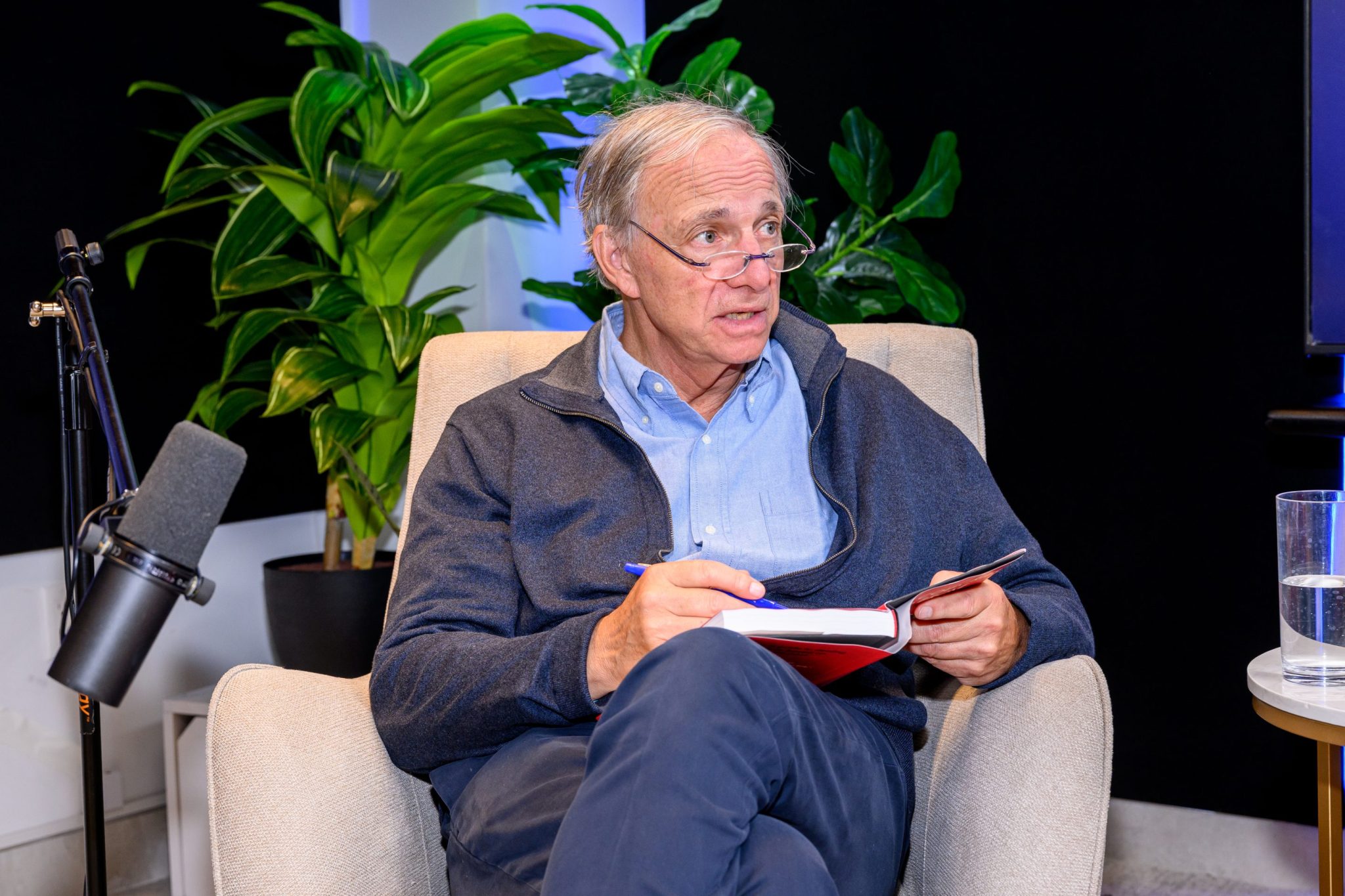
Ray Dalio, the billionaire founder of Bridgewater Associates, delivered one of his starkest warnings yet on the current market environment during a wide-ranging appearance on The Diary of a CEO podcast with host Steven Bartlett, arguing AI enthusiasm has pushed markets into bubble territory reminiscent of 1929 and 2000. His warning arrives just as the market prepares to test his thesis in real time: SpaceX has already gone public in the largest IPO ever, and Anthropic and OpenAI are barreling toward trillion-dollar valuations—precisely the kind of speculative issuance surge that market historians treat as a bubble’s clearest warning sign.
Bartlett opened by referencing a prior guest, Jeremy Grantham, who told the show that markets are staring down “the biggest investment bubble in American history.” Dalio’s response was direct: “He’s right,” he said.
That call is consistent with Grantham’s long track record. The GMO cofounder called the Japanese asset bubble before it collapsed in the early 1990s and the dotcom bubble before it burst. Additionally, he wrote in Fortune in September 2007 that U.S. housing was in “genuine bubble territory” months before the Great Financial Crisis, at a time when even the Federal Reserve was dismissing bubble talk.
When Grantham talked to Fortune in April about his memoir, The Making of a Permabear, Grantham laid out the framework underpinning his current AI call: a “bubble within a bubble.” The original super-bubble was already inflating dangerously through 2021, he told Fortune, and it even cracked—with the S&P 500 falling roughly 25% from January through October 2022—before ChatGPT’s arrival reversed the decline. “The day after Chat came out, the Mag Seven lifted the market on its broad shoulders and staggered forward,” he said, arguing that AI didn’t fix the underlying overvaluation but “deferred it while making it larger.”
Grantham’s January 2026 paper with financial historian (and memoir coauthor) Edward Chancellor found the market’s price/book ratio and cyclically adjusted earnings multiples at extremes surpassed only in 1929, 1972, 1999–2000, and 2021—each followed by a devastating correction.
The Four Horsemen are assembling
Acadian Asset Management’s Owen Lamont has framed the clearest test of whether markets are truly in bubble territory around four conditions he calls the “Four Horsemen of the Bubble Apocalypse“: extreme overvaluation, widespread “bubble beliefs” (investors who admit prices are too high but expect them to rise anyway), a surge in equity issuance, and a flood of new market participants.
Dalio’s comments map almost precisely onto the third horseman. “There’s almost nothing that’s easier to produce than stock,” he said, describing how a company can raise $50 million, get valued at a billion, and mint a paper billionaire without a billion dollars ever changing hands. He’s identified surging stock issuance as one of the two primary forces that “prick” a bubble, alongside rising interest rates.
That issuance horseman is no longer theoretical—it’s on the calendar. SpaceX went public in June, but has since traded below its IPO price, with S&P projecting negative free cash flow through 2029 and Moody’s flagging Elon Musk’s concentrated voting power as a governance risk. Anthropic has confidentially filed for a listing expected as early as October, targeting close to $1 trillion, while OpenAI has filed separately and is targeting a debut some analysts peg above $1 trillion, though the timeline has already slipped from late 2026 toward 2027 amid “shifting market dynamics.”
Dalio walked through the mechanics using a simple thought experiment: Buy a unit of an AI company for $100, borrow against that paper wealth, and when the market turns and everyone needs cash simultaneously, the price can collapse to $25 while the loan still needs repaying. His core distinction is between wealth and money: “Wealth is not the same as money,” he said. “You see a lot of people getting wealthy but you can’t spend the wealth. You have to sell the wealth to get money because you can only spend money.”
Asked whether he’s seeing signs of a bubble, Dalio didn’t hedge: “Yeah. Yeah. Yeah. Classic signs that we’re in [one].” He stressed a bubble is “a degree thing” rather than binary, pointing to unsophisticated investors piling into leveraged bets, including leveraged ETFs tracking the stock market. “It’s more like they’re crapshooting,” he said.
Grantham’s diagnosis of why bubbles form in the first place complements this: Markets are “constitutionally incapable of looking further than the present moment,” he told Fortune, extrapolating current conditions and “double-counting prosperity” until the excitement itself becomes the risk.
Wall Street’s own numbers are starting to agree
These warnings, proliferating since 2025, are increasingly being echoed by an unlikely source: Wall Street’s own bullish research shops. Goldman Sachs, one of the Street’s most consistently bullish research shops, argued on Aug. 3 that “there does not appear to be a valuation bubble…there may be an earnings bubble” in technology, in the words of chief global equity strategist Peter Oppenheimer.
The same day, Apollo’s Torsten Slok declared “the 60/40 portfolio is broken,” arguing that neither stocks nor bonds have been responding in the way that decades of market history would predict, upending 40 years of investment strategy.
The “Big Cycle” behind it
BCA Research’s Peter Berezin has been arguing for months that the AI trade is “primarily an earnings bubble rather than a valuation bubble”—the kind that has historically clustered in boom-bust industries like pre-2008 banks. The pattern repeated the week of July 26–31: Microsoft and Amazon rose 18% and 10% on strong capex credibility, while Alphabet fell 4% and Meta nearly 10%, despite all posting strong earnings—a sign investors are no longer rewarding spending simply for existing and the bubble stage is nearing some kind of reckoning, as Dalio has predicted.
Dalio situated this moment within what he calls the “Big Cycle”—a roughly 80-year pattern combining debt dynamics, growing wealth gaps, domestic political conflict, and shifting geopolitical power. He warned that when a bubble bursts, “you have people at each other’s throats,” citing the U.K.’s six prime ministers in seven years as a symptom of governments lacking money and voters turning on each other over how to raise it. Grantham’s own framing reaches for an even longer horizon, tying market excess to demographic collapse and resource scarcity.
Dalio identified two forces that typically “prick” a bubble: rising interest rates that make debt more expensive to service, and a surge in stock issuance as companies rush to capitalize on investor enthusiasm. He even cited a real-time example: A friend running an AI company told him he was raising hundreds of millions of dollars specifically because he expected a downturn—money he plans to use to buy struggling competitors once the market turns. The rising interest rates align closely with Slok’s warning for years that markets should prepare themselves for a “higher for longer” regime.
His bigger warning wasn’t about the market, it was about what comes after. In Dalio’s telling, the bursting of an AI bubble isn’t just a financial event but the spark for the kind of political and geopolitical conflict that historically accompanies the end of an 80-year cycle—meaning the real risk to prepare for may not be a portfolio loss, but the unrest that follows one.