
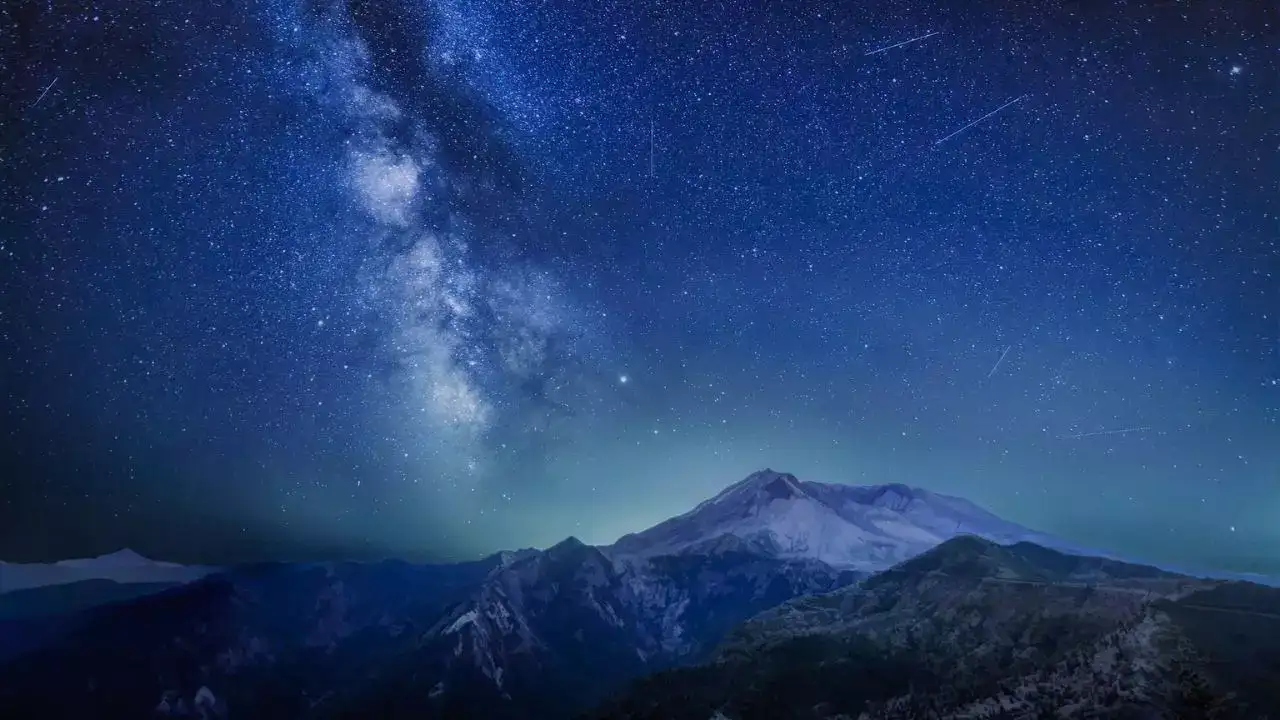
Skywatchers have a reason to stay up late this week as two annual meteor showers are set to reach their peak on the same night. The Southern Delta Aquariids and Alpha Capricornids will both be most active overnight from July 30 into July 31, offering a chance to spot shooting stars streaking across the sky, as per Vice.
However, there's one major obstacle this year, a nearly full Moon. Just one day after July's Buck Moon, the Moon will be around 98% illuminated, creating bright skies that could wash out many of the fainter meteors.

While the viewing conditions won't be perfect, astronomy enthusiasts can still enjoy the celestial event by choosing the right time and location.
Two Meteor Showers Share the Spotlight
The Southern Delta Aquariids are expected to be the more active of the two meteor showers. Under ideal dark-sky conditions, the shower can produce up to 25 meteors per hour. These meteors are typically faint and fast-moving, making them more difficult to see when moonlight brightens the night sky. Adding to the mystery, astronomers have yet to definitively identify the meteor shower's parent comet, as per Vice.
For years, researchers have suspected Comet 96P/Machholz as its source. The comet, discovered by amateur astronomer Donald Machholz in 1986, remains the leading candidate. However, organizations such as the American Meteor Society still list the connection with a question mark, meaning the origin has not been fully confirmed.
Unlike many annual meteor showers with well-established parent bodies, the Southern Delta Aquariids continue to puzzle scientists.
Alpha Capricornids May Offer the Best Show
Although the Alpha Capricornids produce far fewer meteors—typically around five per hour—they have a reputation for creating something far more dramatic. This shower is known for its slow-moving, bright fireballs, which are significantly easier to spot even when the Moon is bright. These larger meteors often leave glowing trails as they cross the sky, making them a favorite among experienced skywatchers.
Because of their brightness, the Alpha Capricornids may end up providing the night's most memorable sights despite their lower numbers.
Best Time to Watch
The best opportunity to catch both meteor showers is between midnight and dawn, when the radiant point of the Southern Delta Aquariids climbs highest in the southern sky within the constellation Aquarius.
Experts recommend finding the darkest location possible, away from city lights. If possible, position yourself so that the moon is behind a building, tree line, or another natural barrier to reduce its glare, as per Vice.
Meteor showers are best viewed with the naked eye. Telescopes and binoculars actually limit your field of vision, making it harder to spot meteors crossing different parts of the sky.
Observers across the southern United States, Mexico, and the Caribbean may enjoy slightly better viewing conditions because the radiant appears higher above the horizon at lower latitudes.
August Brings Even Better Viewing Conditions
If clouds or moonlight interfere with this week's meteor showers, another spectacular celestial event is just around the corner. The Perseid meteor shower, one of the year's most popular astronomical events, is expected to peak on the nights of August 12–13. Under dark skies, the Perseids can produce up to 100 meteors per hour, making them one of the most active meteor showers of the year.
This year's peak is expected to occur under a new Moon, meaning there will be little to no moonlight interfering with visibility.
Adding to the excitement, the same period will also feature a total solar eclipse visible along a path crossing Greenland, Iceland, and northern Spain, while a partial solar eclipse will be visible from parts of Canada and the northeastern United States. For astronomy enthusiasts, August is shaping up to be one of the most exciting months of the year.
A Challenging but Rewarding Night for Skywatchers
Even though a bright Moon will reduce the number of visible meteors this week, the rare overlap of two meteor showers still offers an excellent reason to step outside and look up.
Patience, dark surroundings, and clear skies can make all the difference. And for those who miss this week's display, the spectacular Perseids arriving in August promise an even brighter show.
This article is based on information released by the American Meteor Society (AMS) and publicly available astronomical observations regarding the Southern Delta Aquariids and Alpha Capricornids meteor showers. The viewing guidance and event timings are based on recommendations from astronomy experts and skywatching organizations.







