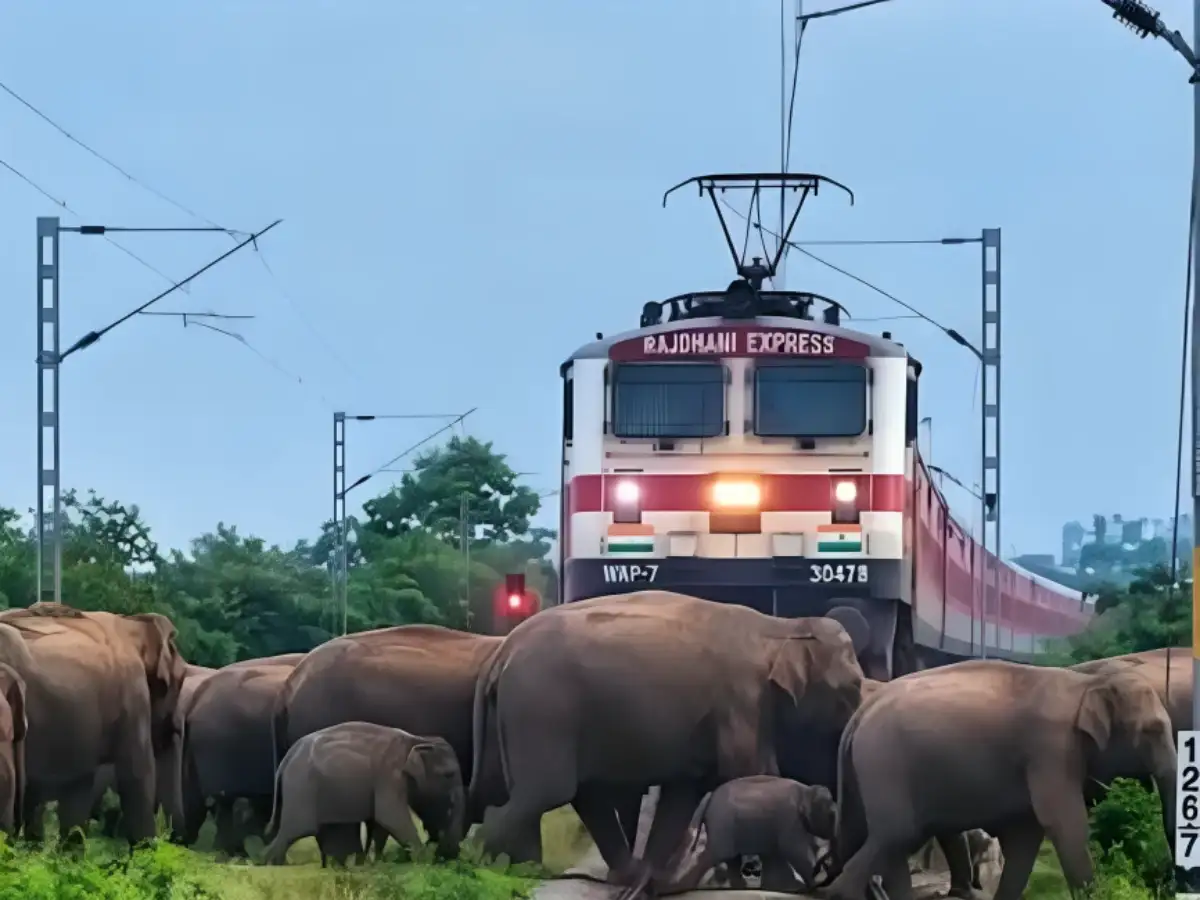
A Rajdhani Express in Assam recently had an unusual reason to pause its journey, a herd of elephants crossing the railway tracks.
The unexpected encounter took place in August at Hawaipur in Assam's Hojai district, where the Down Rajdhani Express was temporarily halted to allow the animals to cross safely. A video of the incident later surfaced on social media, offering a rare glimpse of wildlife moving across an active railway route.
Why was the Rajdhani Express stopped in Assam?
The train was stopped around kilometre 167/8 under the Lanka Range of the Nagaon South Division after forest officials spotted elephants moving towards the railway tracks.
Instead of allowing the train to proceed, railway and forest personnel coordinated to ensure the herd could cross without coming into contact with the train.
Assam Minister Jayanta Malla Baruah described the unusual interruption as a stop that allowed the "adorable giants" to pass safely.
Elephants cross railway tracks as train waits
The video shared on Instagram shows a group of elephants making its way across the railway line, with young calves also seen among the herd.
The incident highlighted the coordination between Assam Forest Department personnel, the loco pilot and the Lumding Railway Control Room. The railway movement was held temporarily while the animals crossed the track.
For passengers aboard the Rajdhani Express, the interruption would have been an unusual sight, a high-speed train waiting patiently while a herd of elephants took priority.
Assam railway route is important elephant habitat
The Hawaipur-Lumding section is located in a landscape known for elephant movement. The Lumding Reserve Forest forms part of the Dhansiri-Lumding Elephant Reserve and is connected to forest areas around Karbi Anglong and Nagaon.
A recent assessment by the Ministry of Environment, Forest and Climate Change has identified the Lumding-Habaipur railway section as a vulnerable stretch because of wildlife movement in the region.
Elephants frequently travel between forest habitats, bringing them into proximity with railway tracks and other infrastructure.
How Indian Railways protects elephants on tracks
Railway authorities have adopted several measures to reduce the risk of elephant-train collisions in identified corridors.
Indian Railways incorporates elephant corridors into working timetables, while speed restrictions can be introduced on vulnerable stretches. Railway staff are also alerted when elephant movement is reported, allowing train operations to be adjusted.
Forest officials and railway control rooms coordinate when elephants are spotted near tracks, helping crews respond quickly and prevent potentially dangerous encounters.
Hojai: Archaeological sites and places to explore
While Hojai is known for its connectivity across Assam, the district also has attractions for travellers interested in history and archaeology.
Rajbari Archaeological Site: Located around 9 km from Hojai town, the site features the remains of a group of Shiva temples, with some architectural elements dating back to the 11th century.
R.M. Nath Archaeological Park: Situated around 600 metres from Hojai railway station, the park houses stone temple remains collected from parts of Hojai, Karbi Anglong and Nagaon.