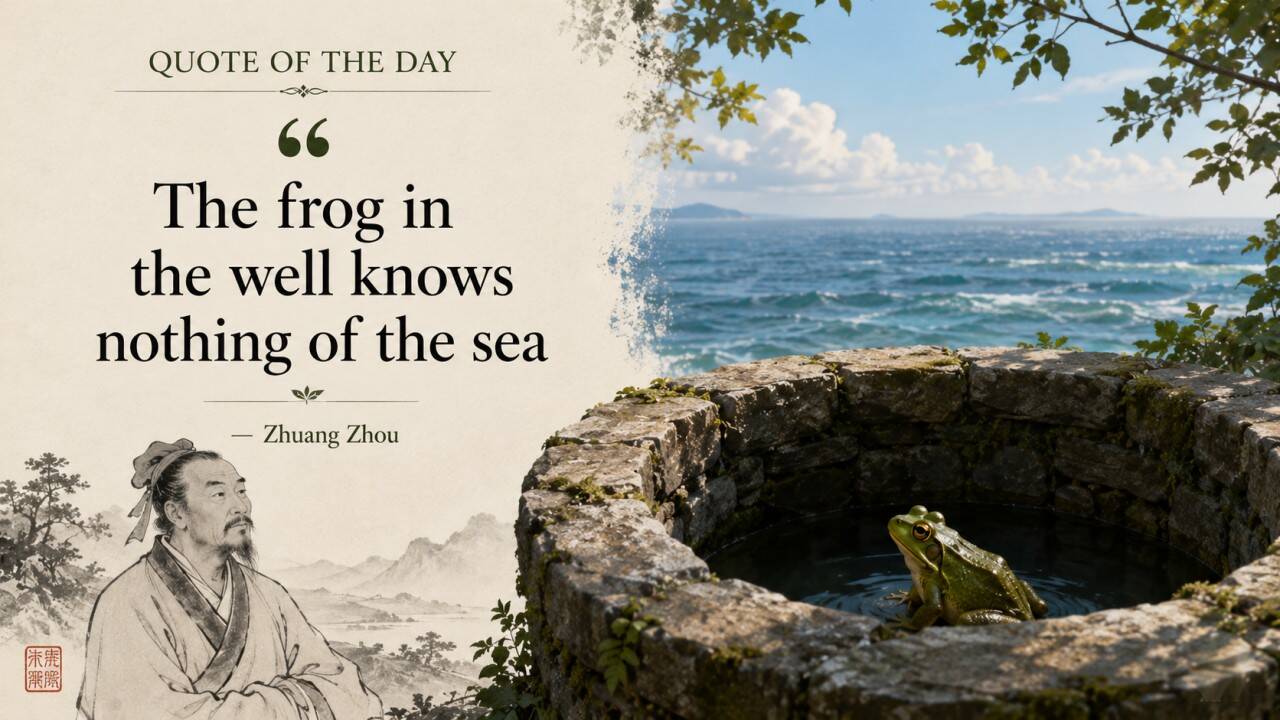
A frog that has spent its entire life inside a small well may believe that the circular patch of sky above it is the whole world. It has never seen rivers, mountains or the vastness of the ocean, so it cannot imagine anything beyond the walls surrounding it. This simple image forms the heart of one of the most enduring sayings associated with ancient Chinese philosophy. Attributed to the philosopher Zhuang Zhou (often written as Chuang Tzu), the proverb continues to remind people that limited experience often leads to limited understanding.
Get breaking news anytime, anywhere. Download the TOI app now!
Meaning of the quote
"The frog in the well knows nothing of the sea" describes someone whose knowledge is restricted by a narrow perspective. Such a person may be intelligent and sincere, yet their understanding is confined to what they have personally seen or experienced.
The sea represents a world far larger, richer and more complex than the frog can imagine. The well symbolises the boundaries people unknowingly place around themselves; whether through habit, upbringing, limited exposure or unwillingness to consider new ideas.
The proverb is less about ignorance than about perspective. It encourages humility by reminding us that no matter how much we know, there is always a wider world beyond our own experience.
Origin of the quote
The saying traces its roots to the Zhuangzi, one of the foundational texts of Daoist philosophy, written around the fourth century BCE. In the chapter often translated as "Autumn Floods," a frog living in a well proudly boasts about its comfortable home to a turtle from the Eastern Sea. The turtle attempts to describe the vast ocean, but the frog cannot comprehend such immensity because it has never known anything beyond its well. The story concludes that people with limited experience often struggle to understand ideas that lie outside their familiar world.
The allegory has survived for more than two millennia and has become a common expression across East Asia. In Chinese, the phrase jǐng dǐ zhī wā literally meaning "frog at the bottom of a well," is still widely used to describe someone with a narrow outlook.
The philosophy behind it
The saying reflects one of Daoism's central ideas that reality is far broader than individual perception. Zhuangzi frequently challenged rigid thinking and encouraged people to question certainty. He believed that human knowledge is always partial and that genuine wisdom begins by recognising the limits of one's own understanding.
The frog is not mocked because it lacks intelligence. Rather, it has simply never encountered a larger world. The story suggests that experience shapes perception, and expanding one's horizons often changes long-held beliefs.
The proverb also warns against arrogance. People who assume they already know everything may close themselves off from learning, while those who remain curious continue to grow.
The wisdom of the quote also extends far beyond philosophy. A student who reads only one viewpoint may miss the richness of other perspectives. A traveller often discovers that cultures once considered unfamiliar are filled with shared human experiences. Professionals who consistently learn new skills adapt more easily to changing industries than those who rely only on past knowledge.
The same lesson applies to everyday conversations. Listening to people from different backgrounds, reading widely and questioning one's own assumptions can reveal ideas that would otherwise remain invisible.
In today's interconnected world, where information is abundant yet echo chambers are common, the proverb serves as a reminder that seeing more of the world requires more than simply having access to it – it requires openness.
Why it endures
More than 2,000 years after it was first written, the image of the frog in the well continues to resonate because it speaks to a universal human tendency.
Every generation risks mistaking its own experience for the whole truth. Every society develops familiar ways of thinking that can become invisible walls. Zhuangzi's allegory gently urges people to climb out of those walls, remain curious and accept that the world is always larger than it first appears. Its enduring message is simple: wisdom begins with recognising how much more there is to discover.