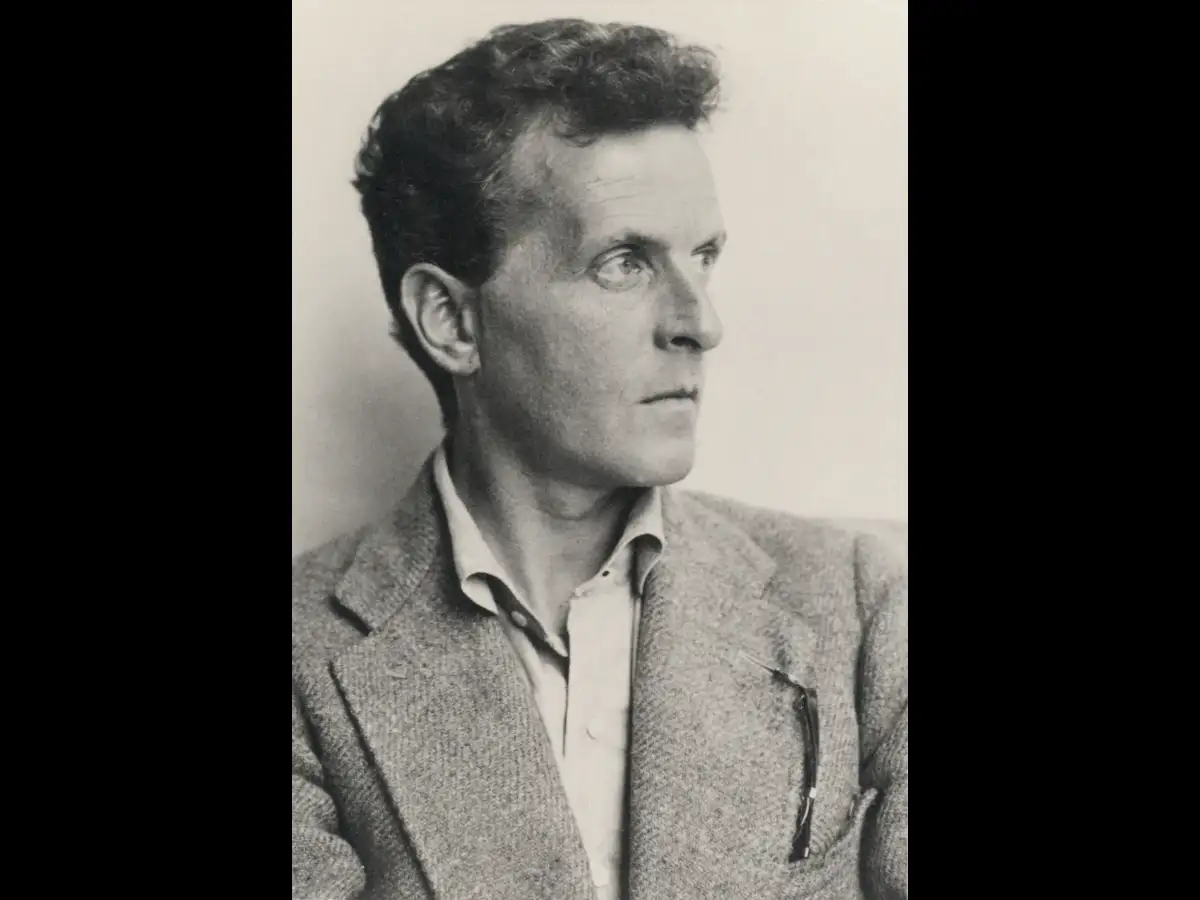
Intelligence can take us into complicated questions, but Ludwig Wittgenstein's striking metaphor suggests that there is a point when endless intellectual sophistication can distance us from the ordinary experiences that make life meaningful.
“Never stay up on the barren heights of cleverness, but come down into the green valleys of silliness.”

The image is characteristically Wittgensteinian: cleverness is a high, barren place; silliness is a green valley. Rather than simply praising ignorance or foolishness, the quote can be read as a warning against becoming so absorbed in intellectual complexity that one loses contact with spontaneity, humour, ordinary language and everyday human experience.
Who was Ludwig Wittgenstein?
Ludwig Wittgenstein was born on April 26, 1889, in Vienna, into a wealthy Austrian industrial family deeply connected to the city's artistic and intellectual world. He initially studied aeronautical engineering at Manchester before becoming increasingly interested in mathematics and its philosophical foundations. His work eventually brought him into contact with Gottlob Frege and, later, Bertrand Russell at Cambridge.
Wittgenstein became one of the most influential and difficult philosophers of the 20th century. His first major book, Tractatus Logico-Philosophicus , was written largely during and around his service in the First World War and published after the war. The work investigated the relationship between language, thought and reality and attempted to identify the limits of what could meaningfully be said.
What makes Wittgenstein particularly unusual is that he later challenged important aspects of the philosophical approach he had developed in the Tractatus . His later work, especially Philosophical Investigations , shifted attention toward ordinary language and the different ways words function in human activities.
His idea of “language-games” emphasized that language cannot be understood simply as a system for describing facts; its meaning depends heavily on how words are used within particular forms of life.
His intellectual journey was also unconventional. After the First World War, believing he had largely resolved the problems that concerned him, Wittgenstein gave away his inherited fortune and worked for periods as a schoolteacher, gardener and architect before returning to Cambridge in 1929. He spent much of his later career teaching and writing there.
Wittgenstein died in Cambridge in 1951, leaving behind a body of work that continued to shape philosophy, particularly debates surrounding language, meaning, mind, ethics and knowledge.
Quote of the day by Ludwig Wittgenstein
“Never stay up on the barren heights of cleverness, but come down into the green valleys of silliness.”
The quote presents cleverness as something that can become sterile when pursued for its own sake. A person may become extremely skilled at analysing, debating, correcting or intellectualising everything, yet still become detached from the ordinary world around them.
The word “barren” is important. A mountain peak may represent intellectual achievement, but if nothing grows there, it cannot sustain life. Wittgenstein contrasts that image with “green valleys”, suggesting warmth, growth, movement and ordinary experience.
“Silliness,” therefore, does not necessarily mean stupidity. It can represent the freedom to laugh, play, make mistakes, speak naturally and experience things without constantly turning them into intellectual problems.
What does Wittgenstein mean by ‘cleverness’?
Wittgenstein spent much of his philosophical life examining how people become confused by language and by the assumptions hidden inside seemingly straightforward questions. His later philosophy particularly emphasized looking carefully at how words actually function in everyday life.
Seen in that context, the quote can be understood as a reminder that not every aspect of life needs to be conquered intellectually.
There is value in knowing when to stop analysing and simply participate: laugh at something ridiculous, enjoy a conversation, appreciate art, play with a child or admit that you do not have an answer.
The “green valleys” are therefore a metaphor for humility and lived experience. Wittgenstein's message is not that intelligence is undesirable, but that intelligence becomes limiting when it prevents a person from experiencing the uncomplicated parts of life.
More memorable quotes by Ludwig Wittgenstein
“The limits of my language mean the limits of my world.”
“Whereof one cannot speak, thereof one must be silent.”
“A picture held us captive.”
“The meaning of a word is its use in the language.”
“Philosophy is a battle against the bewitchment of our intelligence by means of language.”