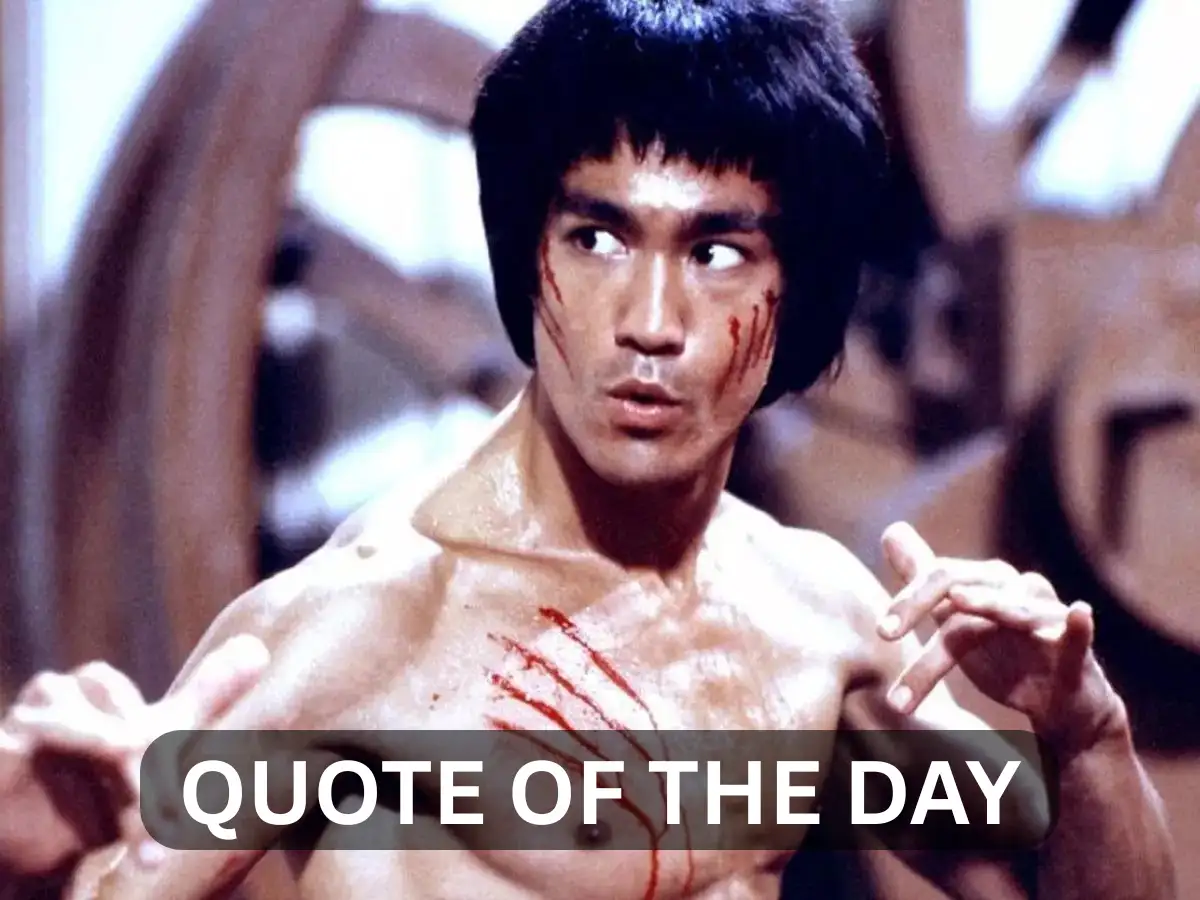
Quote of the day by Bruce Lee continues to inspire people across the world decades after his death. The martial arts actor, philosopher, and filmmaker spoke about discipline, learning, and self-understanding through many of his teachings. One of his widely discussed quotes says, “Art calls for complete mastery of techniques, developed by reflection within the soul.” The statement explains the relationship between technical skill and inner understanding. It also shows why Bruce Lee became more than a martial arts star. His words remain connected to learning, success, self-improvement, and human nature even today.

Quote of the day today
The quote is,
“Art calls for complete mastery of techniques, developed by reflection within the soul.”
Bruce Lee quote explains mastery and self-reflection
The quote, “Art calls for complete mastery of techniques, developed by reflection within the soul,” focuses on two important ideas. The first is mastery of techniques. The second is reflection within the soul. Bruce Lee explained that learning a skill is not enough on its own. A person must continue practicing until the technique becomes natural. At the same time, the person must understand emotions, thoughts, discipline, and purpose. According to the quote, true mastery comes when practice and inner reflection work together.
The quote is relevant in education, sports, business, music, writing, acting, and martial arts. Students may connect the quote to studies and preparation. Athletes may relate it to training and focus. Artists may see it as a reminder that creativity grows through experience and understanding. The statement also reflects human nature. Many people search for success only through external achievements. Bruce Lee’s words suggest that growth also requires self-awareness and reflection.
Life lessons people can learn from the quote
Bruce Lee’s quote offers several life lessons connected to learning, success, and personal development. One lesson is that discipline matters. Mastery takes time and repeated effort. Skills improve only through practice and patience. Another lesson is the importance of reflection. People often focus on speed and results. Bruce Lee’s message reminds people to think deeply about their goals, mistakes, and actions.
The quote also teaches balance. Technical ability without emotional understanding may not lead to complete growth. Bruce Lee believed that mind and body should work together. The message can also help young people who feel pressure to succeed quickly. Bruce Lee’s words show that progress is a long process that combines training with self-understanding. The quote remains relevant in modern society because many industries now value creativity, emotional intelligence, and problem-solving alongside technical skills.
Early life of Bruce Lee
Bruce Lee was born on November 27, 1940, in San Francisco. His Chinese name was Li Jun Fan. Although he was born in the United States, he grew up in Hong Kong. Bruce Lee entered the entertainment industry at a young age because his father worked as an opera singer and part-time actor. Lee appeared in films as a child actor and often played juvenile delinquent or street-child roles.
During his teenage years, he became involved in street fights and local gangs. To defend himself, he started learning kung fu. He also took dance lessons, which improved his balance and footwork. In 1958, Bruce Lee won the Hong Kong cha-cha championship. His parents later became worried about his fights and issues with police. After he turned 18, they sent him to the United States to continue his education and build a different future.
Bruce Lee’s journey in martial arts and acting
Bruce Lee lived in Seattle with family friends after moving to the United States. He completed high school and later studied philosophy and drama at the University of Washington. While living in Seattle, he opened his first martial arts school. In 1964, he moved to Oakland and started a second school.
Around that time, Bruce Lee developed jeet kune do, his own martial arts philosophy and fighting system. It combined kung fu, fencing, boxing, and philosophy. Instead of following only traditional martial arts methods, Lee focused on efficiency and adaptability.
His martial arts demonstration at a karate tournament in the Los Angeles area attracted television producers. This opportunity helped him secure the role of Kato in the television series The Green Hornet from 1966 to 1967. After the series ended, Bruce Lee faced difficulty finding acting roles in Hollywood. He supported himself by teaching jeet kune do lessons to celebrities, including Steve McQueen.
Bruce Lee’s rise to international fame
Bruce Lee gained attention in the 1969 film Marlowe through a fight scene that displayed his martial arts skills. Frustrated with limited Hollywood opportunities, Lee returned to Hong Kong in 1971. His films there achieved commercial success across Asia.
His movies included The Big Boss and Fist of Fury. These films later became successful in the United States as well. Bruce Lee later formed his own production company. He worked as producer, director, writer, and actor for The Way of the Dragon. His next film, Enter the Dragon, became the first major collaboration between Hong Kong and U.S. production companies. The film turned Bruce Lee into an international star.
However, Bruce Lee died on July 20, 1973, in Hong Kong at the age of 32, just days before the Hong Kong release of Enter the Dragon. The official cause of death was listed as swelling of the brain caused by an allergic reaction to headache medication. At the time of his death, he had been working on Game of Death, which was later completed using stand-ins and released in 1978.
Bruce Lee’s impact on culture and cinema
Bruce Lee became one of the biggest pop culture figures of the 20th century after his death. His films developed a global following, and many people credit him with changing how Asians were represented in American cinema.
In 1993, the film Dragon: The Bruce Lee Story presented a fictionalized version of his life. His son, Brandon Lee, also entered acting but died during the filming of The Crow after a prop gun accident. Even decades later, Bruce Lee’s philosophy, quotes, films, and martial arts teachings continue to influence people around the world. His quote about mastery and reflection remains connected to personal growth, success, discipline, learning, and human nature.