Failing is one of those few experiences that most people have in common. It can take many shapes: a job interview that leads nowhere, an exam that fails to meet expectations, an idea for a business that goes nowhere, a personal target that eludes us no matter how many months we spend trying to reach it. At those times, it becomes very tempting to think that failure tells us something about ourselves.
Get breaking news anytime, anywhere. Download the TOI app now!

But there have been instances where history takes a different turn. Many of the most successful people in the world, be it as leaders, entrepreneurs, athletes, or even innovators, have always acknowledged the significance of failure, though not necessarily because they enjoyed it, but because it marked a milestone. The lessons they learned from failing usually outweigh the achievements they made afterwards.
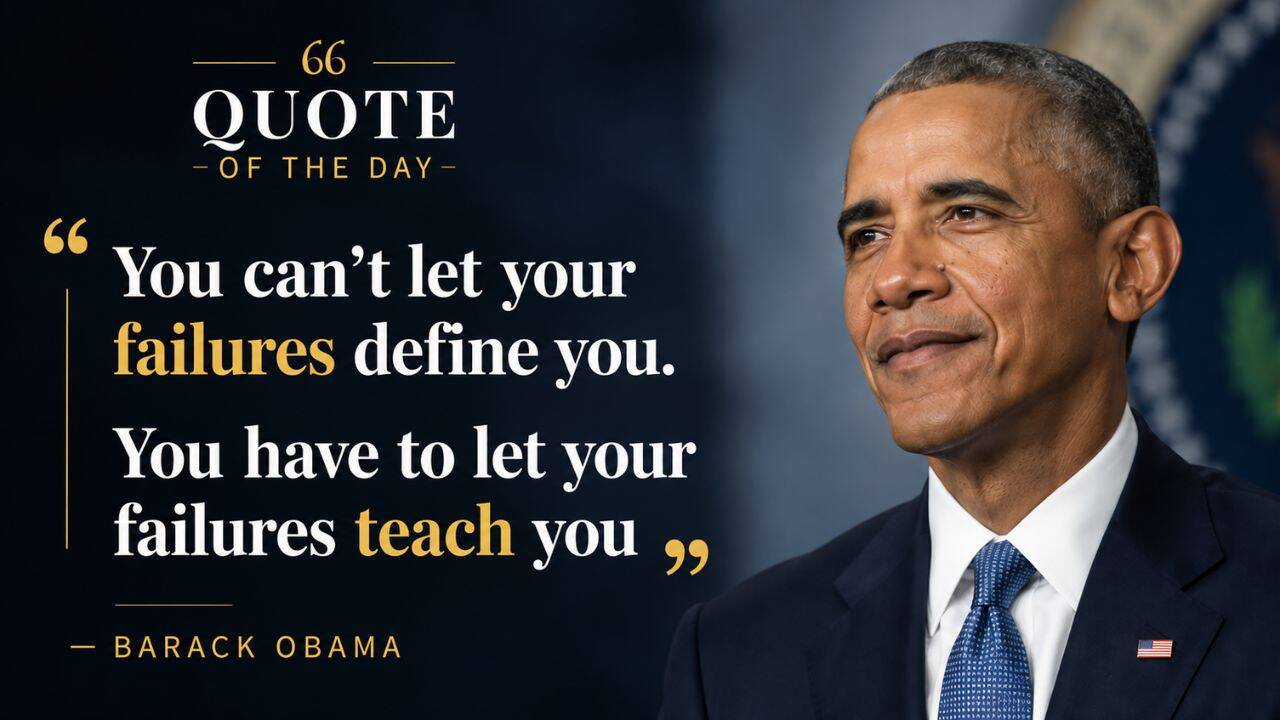
One such example could be Barack Obama, the former president of the United States of America. Throughout his career, he has talked a lot about resilience and perseverance and how important it is to keep going even when things are not falling into place. One of the most popular quotes attributed to him states, "You can't let your failures define you. You have to let your failures teach you." The quote still holds relevance decades later simply because it resonates with all of us in some way or another.
Quote of the Day
"You can't let your failures define you. You have to let your failures teach you." — Barack Obama
At first glance, the quote appears straightforward, but its message reaches far beyond simply staying positive after something goes wrong.
Obama is not suggesting that failure should be ignored or brushed aside. Instead, he encourages people to view setbacks as opportunities to learn. A mistake, disappointment or defeat does not have to become part of a person's identity. What matters more is the response that follows.
Rather than asking whether someone has failed, the quote asks a different question: What did that experience teach you? That shift in perspective is what has made the message relevant to students, professionals, business leaders and anyone trying to achieve a difficult goal.
What the quote really means
The heart of Obama's message is that failure is information, not a final verdict.
People often judge themselves by a single disappointing moment. A rejected application can make someone question their abilities. A failed business can lead an entrepreneur to doubt years of hard work. In reality, most successful careers are shaped by repeated adjustments rather than uninterrupted victories.
Learning from failure requires honesty. It means recognising what could have been done differently, accepting criticism when it is justified and making changes instead of repeating the same mistakes. That process is rarely comfortable, but it is often where meaningful growth begins.
The quote also challenges the fear of failure itself. Many people avoid taking risks because they worry about what others might think if things go wrong. Obama suggests that the greater risk may be allowing fear to prevent progress altogether.
How Barack Obama's own life reflected this message
His political career is full of examples of the philosophy that Obama espoused through his speeches.
For instance, prior to becoming a prominent politician in the country, Obama engaged in community organising in Chicago. It was not only an effort that required patience and perseverance but also helped him to familiarise himself with the challenges of uniting various communities with various agendas and expectations. All those aspects contributed to his political ideology before entering the White House.
One of the major blows that he received in his political career took place in 2000. At that time, he lost his bid for winning in the primary election against the incumbent congressman Bobby Rush.
However, he did not give up his attempts at politics but tried to learn from the mistakes he made. Even after reaching the White House, setbacks did not disappear. Obama governed during the aftermath of the global financial crisis, faced deeply divided political debates and encountered legislative defeats on several issues. While not every initiative succeeded, his public remarks frequently returned to the importance of persistence, compromise and learning from experience rather than expecting perfection.
Lessons from Obama's career
The relevance of President Obama's quote is because of the fact that the statement captures a trend observable throughout his political career.
Progress is not always a straightforward one for any individual or organization, especially when it comes to political campaigns where there is an element of winning and losing on a daily basis, or in making difficult policy decisions that may entail changes in plans and compromises. Progress is all about making mistakes and learning from those mistakes and doing what you can to solve the problem at hand.
Another important point made by Obama is the need to surround oneself with people who can give constructive criticism to help you learn. Failure can be much more painful when a leader does not want to listen to criticism.
Resilience is another very important quality.
These ideas extend well beyond politics. Whether someone is starting a business, preparing for an examination or pursuing a creative career, the ability to adapt after setbacks can become one of the most valuable skills they develop.
Why this quote still matters today
In the modern world, success receives a lot of praise while failures, which precede it, are seldom mentioned.
For instance, social networks glorify only successes, promotions, and important milestones but ignore rejections, failed interviews, and abandoned projects that may precede them. Therefore, many people think that successful people face fewer failures than others.
Obama's quote brings into focus the fact that setbacks are very common phenomena that accompany every significant way of life.
Students use disappointment as a push towards working harder, entrepreneurs can understand what consumers really want after their products' unsuccessful release, and professionals learn how to do better through constructive feedback.
It does not mean that failure will guarantee success; it means that failure is often a stepping stone for success.
What can you learn from Barack Obama's quote
Obama's words remind us that failure is not something to be feared but something to be understood. Every setback carries information that can help us make better decisions, develop new skills and approach future challenges with greater confidence.
Another important lesson is the value of resilience. Bouncing back from disappointment does not mean pretending nothing happened. It means acknowledging the setback, learning from it and refusing to let it become the final chapter of the story.
The quote also encourages people to adopt a long-term perspective. Success rarely happens overnight, and most meaningful achievements are built through repeated attempts, adjustments and perseverance. Progress often comes from small improvements made after every mistake rather than from getting everything right on the first try.
Perhaps the most enduring lesson is that our response to failure matters more than the failure itself. While setbacks are often beyond our control, the decision to learn, adapt and keep moving forward is always within our hands. That mindset is what transforms disappointment into an opportunity for growth.
A common misunderstanding
One misconception about Obama's quote is that it encourages people to treat failure lightly.
That is not the message.
Failure can be painful. It may involve financial loss, emotional disappointment or years of effort that do not produce the expected outcome. Ignoring those realities would oversimplify the experience.
The quote instead argues that failure should not become a permanent label. A setback does not define a person's abilities, character or future potential unless they allow it to.
Learning requires reflection. It involves understanding what happened, identifying areas for improvement and approaching the next opportunity with greater knowledge than before.
In that sense, failure becomes valuable not because it happens, but because of what people choose to do afterwards.