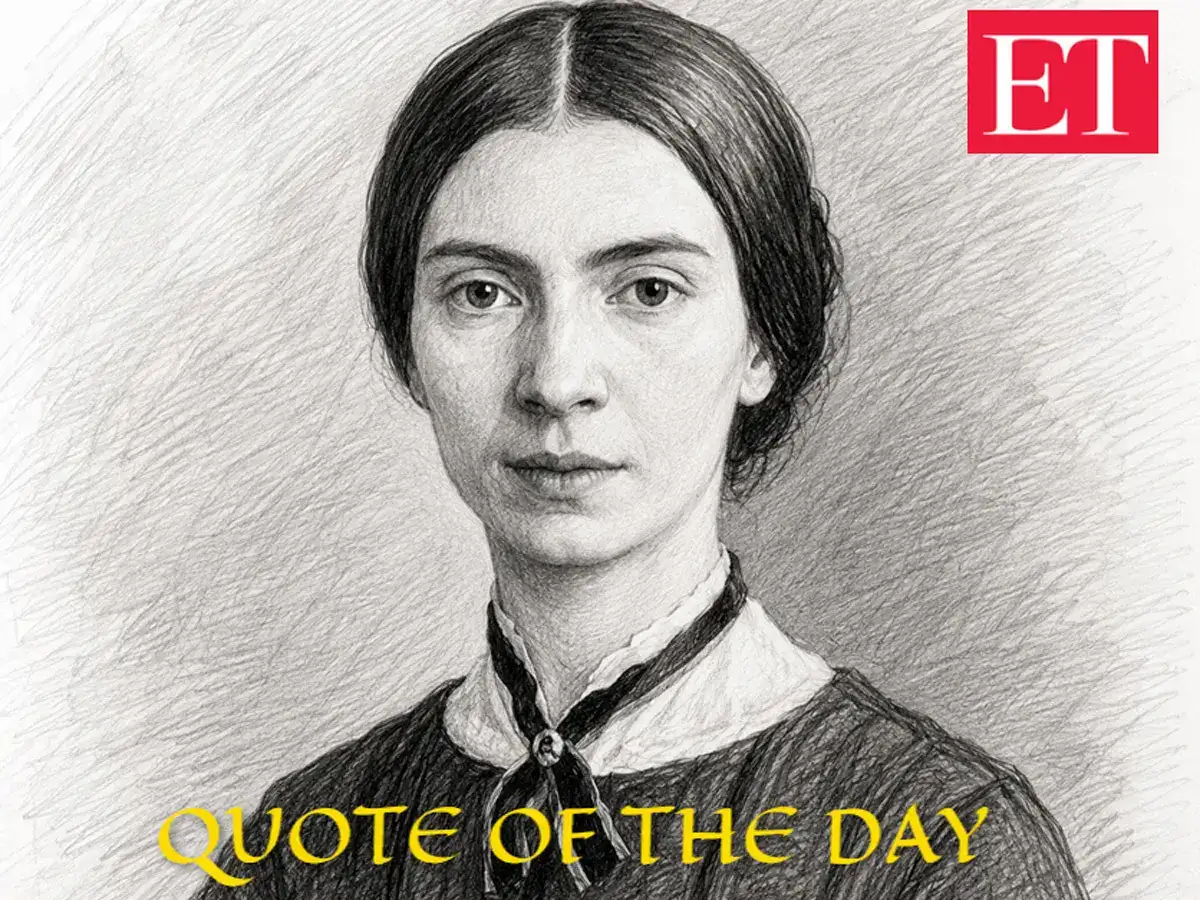
Quote of the Day: In the world of poetry, few voices have captured the mystery of life, time, and human emotion as deeply as Emily Dickinson. Known for her quiet life and extraordinary imagination, Dickinson transformed simple observations into powerful reflections on existence. Her quote of the day is a beautiful reminder that the temporary nature of life is exactly what makes every moment precious.

Emily Dickinson’s Powerful Quote About Life
The quote of the day reads:
“That it will never come again is what makes life so sweet.”
― Emily Dickinson
This simple yet profound line continues to resonate because it touches on something universal. Dickinson suggests that moments become meaningful not because they last forever, but because they cannot be repeated. The passing of time is not only a reminder of loss, but also the reason we should appreciate what we have.
What Did Emily Dickinson Mean by This Quote?
Emily Dickinson’s words reveal a deep understanding of the relationship between time and value. Human beings often wish moments could last forever, whether it is a joyful memory, a special connection, or a peaceful day. However, Dickinson points out that permanence might actually take away some of the beauty.
A sunset is beautiful because it disappears. A childhood memory feels precious because it belongs to a specific moment that can never return. A meaningful conversation becomes unforgettable because it happened only once.
Through this quote, Dickinson encourages people to recognize the importance of the present. Instead of chasing endless repetition, she invites us to see the extraordinary nature of ordinary experiences.
Life’s most valuable moments often pass quietly. A smile from someone we love, a walk through nature, a conversation with a friend, or a small personal achievement may seem simple at the time. Years later, those moments can become some of our most treasured memories.
Why Does Emily Dickinson Believe Impermanence Makes Life Beautiful?
Dickinson’s poetry often explored themes of death, eternity, nature, solitude, and the human soul. She was fascinated by the contrast between what disappears and what remains.
The idea behind this quote connects to one of her recurring themes: the awareness that life is fragile. Because nothing stays exactly the same, every experience carries a unique emotional weight.
If every moment could be repeated forever, people might stop noticing its importance. The limited nature of time gives experiences their emotional power. A person appreciates a season because it changes. They value a relationship because it requires care. They remember a moment because it happened only once.
Dickinson’s perspective is not about sadness. Instead, it is about awareness. She transforms the idea of things ending into a reason to love them more deeply.
The Life and Legacy of Emily Dickinson
Emily Dickinson was born on December 10, 1830, in Amherst, Massachusetts. She grew up in a respected family and developed a passion for reading, writing, science, and philosophy from an early age, as per the Poetry Foundation.
Unlike many famous writers, Dickinson lived much of her life away from public attention. She spent years in relative isolation, writing hundreds of poems that explored themes of identity, nature, love, faith, and mortality.
During her lifetime, only a small number of her nearly 1,800 poems were published. Many of her works remained hidden until after her death in 1886, when her family discovered her manuscripts, as per the Poetry Foundation.
Her unique style made her one of the most important poets in American literature. She often used short lines, unusual punctuation, and unexpected images to express complex ideas. Her poems were brief but carried enormous emotional depth.
Alongside Walt Whitman, Dickinson is considered one of the defining poetic voices of 19th-century America. While Whitman celebrated the vastness of humanity and the natural world, Dickinson often examined the inner life, capturing the quiet struggles and discoveries of the individual mind.
How Did Dickinson’s Personal Life Shape Her Writing?
Dickinson’s private world greatly influenced her poetry. She was deeply observant and found inspiration in small details around her home, garden, and relationships.
Although she lived a quiet life, her poems reveal a mind constantly exploring huge questions. She wrote about love, loss, immortality, loneliness, and the mysteries of existence.
Her limited public presence did not mean her world was small. Instead, her imagination traveled through ideas that were larger than everyday experience.
Many readers connect with Dickinson because she expressed emotions that are difficult to explain. Her poetry gives language to moments of uncertainty, wonder, hope, and reflection.
The Lasting Meaning of Emily Dickinson’s Words
More than a century after her death, Emily Dickinson’s poetry remains powerful because her observations about life still feel personal and relevant.
Her quote, “That it will never come again is what makes life so sweet,” offers a timeless lesson about gratitude. It reminds us that the temporary nature of life is not something to fear. It is what gives memories, relationships, and experiences their special meaning.
The moments we cannot recreate often become the ones we remember most.
Emily Dickinson understood that life’s beauty comes from its movement. Nothing stays forever, and perhaps that is exactly why every moment matters.