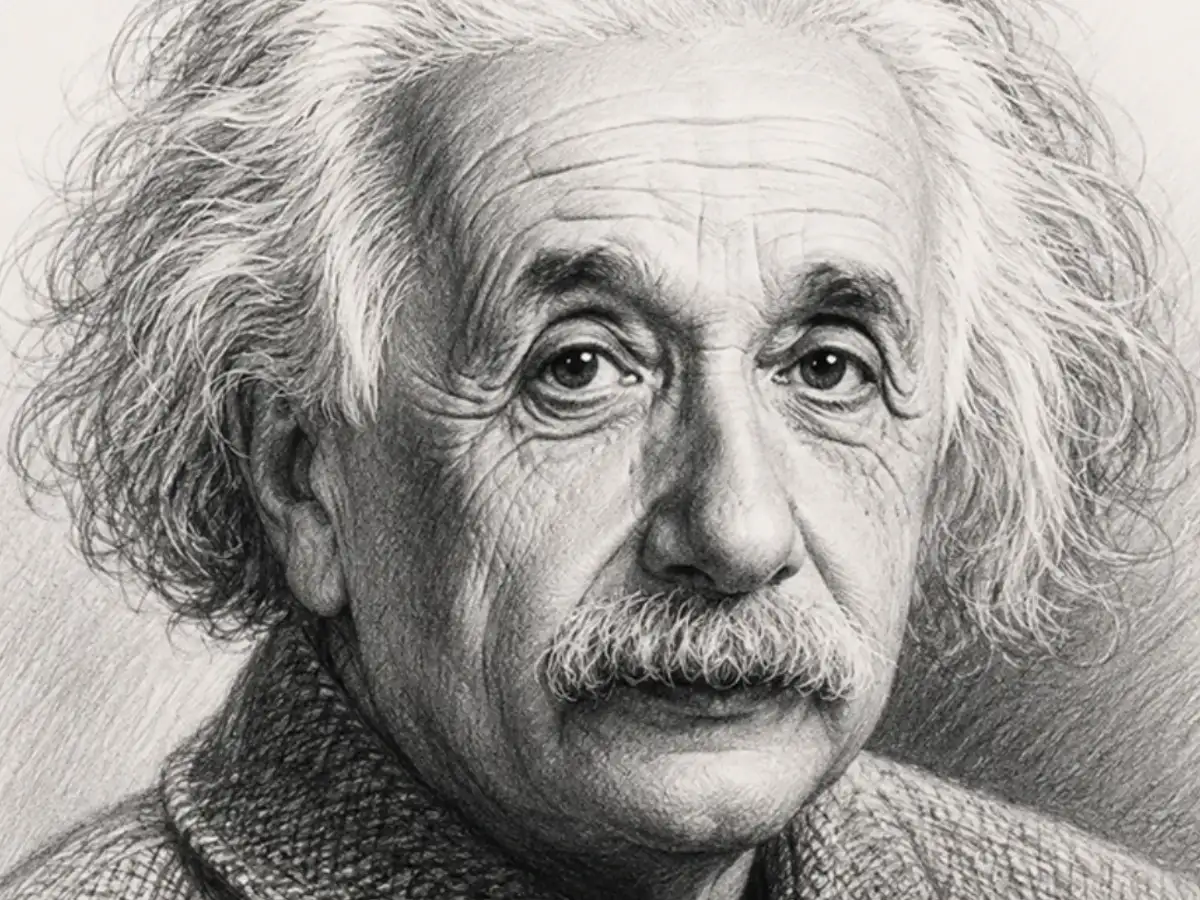
Quote of the day by Albert Einstein — ‘I never think of the future — it comes soon enough.’ The saying is linked with the idea of staying focused on the present instead of spending too much time thinking about what may happen tomorrow. Worry about the future can take attention away from the tasks that can be handled today. The quote also connects with mindfulness, action, mental clarity and peace. It suggests that people cannot control the arrival of the future, but they can decide how they use their time and energy in the present.

A quote about living in the present
The saying focuses on a common problem: excessive worry about the future. People often think about events that have not happened. They may repeatedly consider possible problems, outcomes or situations. Such thinking can make it difficult to focus on what is happening now.
The central idea is not that people should ignore the future. Planning can help people prepare for responsibilities and make decisions. The message is about avoiding unnecessary worry over events that cannot yet be controlled.
The future will arrive without requiring constant mental attention. Instead of repeatedly thinking about what could happen, people can focus on actions that are possible today.
Meaning of the quote
The saying can be understood through three main ideas:
- Live in the present: People can focus on what is happening now rather than repeatedly thinking about events that have not happened.
- Accept the inevitable: The future will arrive whether or not a person spends time worrying about it.
- Save your energy: Time and effort can be directed toward work, decisions and responsibilities that can be handled today.
This approach can also help people separate planning from overthinking. Planning involves deciding what action to take. Overthinking can involve repeatedly considering the same possibility without taking action.
Quote of the day by Albert Einstein and its relevance today
The idea behind the saying remains relevant to daily life. People may worry about work, studies, money, relationships, health, responsibilities or future decisions. Thinking about these subjects can sometimes help with preparation. However, repeated worry does not necessarily change the outcome.
The quote encourages a person to identify what can be done in the present. For example, someone preparing for an examination can spend time studying rather than repeatedly worrying about the result. A person facing a work deadline can divide the task into smaller steps and begin working on them.
This creates a distinction between action and anxiety. Action deals with something that can be done. Anxiety about an uncertain future can continue even when no additional action is possible.
Background of the saying
The supplied background states that the saying was first recorded in a newspaper in Syracuse, New York, in 1938. It was later popularised by columnist Walter Winchell in 1944.
This background places the quote in a period when Einstein was already known internationally for his work in physics. The saying later became associated with discussions about worry, time and living in the present.
The quote is often presented as a statement about future thinking. Its message can be applied to everyday situations where people spend more time imagining possible outcomes than dealing with the tasks in front of them.
Who was Albert Einstein?
Albert Einstein was born on March 14, 1879, in Ulm, Württemberg, now part of Baden-Württemberg, Germany. He died on April 18, 1955, in Princeton, New Jersey, at the age of 76.
He was a German-born physicist who developed the special and general theories of relativity. He received the Nobel Prize for Physics in 1921 for his explanation of the photoelectric effect.
Einstein is widely regarded as an influential physicist of the 20th century. His work covered subjects including relativity, Brownian motion, gravitation, light, mass-energy equivalence, photons and space-time. His mass-energy relation is commonly written as E=mc². He also received the Copley Medal in 1925.
Einstein’s childhood and early interest in science
Einstein’s parents were secular, middle-class Jews. His father, Hermann Einstein, first worked as a featherbed salesman and later ran an electrochemical factory. His mother, Pauline Koch, managed the family household.
Einstein had one sister, Maria, who was known as Maja. She was born two years after him. Two experiences influenced Einstein during his childhood. At the age of five, he encountered a compass. He was interested in the fact that an invisible force could move the needle. This became one of his early experiences with the idea that forces could exist without being visible.
At the age of 12, he discovered a book about geometry. He studied it closely and later referred to it as his “sacred little geometry book.” Einstein also went through a period of strong religious interest at the age of 12. He composed songs about God and sang religious songs while going to school. His views later changed after he read science books that challenged his earlier beliefs.
Education and the question about light
At the Luitpold Gymnasium, Einstein did not feel comfortable with the Prussian-style education system. He believed it limited originality and creativity. One teacher reportedly told him that he would not amount to anything.
Another important influence was Max Talmud, later known as Max Talmey. Talmud was a medical student who often had dinner with the Einstein family. He introduced Einstein to higher mathematics and philosophy.
When Einstein was 16, Talmud introduced him to a science series by Aaron Bernstein. The books described scientific ideas through imagined experiences, including travelling alongside electricity in a telegraph wire.
This led Einstein to consider a question that remained important to him for years: what would a light beam look like if someone could travel alongside it? He also wrote what he considered his first scientific paper around this period. It was titled “The Investigation of the State of Aether in Magnetic Fields.”
School disruption and move to Switzerland
Einstein’s education was affected by his father’s business problems. In 1894, Hermann Einstein’s company failed to secure an important contract to electrify Munich. He then moved to Milan to work with a relative.
Einstein remained in Munich at a boardinghouse to continue his education. He was unhappy and was also concerned about compulsory military service. Six months later, he left Munich and went to his parents in Milan.
At that point, he had left school and faced problems connected with military service and his lack of formal qualifications. He later applied directly to the Swiss Federal Polytechnic School in Zürich. He did not have the equivalent of a high school diploma but was allowed to take the entrance examination.
Einstein performed strongly in mathematics and physics but failed French, chemistry and biology. Because of his mathematics results, he was allowed to enter the polytechnic after completing his formal schooling.
He attended a school run by Jost Winteler in Aarau, Switzerland, and graduated in 1896. He also renounced his German citizenship and remained stateless until receiving Swiss citizenship in 1901.
Years in Zürich and people who influenced Einstein
Einstein later remembered his years in Zürich as some of the happiest years of his life. He developed friendships with people including mathematician Marcel Grossmann and Michele Besso. He and Besso had long discussions about space and time. Einstein also met Mileva Marić, a physics student from Serbia who later became his wife.
The Winteler family also became important to Einstein. He lived with the family while studying in Aarau. Marie Winteler became his first love. His sister Maja later married Paul Winteler, while Michele Besso married Anna Winteler.
Life lessons from the quote
The saying can be connected with several practical lessons:
- Focus on today: Deal with the task that can be completed now.
- Separate planning from worry: Prepare for future situations without repeatedly imagining negative outcomes.
- Take action: If something can be changed today, work on it instead of only thinking about it.
- Protect mental clarity: Constant thoughts about uncertain events can make it harder to concentrate.
- Accept uncertainty: Some future events cannot be controlled or predicted.
- Use time carefully: Time spent worrying can instead be used for learning, working or solving a current problem.
- Find peace in the present: Paying attention to current experiences can reduce the habit of constantly thinking ahead.
- Avoid overthinking: Not every possible future problem needs an answer today.
The broader message is about balance. Thinking about tomorrow can help with planning, but excessive worry can take attention away from the present. The quote therefore encourages people to deal with what they can control while accepting that the future will arrive in its own time.