
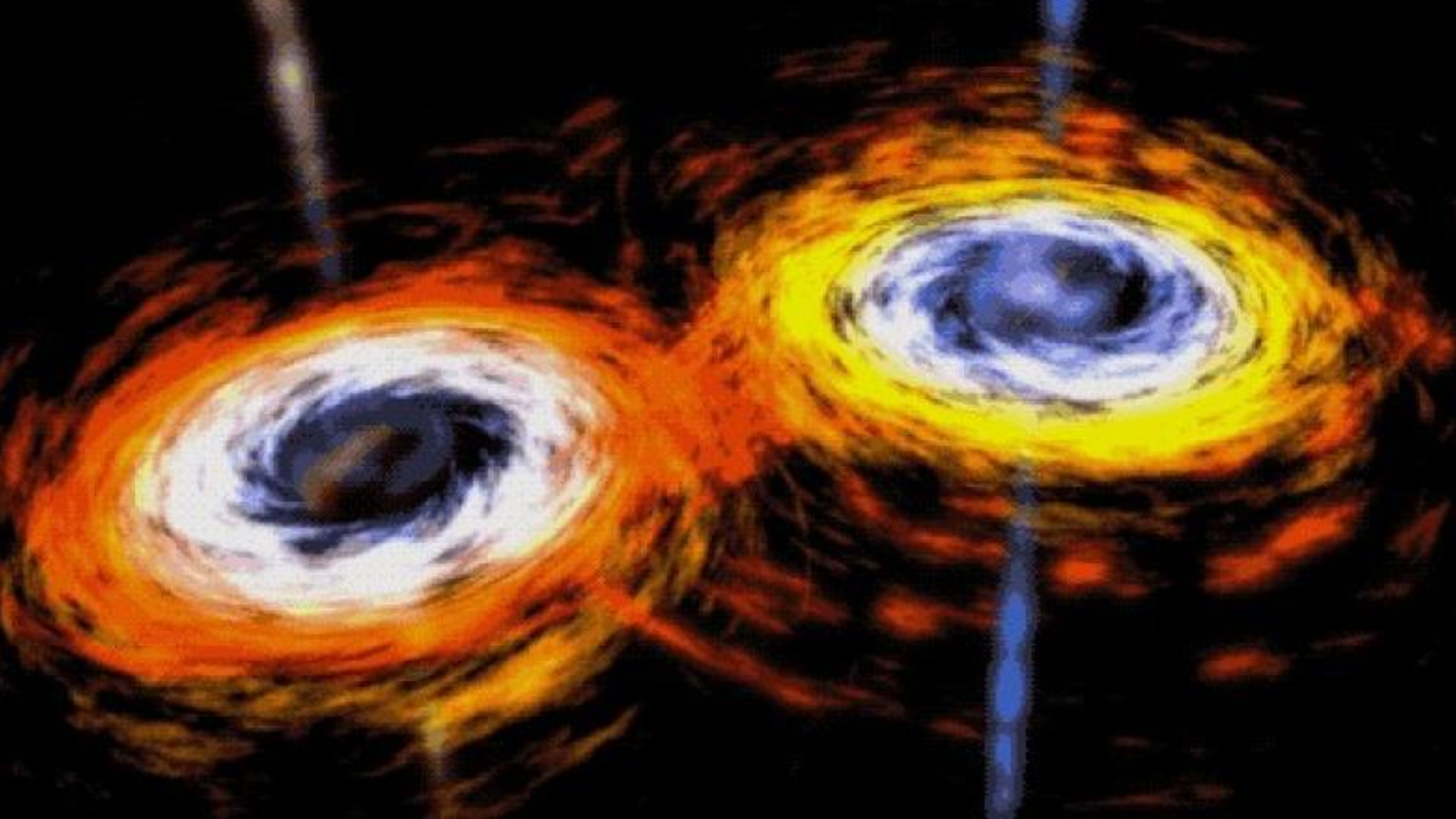
Quasars, the brightest objects in the cosmos, could act as cosmic signposts, directing astronomers to elusive pairs of supermassive black holes.
Though scientists are aware that supermassive black holes with masses of millions or even billions of times that of the sun lurk at the heart of most, if not all, large galaxies, binary pairings of these cosmic titans have been difficult to detect. That can't be because supermassive black hole binaries are incredibly rare. After all, these behemoths form through mergers that begin when galaxies collide. That means there must be a large population of supermassive black hole binaries out there that are on the cusp of colliding and creating an even more monstrous daughter supermassive black hole. But where are they?
New research suggests that quasars — the luminous hearts of active galaxies, which are powered by feeding supermassive black holes — could be the answer to that question. The team behind the research thinks that galaxies with quasars could be seven times more likely to host supermassive black hole binaries than other galaxies.