Get all your news in one place.
100's of premium titles.
One app.
Start reading
The Conversation
The Conversation
Csanád Horváth, PhD Candidate, Radio Astronomy, Curtin University

Puzzling slow radio pulses are coming from space. A new study could finally explain them

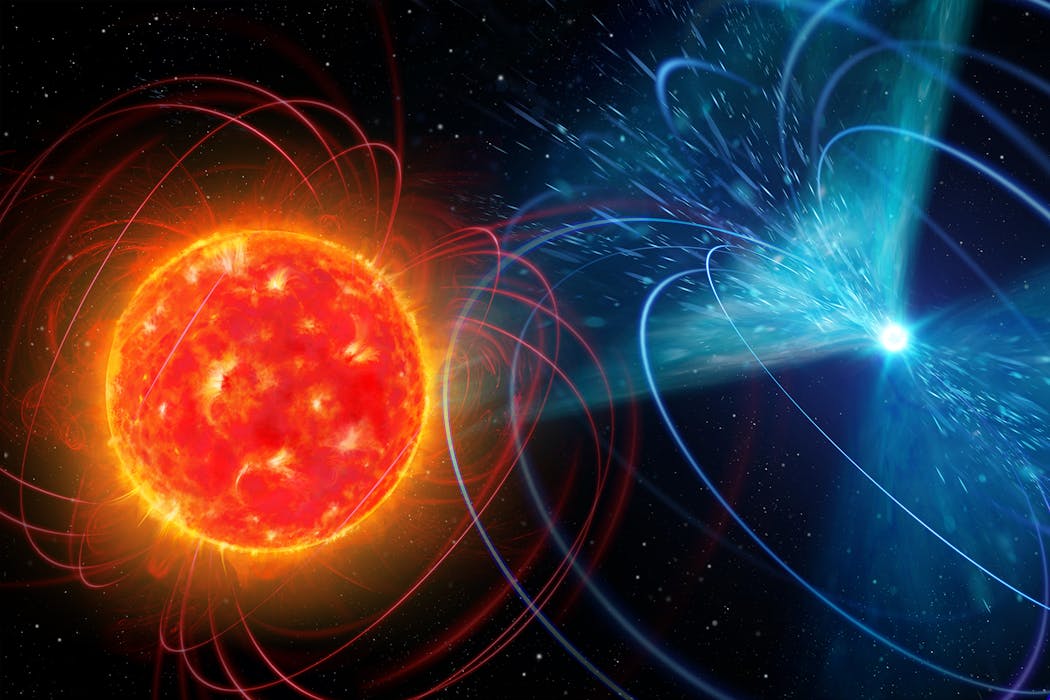
Artists impression of the white dwarf in GPM J1839-10 interacting with its companion star, producing a powerful radio beam. Danielle Futselaar

Cosmic radio pulses repeating every few minutes or hours, known as long-period transients, have puzzled astronomers since their discovery in 2022. Our new study, published in Nature Astronomy today, might finally add some clarity.

Radio astronomers are very familiar with pulsars, a type of rapidly rotating neutron star. To us watching the skies from Earth, these objects appear to pulse because powerful radio beams from their poles sweep our telescopes – much like a cosmic lighthouse.

Sign up to read this article
Read news from 100's of titles, curated specifically for you.
Already a member? Sign in here
Related Stories
Top stories on inkl right now
One subscription that gives you access to news from hundreds of sites
Already a member? Sign in here
Our Picks
Fourteen days free
Download the app
One app. One membership.
100+ trusted global sources.