
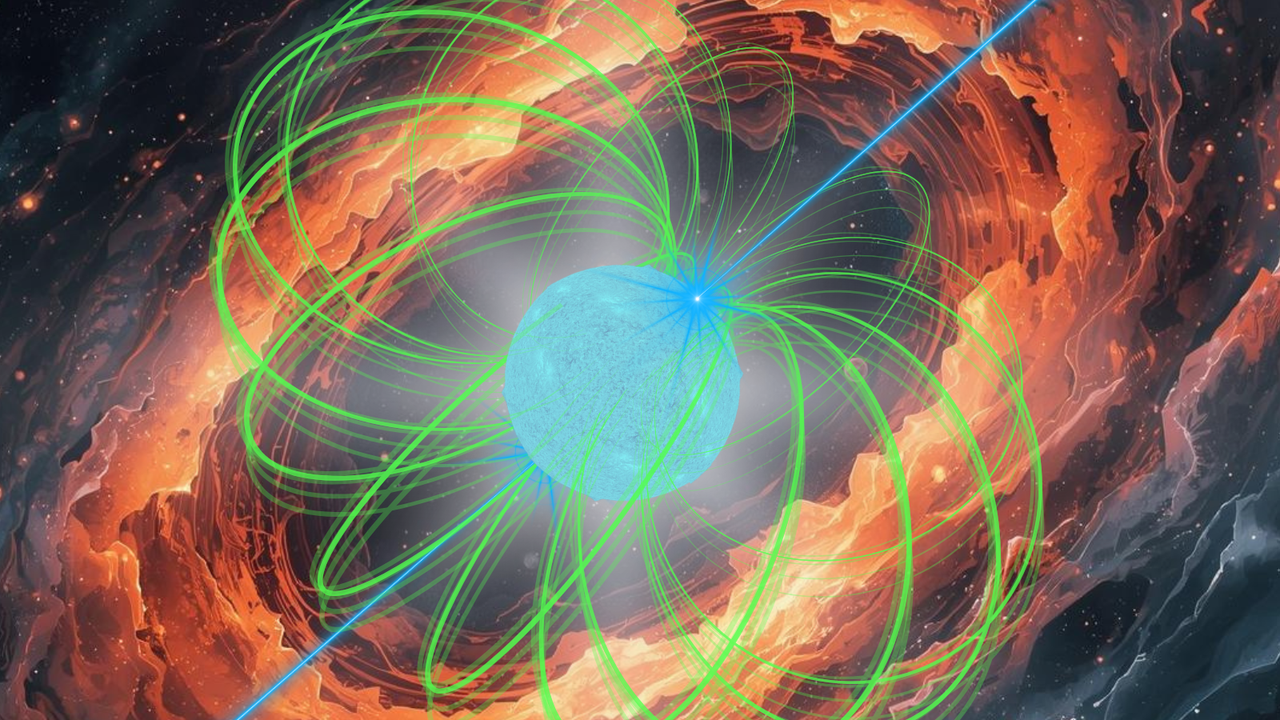
Astronomers have discovered that rapidly spinning dead stars called neutron stars at the heart of pulsars can blast out radio signals from their edges. The finding could overturn decades of thinking suggesting that pulsars only blast beams of radiation from close to their surfaces and at their poles.
Pulsars, like all neutron stars, are created when massive stars run out of fuel needed for their internal nuclear fusion process and thereby collapse, forming a stellar remnant with matter so dense that if a teaspoon of it were brought to Earth, it would weigh around 10 million tons. This collapse also generates the universe's most powerful magnetic fields — and, like the cosmic equivalent of an ice skater drawing in their arms to increase their speed, the collapse can also speed up the spin of neutron stars to as much as 700 times a second.