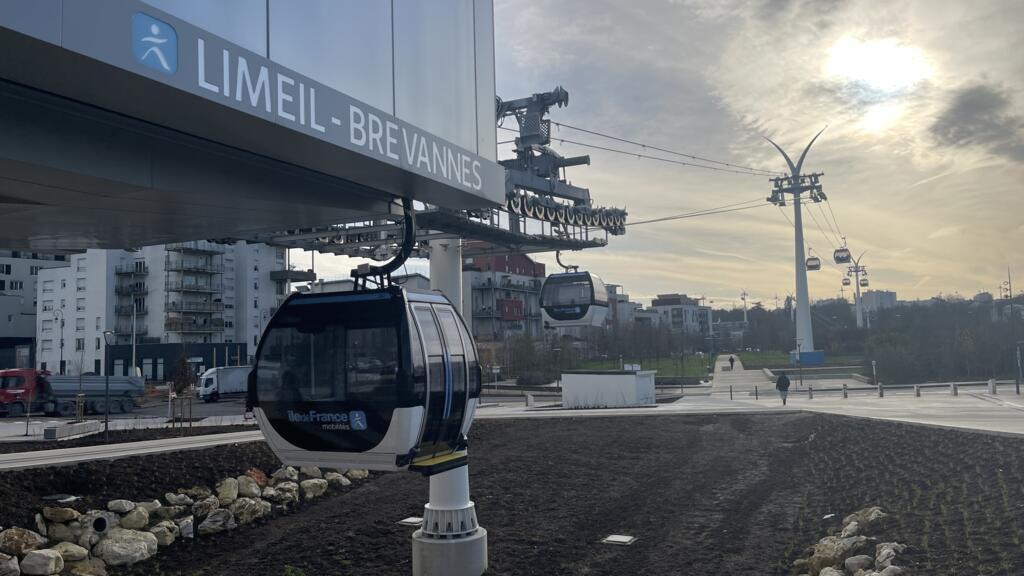
Limeil-Brévannes – The first urban cable car in Greater Paris was unveiled on 13 December, offering a faster link between isolated neighbourhoods and Paris Métro line 8. The 4.5-kilometre line, which includes five stations, is the longest urban cable car in Europe.
French authorities officially inaugurated the C1 cable car line on 13 December in Limeil-Brévannes, a suburb south of Paris.

Stretching 4.5 kilometres and serving five stations, it is now the longest urban cable car system in Europe.
France already has seven urban cable cars fully integrated into public transport networks, including in cities such as Brest, Saint-Denis de La Réunion and Toulouse. Planners of the C1 drew inspiration both from projects in France and from international examples, particularly in South America, where cable cars are widely used in urban settings.
The system operates with 105 cabins. During peak hours, a cabin arrives every 23 to 24 seconds, each able to carry up to 10 passengers.
"We estimate that around 11,000 people will use the cable car on a weekday, but we have a boarding capacity of 1,600 people per hour in each direction," Arnaud Crolais, technical director at Ile-de-France Mobilités, told RFI.
'Environmentally friendly'
"It is 100 percent accessible, with universal accessibility and a distinctive design for the cabins, pylons and stations.
"And it is extremely environmentally friendly. The propulsion is 100 percent electric," he adds.

The new line links Créteil to Villeneuve-Saint-Georges, passing through Limeil-Brevannes and Valenton. The full journey takes 18 minutes, including stops, compared with roughly 40 minutes by bus or car.
Connecting isolated areas
Cable car systems like this are increasingly chosen to connect neighbourhoods that are difficult to reach using traditional transport infrastructure.
"We decided on a cable car as a way to serve this isolated area," explains Crolais.
"We are in an area with quite a few urban dividing lines. You have to cross railway tracks over 100 metres wide, a lot of road infrastructure, both national and regional. There is also a high-speed line that runs right nearby. Behind us, there is a wooded area to get over. This is a plateau and therefore somewhere there weren’t many roads big enough for a tram or bus."

The line now connects previously isolated neighbourhoods to Line 8 of the Paris metro.
"I had to drive to avoid taking the bus. It was easier for me, as I was going to Maisons-Alfort. And now, to get to Paris, I walk to the cable car. It's more convenient," says Raoul, a resident of Limeil-Brévannes, told RFI.
"I don't know yet if it's faster, as this is my first trip. Otherwise, I think it's good."
Françoise, a passenger, agreed: "Very practical. There’s less traffic already and it saves time, so no stress. It's brilliant!"