Get all your news in one place.
100's of premium titles.
One app.
Start reading
The Economic Times
The Economic Times
Mukesh Thapliyal

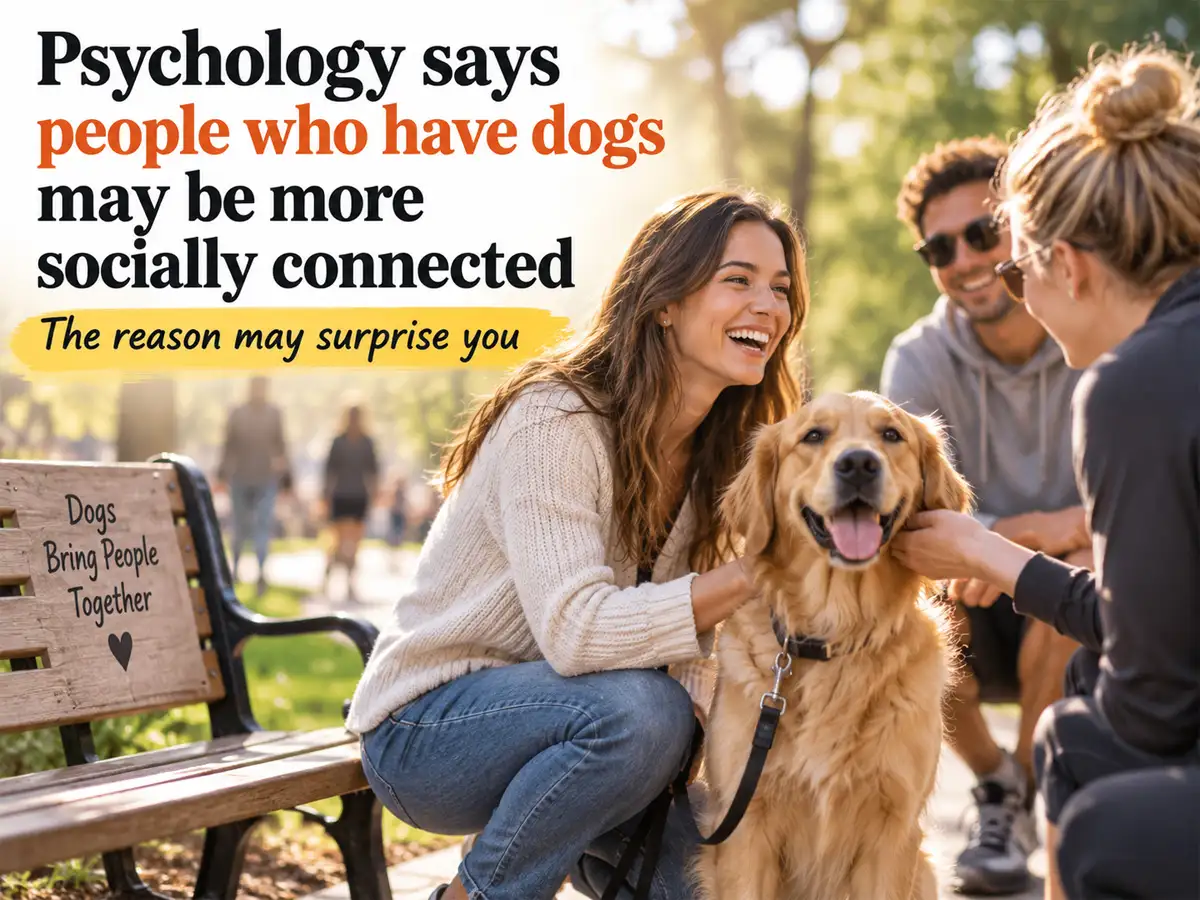
Psychology says people who have dogs may be more socially connected - The reason may surprise you

Dogs might provide more to our lives than just mud-covered paws, daily walks before dawn and constant requests for attention. According to scientific research, they might actually alter the nature of our social interactions without even realizing it. Even when you take your dog for a walk it can provide chances to get in touch with a stranger, have a chat with your neighbor and ultimately you become friends. Lots of research has been going on about this phenomenon for many years, and several interesting studies back the idea that dogs can mostly serve as social bridges for people. However, the most unexpected thing about this is not that dog owners have someone to keep them company at home. It is rather the fact that the habits related to keeping a dog can also help make connections with other people.

DOGS CAN MAKE IT EASIER TO TALK TO STRANGERS

Have you ever realized that seeing a friendly dog can help you initiate a conversation without being uncomfortable? There is research behind that familiar experience. Psychologists June McNicholas and Glyn M Collis of the University of Warwick examined whether dogs could serve as 'catalysts' for human interaction. Their research, published in the British Journal of Psychology, found that being accompanied by a dog increased the frequency of social interactions, particularly encounters with strangers.

The researchers even tested whether appearance made a difference. In one experiment, a male participant was dressed either smartly or more casually. Although clothing affected interaction to some extent, the presence of the dog produced the biggest difference between conditions. It seems quite logical. It can be very awkward to just ask someone his/her name without giving any reason. However, asking 'what’s your dog’s name?' could prove much more comfortable. It gives an instant topic of discussion for the two persons.

READ ALSO: Psychology explains how US Navy SEAL training builds resilience - even when motivation runs out

DOG OWNERSHIP MAY HELP BUILD STRONGER NEIGHBORHOODS

A 2017 study titled Social capital and pet ownership - A tale of four cities, led by Lisa Wood, alongside Karen Martin, Hayley Christian, Steve Houghton, Ichiro Kawachi, Shannen Vallesi and Sandra McCune, examined people in San Diego, Portland and Nashville in the US and Perth, Australia.

Researchers found pet ownership was significantly associated with higher levels of social capital - broadly referring to social connections, trust and networks within a community. The researchers concluded that pets could be an underrecognized way of strengthening connections within neighborhoods.

It could be especially critical for dog walking. In a second study from 2021 conducted by Mohammad Javad Koohsari and colleagues, comprising 3,606 adults in Japan, younger and middle-aged dog walkers were shown to engage in more neighbor-related activities compared to people without dogs. At the same time, the authors considered the body of evidence to be modest and found no such correlation in older people.

READ ALSO: Psychology explains why some women stick to one perfume for years - How a 'signature scent' becomes part of identity and memory

COULD DOGS ALSO HELP PEOPLE FEEL LESS ALONE?

Social connectivity is not only about the number of individuals one knows but also about feeling connected. In 2021 research conducted on 466 adults aged 60 years and above from Florida, the impact of loneliness was observed both before and during the COVID-19 pandemic. The researchers, Dawn Carr, Erika Friedmann, Nancy R Gee, Chelsea Gilchrist, Natalie Sachs-Ericsson and Lincy Koodaly, discovered that regular dog walks may have reduced the effect of social disruption associated with the pandemic on loneliness. Recent research brings further evidence into the discussion.

An observational study conducted in 2026 with adults aged over 75 years old in France involving 160 subjects showed the correlation between loneliness levels and dog ownership when controlled for other variables. Correlation was due mainly to emotional loneliness, whereas 81% of people owning dogs reported that the dogs are their friends and companions. It should be pointed out that there should be conducted longitudinal studies to prove cause and effect relations.

In the end, having a dog does not necessarily mean that one becomes an extrovert and makes friends to avoid being lonely. Most of the research indicates correlation but not evidence that having dogs causes increased social connection. Personality, neighborhood design, health and lifestyle can all influence how often people interact.

Still, the research highlights something wonderfully simple about everyday life with a dog. Regular walks get people outside. Dogs attract attention. Familiar faces become familiar names, and tiny conversations can gradually turn strangers into acquaintances. So, the social benefit of having a dog may not only come from the relationship between owner and pet. Sometimes, the dog at the end of the leash provides the easiest reason to say hello to another human being.

Sign up to read this article
Read news from 100's of titles, curated specifically for you.
Already a member? Sign in here
Related Stories
Top stories on inkl right now
One subscription that gives you access to news from hundreds of sites
Already a member? Sign in here
Our Picks
Fourteen days free
Download the app
One app. One membership.
100+ trusted global sources.