Get all your news in one place.
100's of premium titles.
One app.
Start reading
The Economic Times
The Economic Times
Mukesh Thapliyal

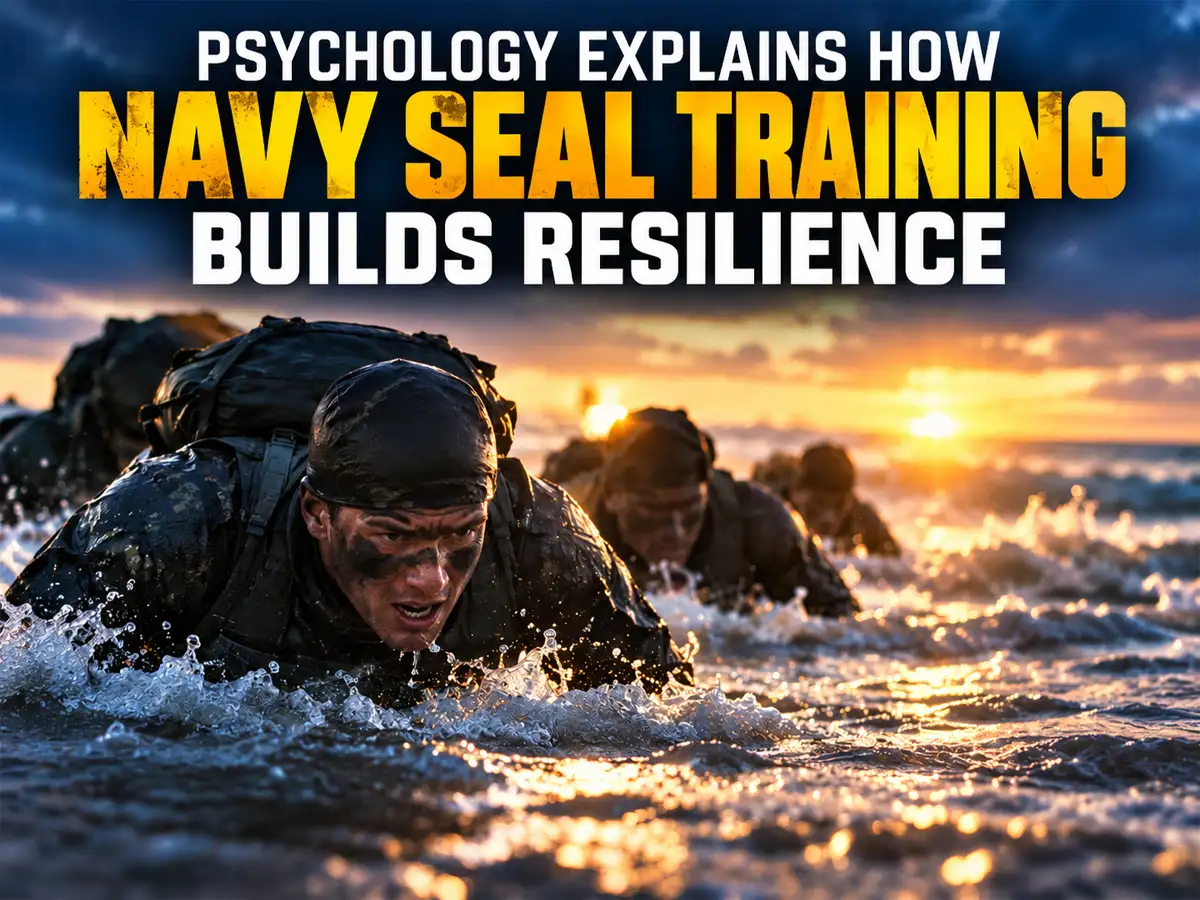
Psychology explains how US Navy SEAL training builds resilience - even when motivation runs out

Motivation can get you started, but it rarely stays at its peak when the challenge becomes exhausting. That is one reason the psychology of US Navy SEAL training has attracted researchers interested in resilience, stress and human performance. Becoming a SEAL involves prolonged physical and psychological demands, making BUD/S training an unusual real-world setting for studying how people respond when discomfort, fatigue and uncertainty keep piling up. Research involving SEAL candidates suggests that resilience is not simply about having an unusually tough personality. This can include the way people understand stress, control emotions, set goals and handle problems that arise. This is a valuable lesson from these studies that can be applied to real life. The lesson is that when motivation runs out, psychological resources will help people function.

RESILIENCE CAN CHANGE UNDER PROLONGED PRESSURE

A 2022 longitudinal study conducted in 2022 on the psychological and physiological changes of 353 participants from three batches of a 6-month-long Seal Assessment and Selection course at the US Naval Academy was led by Andrew K Ledford. The psychological traits of resilience, hardiness, and grit were evaluated at various stages of the training period. It was found out that resilience and hardiness were initially low but later increased. There were also some physiological characteristics which adapted to stress. This finding is very important because it negates the idea of resilience being innate. The researchers did not prove that SEAL training alone caused these changes, but the results show that psychological characteristics can shift during prolonged exposure to demanding conditions. In other words, resilience may involve adaptation - not just motivation.

YOUR VIEW OF STRESS MAY CHANGE HOW YOU HANDLE IT

Research by Eric N Smith, Michael D Young and Alia J Crum, published in 'Frontiers in Psychology', examined 174 Navy SEAL candidates. The researchers looked at whether candidates viewed stress as something harmful or potentially useful. Those with stronger 'stress-is-enhancing' mindsets tended to persist longer, complete an obstacle course faster and receive fewer negative evaluations from instructors and peers. That does not mean stress is automatically good. Instead, the study suggests that how people interpret stressful experiences can be associated with how they perform under pressure. This helps explain why simply telling yourself to “try harder” may not be enough. A person may respond differently when stress is viewed as an obstacle that signals failure versus a difficult experience that can be managed.

READ ALSO: Psychology explains why some women stick to one perfume for years - How a 'signature scent' becomes part of identity and memory

GOAL-SETTING CAN REPLACE THE NEED TO FEEL MOTIVATED

Another useful piece of research comes from Marcus K Taylor and colleagues, who studied 58 US Navy Explosive Ordnance Disposal operators. The researchers found that goal setting and emotional control were among the most frequently used psychological strategies during training and military operations. Goal setting, emotional control and attentional control contributed most to differences between operators with higher and lower resilience. The participants were Navy EOD operators rather than SEALs, so the findings should not be presented as direct evidence about SEAL training. But they offer a valuable comparison from another highly demanding military environment. The lesson is surprisingly familiar: when motivation disappears, having a specific next task can make the challenge feel more manageable. Instead of thinking about everything that remains, people can focus on the immediate goal, control their response and keep attention on the task.

RESILIENCE MATTERS, BUT IT IS NOT THE SAME AS NEVER QUITTING

Ledford and colleagues also studied the role of resilience and mindfulness among SEAL candidates during a six-month BUD/S selection program. Their research found that resilience was positively associated with completing training, while the mindfulness measures used in the study were not associated with completion. That distinction matters. Resilience should not be confused with blindly pushing through every situation. True resilience is much more about adapting oneself to adverse conditions, regulating one’s reactions and maintaining motivation to achieve goals under such conditions. In case of ordinary people, such resilience can manifest itself in the form of getting through a tough job, coming back after a failure, continuing exercising or engaging in an awkward conversation.

READ ALSO: Psychology explains why you may still want your ex back after divorce - even when you know it's over

However, Navy SEAL training provides insight into the psychology of resilience which is far from the common misconception that resilient individuals are those who have never been exhausted, fearful or discouraged. The study by Andrew Ledford and colleagues implies that the trait of resilience can vary within stressful training, while work by Eric Smith, Michael Young and Alia Crum have found that perceptions about stress are connected to perseverance and performance of future Navy SEALs. Another study conducted among Navy EOD operators includes goal-setting, emotional regulation, and attentional control in their list of psychological tools. The broader lesson is simple: motivation is a feeling, but resilience involves what you do when that feeling fades. Sometimes the next step is not about becoming tougher.

Sign up to read this article
Read news from 100's of titles, curated specifically for you.
Already a member? Sign in here
Related Stories
Top stories on inkl right now
One subscription that gives you access to news from hundreds of sites
Already a member? Sign in here
Our Picks
Fourteen days free
Download the app
One app. One membership.
100+ trusted global sources.