
Get all your news in one place.
100's of premium titles.
One app.
Start reading
Space
Space
Science
Anthony Wood

'Project Hail Mary' end credits showcase stunning nebula photos captured over 400 hours by a single astrophotographer — here's the inside story

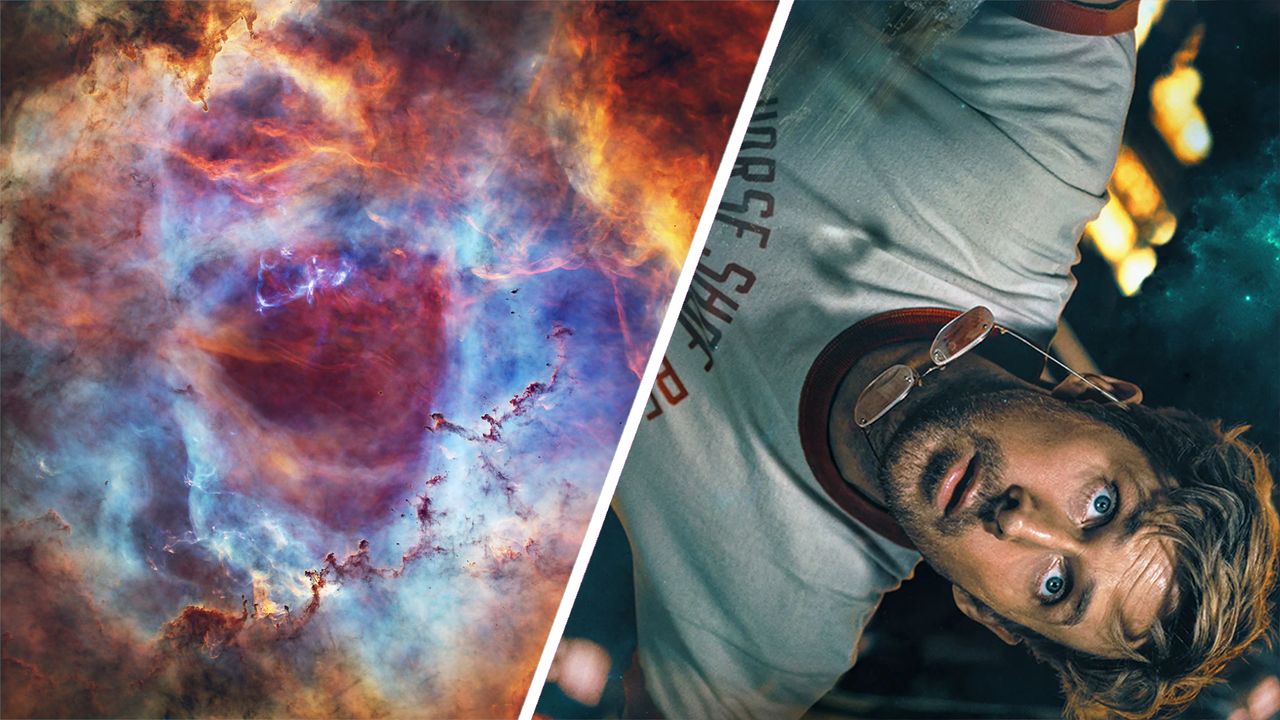
A two-panel image with a nebula colorful deep space nebula astrophoto on the left and a scene from the movie 'Project Hail Mary' featuring Ryan Gosling on the right with a white divide.

In August 2025, astrophotographer Rod Prazeres received a strange Instagram message that seemed a little too good to be true — a "small production company" wanted to license his images for use in an undisclosed sci-fi movie.

Prazeres' initially — and reasonably — assumed that he was being scammed. After all, how many production companies and movie studios approach collaborators by sliding into their DMs and asking for space pics? Several months and a binding non-disclosure agreement later, his images would appear on the silver screen as a magnificent backdrop for the credits of Project Hail Mary, the Ryan Gosling-fronted adaptation of Andy Weir's beloved novel of the same name.

Project Hail Mary launched to both critical acclaim and impressive box office earnings earlier in March. More impressively, it managed to maintain a sense of charm and wonder at the cosmos throughout its 156-minute runtime that compelled us here at Space.com to praise it as the optimistic look towards the stars that humanity needs right now. The film also drew heavily from real-world biology, space exploration and science, which grounded the blockbuster's fantastic story in reality and an air of authenticity. Prazeres' astrophotography — and the drive to showcase real deep space images over CGI as the credits rolled — added to that sense of authenticity.

"So the first thing I thought was, you know, it's a scam," Prazeres told Space.com in an interview. “The second thing I thought was that maybe it was for a local film, or something tied to a local festival. Since he mentioned the company name, I went online to look up both him and the company to check that it was genuine.” Prazeres went on to create what he jokingly called a "dossier" on the company to determine if they were genuine.

Next followed a series of conference calls, accompanied by the signing of an NDA. For months, Prazeres and the production company discussed using his images for a sequence earlier in the movie, but as the producers' creative vision shifted, things began to look uncertain.

"They got back to me and said, oh, you know, it may not be going ahead," recalled Prazeres, "but there may be a place to [work with] some of these materials for something else" Weeks later, the production company broached the possibility of using Prazeres' deep space imagery to close out the blockbuster movie.

The chain of events is all the more noteworthy given the relatively brief time that Prazeres has been capturing the night sky. His first experience of deep sky astrophotography came in July 2023 when he captured a view of the Omega Nebula (Messier 17), which glows in the constellation Sagittarius 5,500 light-years from Earth, according to NASA. The years that followed saw Prazeres embark on a personal journey to research and learn the craft, which saw him attend multiple workshops with veteran astrophotographers. One of Prazeres' nebula shots was even shortlisted for the Best Newcomer award in the Royal Observatory Greenwich's 2024 Astrophotographer of the Year competition, eight months into his astro training.

Of course, working with Amazon MGM Studios to help illustrate a major blockbuster was on an entirely different level from anything that had come before, and all because his photography had drawn the eyes of a production company searching Google Images for views of the Milky Way. "Never in a million years would I have expected that to happen, even if I had 10 years experience, 20 experience, let alone two and a half?"

A deep space image of the 'Running Chicken Nebula' used in the credits of 'Project Hail Mary'. (Image credit: Rod Prazeres Astrophotography)

The images selected for the credit sequence took a cumulative 396 hours to capture using two telescopes, a William Optics RedCat 51 II and a Askar 130PHQ, in conjunction with a host of specialized ZWO astronomy cameras, filters and peripherals.

The images include some of the most famous nebulas in the night sky such as the Carina Nebula, the Fighting Dragons of Ara and the distinctive Vela Supernova Remnant, each of which was painstakingly edited to bring out spectacular detail in the deep space vistas.

However, for all the structural beauty of the swirling clouds of dust and gas, one key element was intentionally omitted — none of the images used in Project Hail Mary's credit sequence contained a single star. The stellar bodies, which are central to the plot of the sci-fi epic, were intentionally removed during the editing stage using special astrophotography software to prevent them from interfering with the foreground subtitles.

"It's relatively simple to do it," explained Prazeres. "You've just got to make sure it's done without, you know, damaging anything in the image and not adding or altering anything from the underlying data".

The Vela supernova remnant shines in deep space. (Image credit: Rod Prazeres Astrophotography)

Prazeres finally went to see Project Hail Mary a few days ahead of the worldwide release, surrounded by his wife, children and extended family having been bound for months not to share his experience of contributing to the movie with those around him.

"You know, it is a creative process that the producers could have just woken up one day and decided black screen on credits is perfectly fine and not move on," reasoned Prazeres. "So that whole situation, all these months of keeping this to myself and working with the studio to get it going, it was very nerve wracking. But now that it's out there, I'm just, yeah, there's no feeling to describe it."

Inspired to begin your own astrophotography journey? Then be sure to check out our roundups of the best lenses and cameras for astrophotography, along with our beginner's guide to photographing the night sky.

Editor's Note: If you would like to share your astrophotography with Space.com's readers, then please send your photo(s), comments, and your name and location to spacephotos@space.com.

Sign up to read this article
Read news from 100's of titles, curated specifically for you.
Already a member? Sign in here
Related Stories
Top stories on inkl right now
One subscription that gives you access to news from hundreds of sites
Already a member? Sign in here
Our Picks
Fourteen days free
Download the app
One app. One membership.
100+ trusted global sources.


