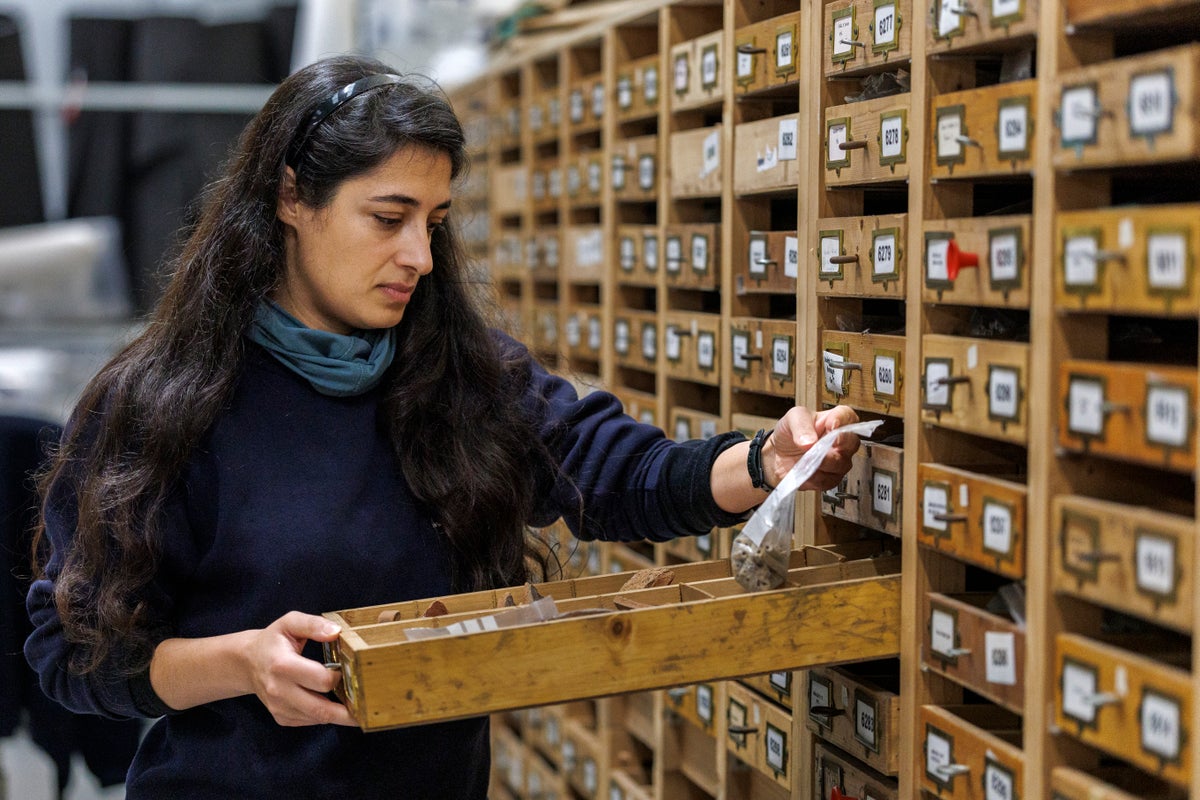
Tens of thousands of historical artefacts are undergoing meticulous recataloguing and repackaging at Northern Ireland’s archaeological storehouse. The state-of-the-art, climate-controlled facility in County Antrim recently doubled its capacity following a major refit.
While only a small proportion of items from archaeological digs reach public display, the rest are preserved and stored here. This centralised store was established by Stormont’s Historic Environment Division (HED), consolidating collections previously housed across the region.
The facility is full of rare artefacts, from flint spearheads to a seven-metre, 4,000-year-old log boat found near the River Bann.
Many of the items were unearthed decades ago, when cataloguing and storing practices were very different from modern day standards.
Archaeologists based at the store are now working to address these issues after a new set of guidelines for preserving artefacts was introduced earlier this year.
One of the experts involved in the project is curatorial archaeologist Sapphire Mussen.
Ms Mussen said standards for artefact care in Northern Ireland were previously not as high as those implemented in the rest of the UK and the Republic of Ireland.
“The standards of practice naturally do change with time and unfortunately we’ve fallen behind a little bit here,” she said.
“We’re no longer in line with other jurisdictions, but we have made massive strides to change that.
“We have published a suite of standards and guidance for the creation and care of archaeological archives in Northern Ireland and what that means is from 2025 onwards all new excavation archives that are generated in the field must meet a certain standard for long-term archive storage and preservation.
“The legacy archives, which is what we have here (in the Co Antrim store), so anything pre-dating 2025, may not be up to that standard, but we are taking opportunities to improve the collections’ care – improving things like packaging, the labelling, just to improve how they’re housed.”

The store is accessible to archaeological researchers who can apply to HED to examine artefacts. They are allowed to perform certain tests on the items, such as carbon dating.
The team in the facility is aligning its work programme with those research applications, prioritising the artefacts that are of interest to archaeologists and other academics.
Ms Mussen said researchers from around the world have sought access to the storehouse.
“The success in what we do, I think, is measured by seeing those researchers come in and seeing the collections be used in a meaningful way,” she said.

“We’ve had people from America and Scotland and the south of Ireland, people from all over. We never know what kind of request we’re going to get, but we’re very happy to try and facilitate all and any requests as much as we can. It’s great to see.
“We had someone over from America recently looking at glass beads from an early medieval site.
“It might not seem very exciting from a public-facing point of view, but it’s very important for learning more about the past and the history of people on this island – how they lived, what they ate, what they did.”
She added: “It gives validity to what we hold if they are accessed and used. If they sat on a shelf they would be questioning what’s the point in holding on to them.
“But they are invaluable as research potential.”
In Pictures: Royal and presidential visits make it year to remember in Scotland
Swinney ‘duping’ supporters into thinking he can win majority, says Anas Sarwar
Wind and cold weather warnings due but no white Christmas for UK
Archaeologists uncover Bronze Age Chinese secret to brewing red rice wine
First-of-its-kind ancient mosaic board game found at Mayan city in Guatemala
Egyptian boat ‘one of the most important restoration projects in the 21st century’