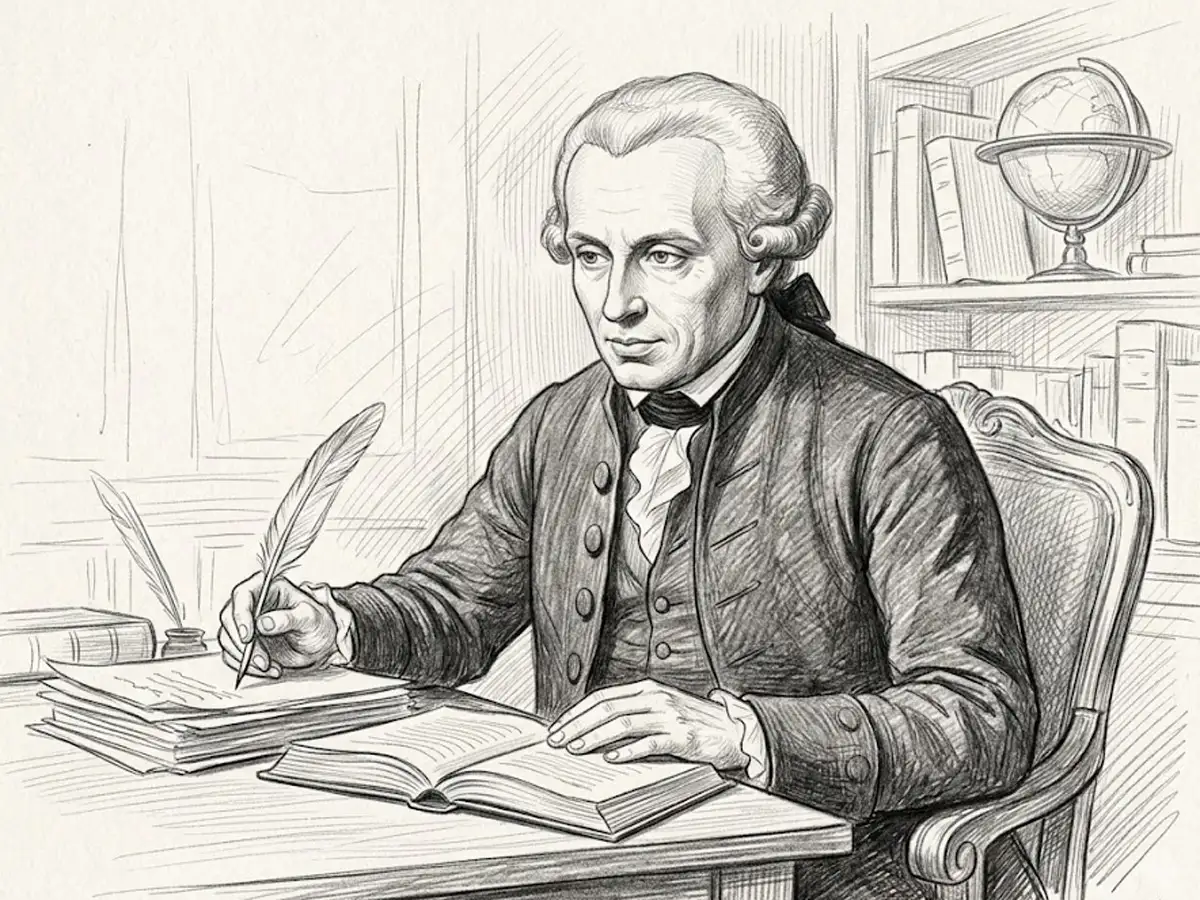
Immanuel Kant’smotivational quote, "Thoughts without content are empty, intuitions without concepts are blind," explains how reason and experience depend on each other to create meaningful knowledge. Kant believed that simply having ideas is not enough. Thoughts need information from real-world experience to give them substance. Without facts, observations or experiences to support them, our thoughts can become abstract and disconnected from reality. At the same time, experience alone is not enough. We may see, hear or feel countless things, but without concepts to organize and interpret those experiences, they remain confusing and directionless. In simple terms, Kant is saying that knowledge requires both experience and understanding. Our senses provide the raw material, while our minds give that material structure and meaning.
Immanuel Kant was one of the most influential philosophers of the modern era, transforming the way people think about knowledge, morality, freedom and human reason. Born in 1724 in Königsberg, Prussia, Kant spent almost his entire life in the city, yet his ideas reached far beyond it and continue to shape philosophy today. Kant became famous for asking a fundamental question: How does the human mind understand the world? In his landmark work, 'Critique of Pure Reason', published in 1781, he argued that the mind does not simply receive information from the outside world. Instead, the mind actively organizes experience through basic structures of understanding.

Kant sought to find a middle ground between competing philosophical traditions. Rationalists emphasized reason, while empiricists argued that knowledge comes primarily through experience. Kant believed both played essential roles. His approach became known as 'transcendental idealism'. In simple terms, Kant argued that although we experience the world through our senses, our minds also contribute to how that experience is structured.
This idea helped reshape debates about what humans can know and where the limits of knowledge lie.
Kant also developed a powerful theory of ethics. He believed morality should not depend simply on emotions, personal interests or the consequences of an action. Instead, he emphasized duty and rational principles. His best-known ethical concept is the 'categorical imperative', which asks people to act according to principles they could reasonably want everyone to follow. Kant also argued that every person should be treated as an end in themselves, rather than merely as a means to achieve someone else's goals. That principle remains highly influential in modern discussions about human dignity, rights and ethical responsibility.
Kant's philosophy extended beyond knowledge and morality. He wrote about freedom, aesthetics, politics and peace, including his influential essay Perpetual Peace, which explored ideas about international cooperation and lasting peace.
Kant died in 1804, but his influence did not end there. His ideas helped shape later German philosophy and influenced fields ranging from ethics and political theory to psychology and the philosophy of science. More than two centuries later, Kant remains important because he challenged people to examine not only what they believe, but also how they know it and why they should act on it.