
Get all your news in one place.
100's of premium titles.
One app.
Start reading
Digital Camera World
Matthew Richards

Polaroid Wave review: a basic and relatively cheap underwater streaming camera

Polaroid Wave product image.

Think Polaroid and you’re probably thinking iconic ‘instant cameras’ of the 1960s and 1970s, although the company goes all the way back to 1937, originally focusing on light polarization tech for sunglasses and photographic filters. Even in this decidedly digital age, Polaroid is still making some of the best analog instant cameras, including the Polaroid I-2 and the Polaroid Flip, both earning 5-star Gold awards in our respective reviews.

The Polaroid Wave that I’m reviewing here is an all-digital affair that doesn’t print photos, instantly or otherwise. However, you can pair it with your mobile phone over Wi-Fi, and use the Polaroid companion app to share photos and video instantly in a streaming kind of way. The camera’s main claim to fame is that it’s fully waterproof and designed to be used in and around water. As such, it aims to be one of the best underwater cameras as well as one of the best low-cost cameras, or at least one of the cheapest and easiest to use.

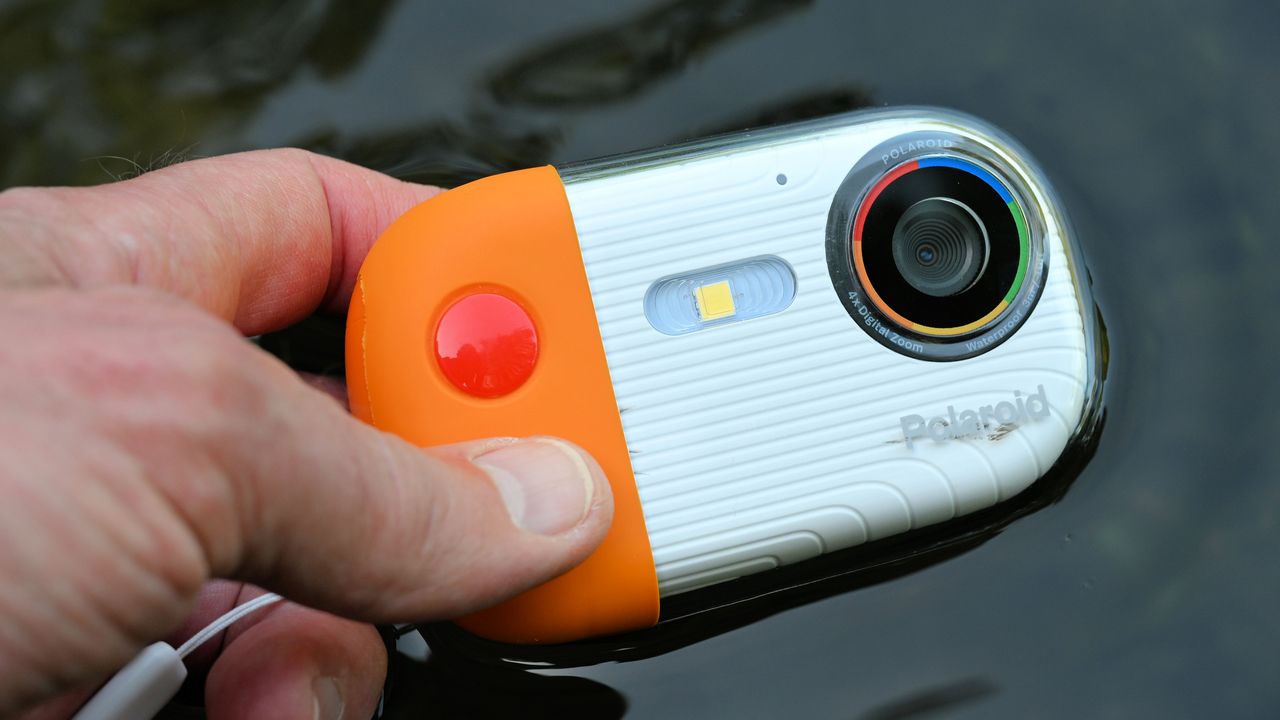
The Polaroid Wave seems pretty unsinkable – here it is floating on water, cast adrift and all on its own. (Image credit: Matthew Richards)

Polaroid Wave: Specifications

Photo Resolution

18MP

Video Resolution

4K UHD

Image Sensor

CMOS

Selfie mirror

No

Display

2.4-inch fixed

Touchscreen

No

Battery

Li-ion (internal)

Connections

Micro USB, Wi-Fi

Size (WHD)

10.4x3.0x6.4cm
4.1x1.2x2.5in

Weight

138g / 4.9oz

Polaroid Wave: Price

You can expect to pay around $50 to $90 for the Polaroid Wave in the USA, but it’s been discontinued and is getting hard to find if you want a brand new one, especially in other world regions. Used ones in good condition are easier to get your hands on, selling from around $25 / £25 / AU$55.

Polaroid Wave: Design & Handling

I bought a Polaroid Wave underwater camera in white and orange, although I’ve also seen it in white and other colors. The design is pretty basic and the Polaroid looks more like a toy camera than something to be taken too seriously. Even so, it does feature a protective housing that’s reasonably robust. I like that it’s designed to float on water, avoiding the worry that it’s going to sink without trace into the murky depths if you accidentally let go of it.

The camera has a transparent protective housing over the white section, and a colored section on one side, made in either orange, blue, green or yellow. (Image credit: Matthew Richards)

You really wouldn’t want the camera to descend to any serious depths, as it has an advertised depth limit of 3 meters or 10 feet. That should be sufficient for fun in the swimming pool, partying in the hot tub, and for snorkeling. However, diving is out of the question and very much off the ‘can do’ list.

Point and shoot simplicity is based around a red button on the front that you press for shooting stills or starting/stopping video capture. A smaller button on the top, just about visible in this picture, performs the same functions. (Image credit: Matthew Richards)

Definitely a point and shoot camera, the Polaroid Wave is stupendously easy to use. You literally just point it and shoot, using the large red button on the front or the smaller ‘OK’ button up on top. The same buttons also enable you to start and stop video recording, depending on whether you’re in stills of video capture mode. Still images are available at resolutions up to 18 megapixels, and video supposedly maxes out at 4K UHD.

Here’s a closer look at that top-panel button, labelled ‘OK’. Not just for shooting stills and starting/stopping video recording, this button is also used when selecting and changing items in the menu system. (Image credit: Matthew Richards)

The front panel of the camera plays host to a moderately wide-angle lens that adds a 4x zoom facility for getting closer to the action. There’s also a mini flash on the front panel, which comes in handy for underwater illumination, or just for when ambient lighting is dim.

As well as the lens and flash on the front panel, there’s also a red status lamp towards the top center. This lights up when taking a still image, and flashes while you’re shooting video. (Image credit: Matthew Richards)

Around the back, there are three buttons on the colored strip to the right of the LCD screen. The top one enables you to change modes between shooting stills and video, and reviewing either in playback mode. A long press of the button takes you into the menu system, where it subsequently acts as a ‘back’ button. The two lower buttons have up and down symbols on them and serve for navigating menus and images/video in playback mode. When shooting, the up/down arrows apply digital zoom.

Three operating buttons are arranged in a vertical strip down the right hand side of the LCD screen. (Image credit: Matthew Richards)

As I’d expect, considering the low-budget price of the camera, the LCD screen is pretty basic fare. It measures 2.4 inches on the diagonal, so it’s not overly small, but it’s fairly low res and isn’t a touchscreen. It’s pretty clear to see underwater, less so if you have the sun shining on it from over your shoulder, where it can make life really difficult in terms of composing shots.

The right hand side of the camera has a strap lug and waterproofed door which opens to reveal an old-style Micro USB port and a microSD card slot. You can use the USB port for charging the internal Li-ion battery using a standard mains charger or power bank. Other connectivity options include built-in Wi-Fi, enabling you to pair the camera with your mobile phone for live streaming, controlling recording and downloading photos and video.

The waterproofed door on the right hand side of the camera gives access to the Micro USB port and microSD memory card slot. (Image credit: Matthew Richards)

Polaroid Wave: Performance

Picture quality has a distinctly ‘snapshot’ look to it. Sharpness, clarity, contrast and color rendition are all passable, rather than being particularly pleasing. However, in good lighting conditions, the Polaroid Wave is capable of pictures that I’d want to keep, which I can’t say about some cheap cameras that I’ve used, like the Andoer 48MP Digital Camera and the Mutrain X10 Digital Camera.

Exposure metering has worked well for this shot but I found mixed results throughout testing, with some shots being overexposed. No exposure compensation is available when shooting. (Image credit: Matthew Richards)

Retention of fine detail and texture is a little lacking at the widest viewing angle, and deteriorates further at longer zoom settings. It can be particularly noticeable if you take a series of shots of the same subject from the same shooting distance, increasing the zoom factor along the way. For comparison, the gallery below contains photos of the same scene taken at 1x, 2x, 3x and 4x zoom.

Like many basic point and shoot compact cameras, the Polaroid struggles in low lighting conditions. Its flash can be a help for close-ups but lacks the power to cover any real distance.

According to the EXIF data recorded in the image, the camera has bumped up the sensitivity from ISO 100 to ISO 676 for this dimly lit indoor shot. There’s a lot of smoothing in evidence, to reduce the appearance of image noise. (Image credit: Matthew Richards)

Like a few other underwater cameras that I’ve used, the Polaroid suffered from condensation while I was using it underwater, which built up under the housing and in front of the lens. It happened during my testing both very quickly and very frequently, when dunking the camera underwater. Naturally, this affects the underwater image quality, much like trying to see anything through your car windscreen when it’s all fogged up on a cold morning.

An interesting perspective can be attained by partially submerging the camera in water, in this case with the lens just above the surface of a pond. (Image credit: Matthew Richards)
I had to be quick taking this fully underwater shot of pond weeds, before the inside of the housing steamed up with condensation, obscuring the view from the lens. (Image credit: Matthew Richards)

Polaroid Wave: Sample Images

The following gallery of example shots was taken in and around the Bishop’s Palace and Gardens in the English city of Wells.

Polaroid Wave: Video

Above: sample video shot with the Polaroid Wave

The camera is advertised as offering 4K UHD video capture but the used model that I bought gave no video resolution options other than Full HD 1080p. Quality is pretty mediocre and as there’s no kind of stabilization available, handheld video can look very shaky, especially when panning. This is amply demonstrated in the sample video clip below, even though I was trying my hardest to keep the camera steady.

Polaroid Wave: Verdict

I feel that the Polaroid Wave injects an element of fun into family photography. It’s simple enough for anyone and everyone to use, from little kids to great-grandparents. The quality of still photos isn’t fabulous but should suffice for general snapshots. Video can look very shaky if you’re handholding the camera, as there’s no stabilization on offer.

The main attraction is that the camera is fully waterproof so you can use it in the pool or at the beach, submerging it to a depth of 3 meters or 10 feet. That’s not overly generous in the depth stakes but should prove sufficient for casual use and snorkeling. I was frustrated when trying to shoot underwater that the camera misted up inside the housing, in front of the lens, both frequently and severely. That aside, it’s a decent, fun camera at a relatively low purchase price.

Features

★★★☆☆

The headline feature is that the camera is waterproof, albeit only to a relatively shallow depth of 3m / 10ft. Other features include a built-in flash and a 2.4-inch LCD screen, plus built-in Wi-Fi connectivity.

Design

★★★☆☆

It looks more like a toy than a ‘proper’ camera and the design is nothing if not simple. Part of its attraction is that it’s so basic and simple to use.

Performance

★★★☆☆

Image quality is pretty mediocre but I’ve seen a lot worse in cheap digital cameras. Handheld video can look rather shaky.

Value

★★★★☆

Although it’s a basic model, that’s reflected in the price making it reasonable value for an underwater camera.

(Image credit: Matthew Richards)

Alternatives

See our guides to the best waterproof cameras, and to the best cameras under $100

Sign up to read this article
Read news from 100's of titles, curated specifically for you.
Already a member? Sign in here
Related Stories
Top stories on inkl right now
One subscription that gives you access to news from hundreds of sites
Already a member? Sign in here
Our Picks
Fourteen days free
Download the app
One app. One membership.
100+ trusted global sources.