
Get all your news in one place.
100's of premium titles.
One app.
Start reading
The Economic Times
The Economic Times
Shaghil Bilali

Want to exchange old gold for new jewellery? Beware of these taxes

Following Prime Minister Narendra Modi’s appeal to Indians to hold off gold purchases for a year and the government’s hike in gold import duties, numerous jewellery brands have launched gold recycling schemes, asking people to replace their old gold with new. They argue that this gold exchange can reduce India’s import bill immensely while still allowing buyers to get fresh gold.

Although trading in old physical gold with new might attract a lot of buyers in India, they should be aware that they might incur taxes when selling old gold and buying new.

At the same time, the Income Tax Department keeps a tab on high-value gold sales and transactions. It can send you a notice if you deposit large cash amounts in the bank after selling gold or cannot explain the source of funds for this gold.

Also Read: EPFO: When can EPF interest be credited to your account? Check here

ET Wealth Online tells how your physical gold is taxed during sales and purchases as well as when the Income Tax Department might scrutinise your gold transactions.

Sandeep Bhalla, partner, Dhruva Advisors, told ET Wealth Online that taxpayers should carefully evaluate income tax implications arising from gold-related transactions under the Income Tax Act, 1961.

“Gold jewellery, bars and coins are generally treated as ‘capital assets’. Accordingly, sale, exchange or conversion thereof may attract capital gains tax depending on the nature of transaction and the period of holding,” says Bhalla.

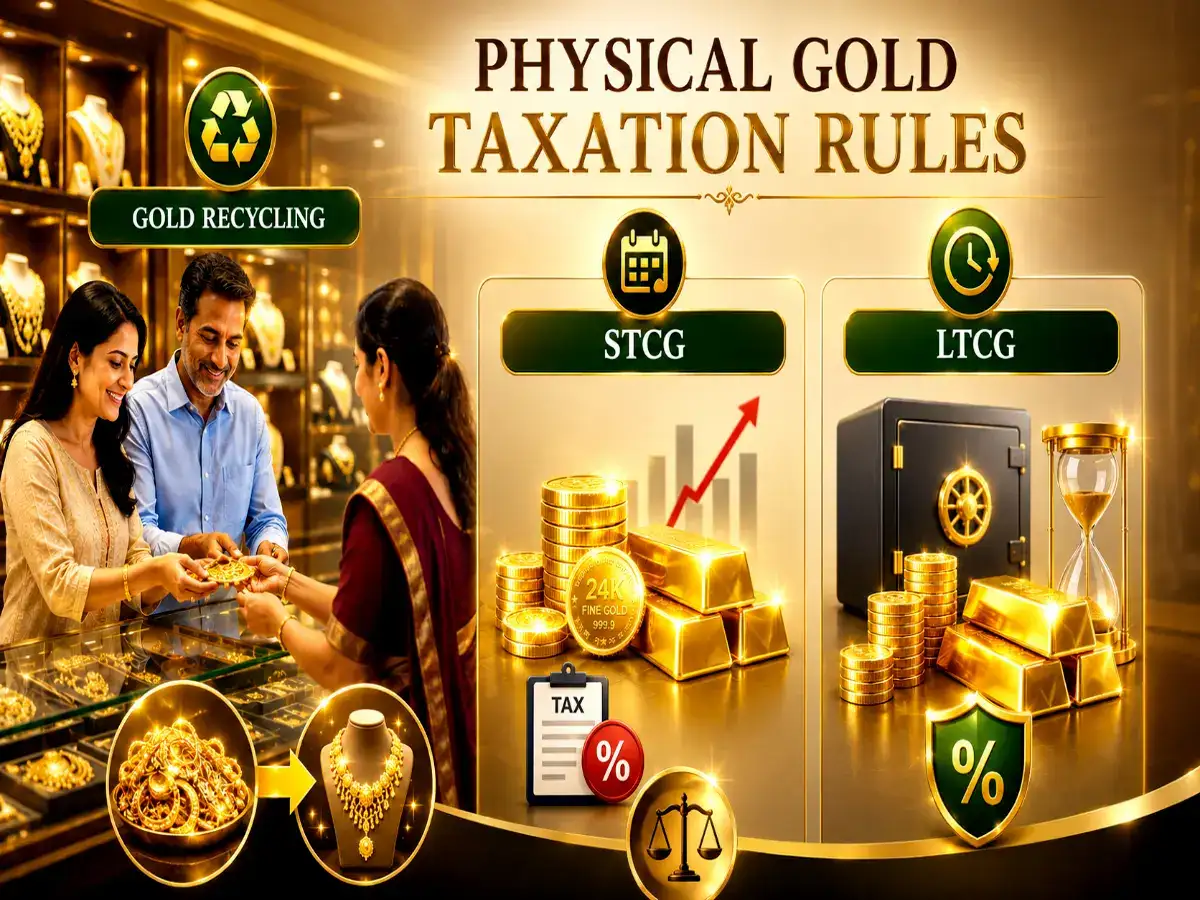
Physical gold taxation rules (As per CA Hitesh Jain, partner, direct tax, N.A. Shah Associates LLP.)

Investment type GST at purchase Short-term capital gains (STCG) Long-term capital gains (LTCG)
Physical gold 3% GST on value; jewellery making charges attract extra 5% GST Up to 24 months: taxed at slab rate Beyond 24 months: 12.5% without indexation
Gifted gold Not applicable Taxable only if gift from non-relatives exceeds ₹50,000 Taxable in the recipient’s hands
Inherited gold Not applicable Capital gains apply on sale Capital gains apply on sale

Bhalla explains how different forms of physical gold are taxed.

1. On sale/exchange/conversion of old gold

Transactions such as selling old jewellery and purchasing new jewellery/bars/coins; exchanging old jewellery for new jewellery without cash consideration, or converting jewellery into bars or coins, can amount to ‘transfer’ under Section 2(47) and can trigger capital gains tax.

Also Read: Rs 10,000 monthly investment in post office RD vs SBI RD: Where will you get higher maturity amount in 5 years?

Even barter or exchange transactions are taxable.

If gold is held for more than 24 months, the gains would generally qualify as LTCG; otherwise, STCG.

2. On melting and remaking jewellery

When old jewellery is melted and remade into new ornaments using the same gold without a transfer to another person, it may generally be regarded as remodelling and not a taxable transfer.

However, in such a case, proper records proving the reuse of the same gold should be maintained.

3. Inherited/gifted/jointly held gold

In case of inherited or gifted gold, Section 49(1) provides that the cost and holding period of the previous owner may be considered for computing capital gains. Accordingly, ancestral or family-held jewellery would often qualify as a long-term capital asset.

If jewellery is jointly owned by your spouse or family members, taxability would generally arise in proportion to beneficial ownership. In such a case, proper documentation regarding ownership and the source of acquisition is important.

4. If gold purchase bill is not available

If original gold purchase invoices are unavailable, taxpayers should maintain alternate supporting documents such as valuation reports, gift deeds, family settlement records, wealth tax records, insurance papers or bank records to substantiate ownership, cost and holding period.

5. Selling gold brought from abroad

If someone sells gold lawfully imported into India, normal capital gains provisions would apply. Taxpayers should preserve import documents, customs declarations and invoices to substantiate lawful acquisition and cost.

However, in the case of scrutiny of such high-value gold transactions, taxpayers should maintain adequate documentation and evaluate tax implications before undertaking gold recycling or restructuring transactions.

6. Loss on sale of gold

If gold is sold at a capital loss, such loss may generally be eligible for set-off against capital gains in accordance with Sections 70 and 71 of the Income-tax Act in the old and the new tax regimes.

In this regard, taxpayers should maintain adequate supporting documentation, including alternate documentary evidence wherever original records are unavailable, to substantiate the computation of capital loss, cost of acquisition and period of holding.

It may be noted that short-term capital loss can be set off against both short-term and long-term capital gains, whereas long-term capital loss can be adjusted only against long-term capital gains.

Further, unabsorbed capital losses may be carried forward for up to 8 assessment years, subject to the condition that the return of income is filed within the due date prescribed under section 139(1) of the Act.

However, when buying or selling large cash sales of gold, you should keep in mind that the Income Tax Department tracks such transactions. If you are found guilty of not paying the tax or using unreported income for such high value transactions, the I-T Department can also punish you.

When can a gold transaction trigger mandatory reporting or ITR scrutiny?

Chartered accountant Abhishek Soni, founder, Tax2Win, told ET Wealth Online that gold transactions may attract scrutiny when cash dealings are very high, PAN reporting thresholds are crossed, bank deposits suddenly increase or capital gains are not properly reported in the ITR.

Soni reveals that the Income Tax Department also compares AIS/TIS data, bank transactions, and income disclosures.

How does the Income Tax Department treat large cash sales of gold?

Soni says that large cash transactions in gold are also closely monitored by the Income Tax Department.

“Jewellery dealers must maintain records of high-value sales and PAN details. If someone deposits large cash amounts after selling gold or cannot explain the source of gold, the department may issue notices or start scrutiny.”

What are the red flags people should avoid while selling gold?

  • Soni says people should avoid
  • Cash sales without invoices
  • Sudden large cash deposits
  • Fake or borrowed purchase bills
  • Underreporting capital gains in ITR
  • Splitting transactions to avoid reporting limits

“Poor documentation and a mismatch between income and gold holdings often trigger scrutiny,” says Soni.

Sign up to read this article
Read news from 100's of titles, curated specifically for you.
Already a member? Sign in here
Related Stories
Top stories on inkl right now
Our Picks
Fourteen days free
Download the app
One app. One membership.
100+ trusted global sources.






