
Get all your news in one place.
100's of premium titles.
One app.
Start reading
Marie Claire
Marie Claire
Lifestyle
Ally Head

Pilates Isn't Just About a Strong Core—These Surprising, Lesser-Known Benefits Can Genuinely Change Your Life

Ashlea McKee.

By now, you'll know that we're big fans of Pilates here at MC UK. The low-impact, full-body workout has soared in popularity in recent years, with boutique studios and on-demand platforms popping up left, right and centre. While social media might make it seem like a passing wellness trend, the method has more than a century of history, not to mention a growing body of research to back up its benefits.

Popularised by the likes of Hailey Bieber, Kendall Jenner and Harry Styles, the method was first developed in the early 1920s by Joseph Pilates, which was originally called Contrology. The popular workout is practised all over the world to help improve strength, posture, flexibility and body awareness through mindful, controlled movement.

Today, Pilates is widely recognised for far more than its physical benefits. Research suggests regular practice can improve core strength, balance and functional mobility, while systematic reviews have also linked it to improvements in wellbeing and quality of life. In other words, those slower, more intentional movements can deliver benefits that extend well beyond toned abs.

But perhaps the best part? Scientists are continuing to uncover lesser-known ways the practice may support both body and mind.

For those of you who don't know me - I'm Ashlea McKee, a classical Pilates instructor, MC UK Master and founder of Élan Wellbeing and the Pilates with Ashlea app. Below, I've explained the one benefit you might not have heard about yet - plus exactly why Pilates is worth adding to your routine this year.

If you're eager to read more Pilates content, while you're here, don't skip our guides to the best Pilates exercises for beginners, best Pilates core moves, best core sculpting Pilates moves and the best Pilates bar exercises, here.

The rise of the Pilates runner

You'll know from my first Marie Claire Masters article back in March that I think Pilates is an incredible all-rounder of a workout - but there's one lesser-known benefit that no one seems to be talking about.

You see, Pilates is an incredible method to train alongside cardio disciplines, like running, as it boosts core strength, coordination, recovery times and injury prevention (I'll go into more detail on each below).

First up: training Pilates alongside your weekly mileage helps to aid joints and improve mobility and body awareness, making you a more fluid, form-focused runner. It also assists with any postural imbalances which, if left unnoticed, could lead to potential injuries down the line. It's an excellent workout for boosting abdominal and pelvic stability, too, creating a stronger core foundation which, in turn, supports better balance, control, and running efficiency.

Connecting to your breath is a key tenet in both disciplines; focusing on your breath during Pilates will only improve your ability to do so during training miles or races. Breathing is one of the main principles of Pilates, as you'll know, and there's a big focus on connecting your breath to movement. To sustain your pace while running, breathing is essential, and efficient breath control can help take your performance to the next level.

One of the things I love most about Pilates is what a mindful form of movement it is: it creates a powerful connection between breath, mind, and body.

Next, Pilates trains controlled, low-impact movement in a way that running can't. Running is high-impact and cardio-based; Pilates is a slower and controlled low-impact workout. Train them both together, and you'll reap the cardio benefits from your mileage and the strength and mobility gains from the Pilates mat or apparatus work, like the Reformer, Tower, and Wunda chair. Pilates can improve running efficiency and economy in many ways, in other words, making you a stronger, faster runner.

And finally? And finally? Pilates can help lower your risk of injury - not just during marathon training, but across many sports and everyday activities as it improves form, body awareness, and alignment. It helps runners move more efficiently and stay stable during long-distance running, especially when you start to tire. Pilates gives runners the tools to better support their bodies throughout training, which you can then take into your race.

Take it from those who've tried it

I asked the members of my Pilates community who workout regularly with me while fitting in their weekly miles, and they said the main benefits they've noticed themselves span:

  • The core stability and control helps with your leg control and therefore your stride.
  • The coordination of your arms and legs with the power and pace you're generating.
  • The posture perspective - if you're running long distance, staying straight and aligned through the trunk and spine helps to sustain pace, movement, and speed, as well as distribution of weight.
  • The reduction of tension , aches and pains
  • The stamina from the classical order (progressions and transitions).

The importance of a strong core and glutes

Underpinning many of the Pilates moves I'd recommend for runners is a focus on core and glute strength. Both muscle groups are essential for runners and non-runners alike, helping you move well in everyday life and supporting the strength and stability that become increasingly important as you age.

A strong core helps you hold yourself taller and feel lighter while running. Strong abdominals also support better posture, and better posture helps you breathe more efficiently and sustain your pace for longer. Remember - it's all connected! Pilates emphasises movement from the centre in every exercise, helping to build strong foundations through the deep abdominal and stabilising muscles. This, in turn, creates better control and stability, especially as fatigue sets in.

Next up, your glutes. The glutes play a major role in powering and supporting movement, and the hips need to be both strong and mobile for an efficient stride. As we know, running is high impact, so if the glutes and hips are weak or tight, other muscles begin to compensate, which can lead to poor form, fatigue, and even injury. Pilates helps strengthen and mobilise these areas to improve overall running performance.

If you only have ten to fifteen minutes to work out, remember this: it's always better than nothing, and can still be super effective. Focus on moving the body through all planes of movement.

A beginner classical Pilates order is a great place to start with exercises like The Hundred, Roll Up, Single Leg Circles, and more foundational movements that never date.

Keen to prepare your body for smoother, more efficient running and reduce the risk of injury? Try the moves below.

7 Best Pilates Moves for Runners

Warm up: Bridges

One simple change runners could make this week to improve performance is simple: to warm up and cool down. Taking care of your body is key for longevity, injury prevention, and performance.

A warm-up can include some breathing, standing Pilates, spinal mobility, and hip, knee, and ankle mobility, keeping it dynamic but controlled.

A cool-down post-run can be more focused on releasing through stretching and mobility work for the hamstrings and hips, using exercises such as Child’s Pose, the Roll Up, Spine Stretch Forward, and a side-lying quad stretch.

Best for: Warming up the body, spinal articulation, glute activation, pelvic stability, and mind-body connection.

(Image credit: The Newman Hotel / Ashlea McKee)

Move one: The Hundred

How to: Lie on your back, lift your head, neck and shoulders, and extend your legs to tabletop or a 45-degree angle while engaging your core. Pump your arms up and down in small, controlled movements, inhaling for five pumps and exhaling for five, until you've completed 100 arm pumps (10 breath cycles).

Best for: Breath, deep core activation, coordination, and full-body warm-up.

(Image credit: The Newman Hotel / Ashlea McKee)

Move two: Single Leg Circle

How to: Lie on your back with one leg extended on the mat and the other raised towards the ceiling. Keeping your hips stable and your core engaged, circle the lifted leg in a slow, controlled motion, making small circles before reversing the direction. For your reps, try five circles in each direction.

Best for: Hip mobility, pelvic stability, and single-leg control.

(Image credit: The Newman Hotel / Ashlea McKee)

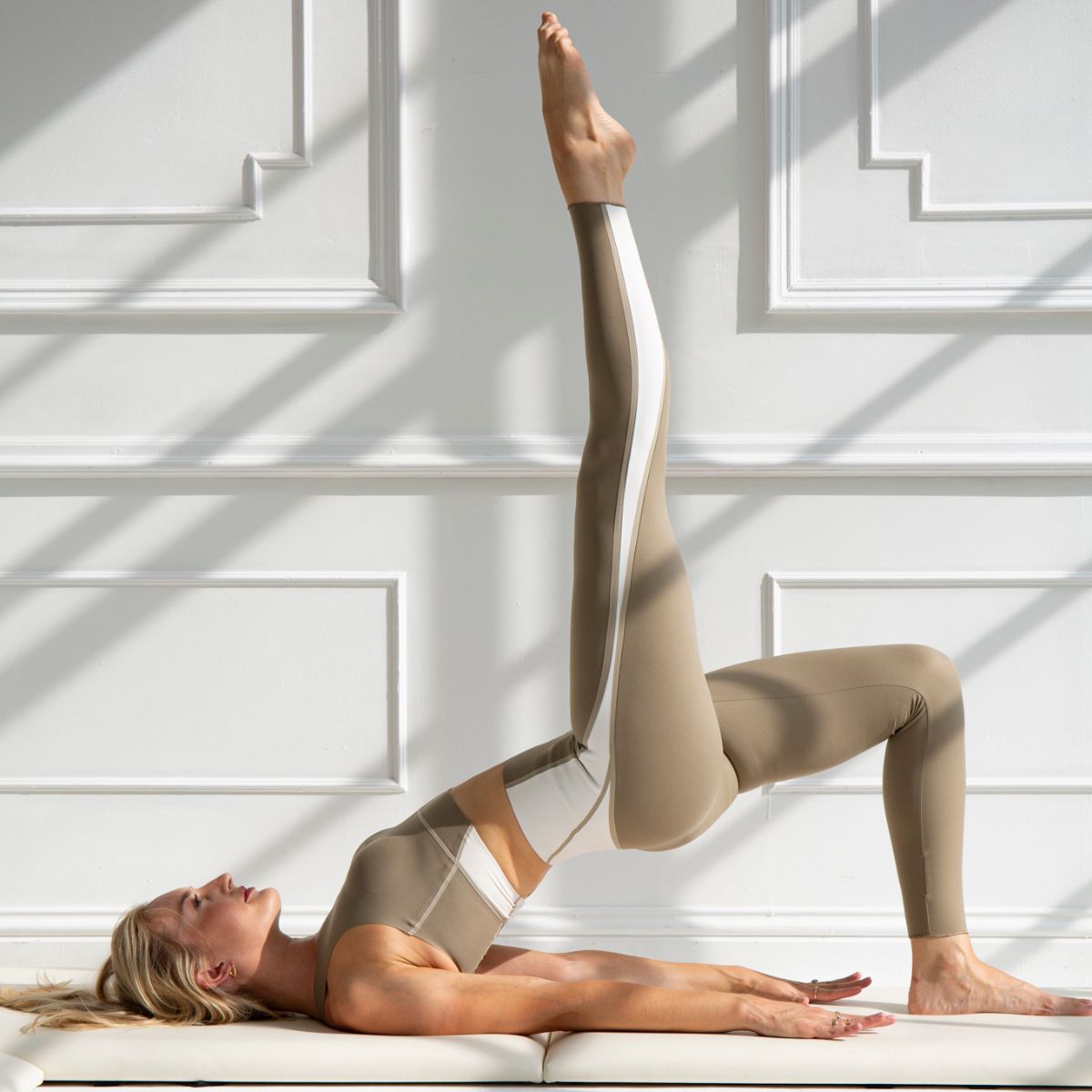
Move three: Shoulder Bridge

How to: Lie on your back with your knees bent and feet hip-width apart. Press through your heels and the backs of your arms to lift your hips until your body forms a straight line from your shoulders to your knees. To progress the exercise, keep one heel firmly pressed into the mat while lifting the other leg straight up toward the ceiling. Flex your foot as you lower the leg halfway, then point your toes as you lift it back up. Complete 6 reps on one side before switching legs.

Best for: Pelvic stability, posterior chain (back body) activation including the glutes and hamstrings, ankle mobility through dorsiflexion (flex) and plantarflexion (point).

(Image credit: The Newman Hotel / Ashlea McKee)

Move four: Side-Lying Bicycle

How to: Lie on your side with your body aligned along the back edge of the mat, your legs slightly in front of your hips, your head supported, and your core engaged. Bend your top knee and extend the leg forward, then open through the hip and sweep the leg back behind you. Bend the knee to return to the starting position, keeping the movement smooth and controlled while maintaining a stable pelvis throughout. Aim for five reps in each direction

Best for: Hip and knee mobility, lateral hip stability, and single-leg control.

(Image credit: The Newman Hotel / Ashlea McKee)

Move five: Single Leg Kick into Swimming

How to: Lie face down on your mat, propped up on your forearms with your elbows directly beneath your shoulders and your chest gently lifted. Bend one knee to kick your heel towards your glutes twice, then switch legs, keeping your core engaged and your pelvis stable. Next, lower onto your front and extend both arms forward. Lift your opposite arm and leg, then continue alternating sides in a smooth, controlled "swimming" motion, keeping your torso as still as possible. Aim for eight to ten reps of each.

Best for: Hip flexor and quadriceps focus, posterior chain strength, and postural focus

(Image credit: The Newman Hotel / Ashlea McKee)

Move six: Single Leg Stretch

How to: Lie on your back, lift your head, neck and shoulders, and draw one knee into your chest while extending the other leg away at a low diagonal. Switch legs in a controlled, rhythmic motion, keeping your core engaged and your upper body lifted throughout. Aim for eight to ten reps.

Best for: Deep abdominal strength, breath coordination, core and pelvic stability, control, and hip mobility

(Image credit: The Newman Hotel / Ashlea McKee)
Sign up to read this article
Read news from 100's of titles, curated specifically for you.
Already a member? Sign in here
Related Stories
Top stories on inkl right now
One subscription that gives you access to news from hundreds of sites
Already a member? Sign in here
Our Picks
Fourteen days free
Download the app
One app. One membership.
100+ trusted global sources.







