
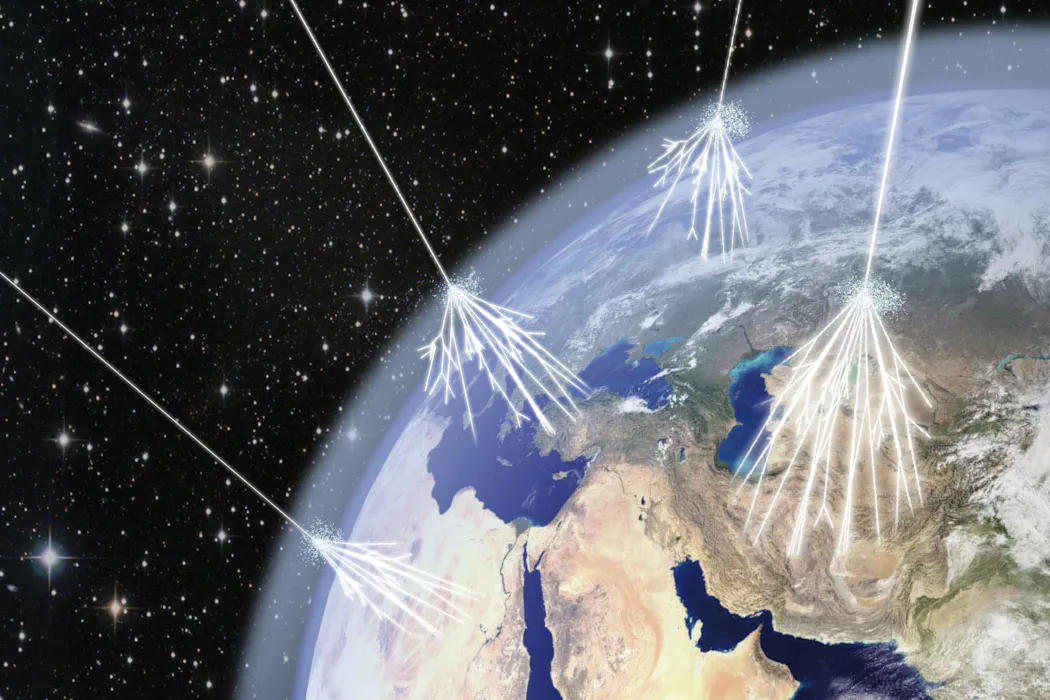
Every second, particles zip through your body at nearly the speed of light. They rain down from a storm high in the sky, where cosmic rays, a powerful type of interstellar matter, are constantly striking atoms in Earth’s atmosphere. The impacts break them apart into a shower of particles that rain to the ground.
Scientists have studied these cosmic rainstorms for over a century, but they lack a precise understanding of how they form. Many researchers are searching for a clearer picture, and they don’t even need to look to the sky to study them. They can instead use a particle collider, CERN’s Large Hadron Collider in Switzerland.













