
Get all your news in one place.
100’s of premium titles.
One app.
Start reading
T3
T3
Technology
Steve May

Philips 'The Tina' (TAV9000D) review: Back to the future in style

Philips Audio's 'The Tina' all-in-one turntable review.

The Philips TAV9000D (for its 'proper' name) is a retro-styled, all-in-one console that's actually (for its 'fun' name) titled after Rock & Roll Hall of famer Tina Turner. It doesn’t so much take cues from the past, as nod furiously in its direction.

Vinyl is central to The Tina, but this combo is just as happy pulling duty as a chunky Bluetooth speaker or DAB radio. It’s a canny enough mix, but the spec is only half the story...

Price & Availability

Out now, the Philips TAV9000D sells for £399. Track one down in Europe, and that'll be around €449. At the time of writing, there’s no confirmation of availability in the US, Australia or Canada.

That price tag actually places The Tina well below design-led rivals such as Ruark’s all-in-one radiograms, but several steps up from mass-market 60s-style transportables, from Crosley and their ilk.

Features & What's New?

(Image credit: Future)

As a company, Philips has played a pivotal role when it comes to home audio, with a product lineage that stretches from early radios, through the vinyl boom of the 60s and 70s, and the launch of the Compacy Disc in the 80s – and CD Players are so back on trend right now.

By way of celebration, the brand has developed a five-strong product line-up under the banner of Century, marking 100 years of such audio innovation. Each model channels a particular era – and The Tina, featured here, is the flagship of the group.

When it comes to features, the belt-drive turntable takes top billing with its die-cast platter, straight aluminium tonearm, and Audio-Technica moving-magnet cartridge.

The deck spins both 33⅓ and 45rpm discs, selectable via a simple dial.

Beyond vinyl, there’s DAB+/FM radio, complete with 30 presets per band, and Bluetooth 5.4 with Auracast support, allowing the system to feed audio to compatible Auracast speakers elsewhere in your home.

Wireless support doesn’t extend to Wi-Fi, but I don’t think that’s a deal-breaker here.

Physical connections include a USB-A port for local file playback (it’s good for MP3, WAV, WMA and FLAC files), a 3.5mm input for external sources, and a stereo analogue output, ostensibly enabling The Tina to act as a source component within a larger system, if required.

What you won’t find is HDMI, a digital optical digital input, AirPlay or Chromecast. Also conspicuous by its absence is CD playback, but perhaps that didn’t quite fit with the overall period vibe (and, of course, costs).

Performance

(Image credit: Future)

The Tina may not shift the needle when it comes to overt musicality, but vinyl playback is warm and satisfying. The belt-drive mechanism keeps unwanted vibration in check, and the sturdy platter offers stable rotation.

Tracking from the adjustable counterweighted tonearm is confident and steady, courtesy of the Audio-Technica cartridge. It’s not a high-end needle, but given the context, it feels appropriate enough.

The system rewards high-quality modern pressings with a rich mid-range, and clean high frequencies, flattering vocals and mid-band complexity. Bass is controlled, authoritative for its scale.

Older records fare surprisingly well too – the occasional pop and crackle entirely in keeping with the system’s period character. There’s nothing to be embarrassed about here, as it’s all just part of the vinyl experience.

Once tuned, DAB+/FM radio stations are similarly full and lively, and when asked to perform as a Bluetooth speaker, the TAV9000D works well. Higher-resolution streams reveal suitable clarity and dynamic nuance.

(Image credit: Future)

Usability is fine. While there aren't too many menus available via the main display, additional sound modes are accessible via the companion app, including Balanced, Warm and Powerful, should you feel the need. I stuck with the Balanced default for the bulk of my listening.

Welly is something of a movable feast. While there’s 120W RMS on tap for radio and streaming sources, this drops to 60W RMS for record playback. In practice, this disparity hardly registers.

Edging up the volume when vinyl spins brings out a certain granularity, which rather takes the shine off any high-volume antics. That said, in a typical living room space, it sounds reasonably loud without cranking the dial.

The internal speaker array consists of two 2.5-inch mid-range drivers, two 1-inch tweeters, and a single 4.5-inch woofer, arranged in what might be considered a 2.1 configuration. However, stereo spread is inevitably limited by the cabinet design.

On the plus side, the presentation is supremely well balanced. Given the option of listening to big bands and bebop here, or a high-end singular wireless speaker, I’ll stick with the Philips.

Design & Usability

(Image credit: Future)

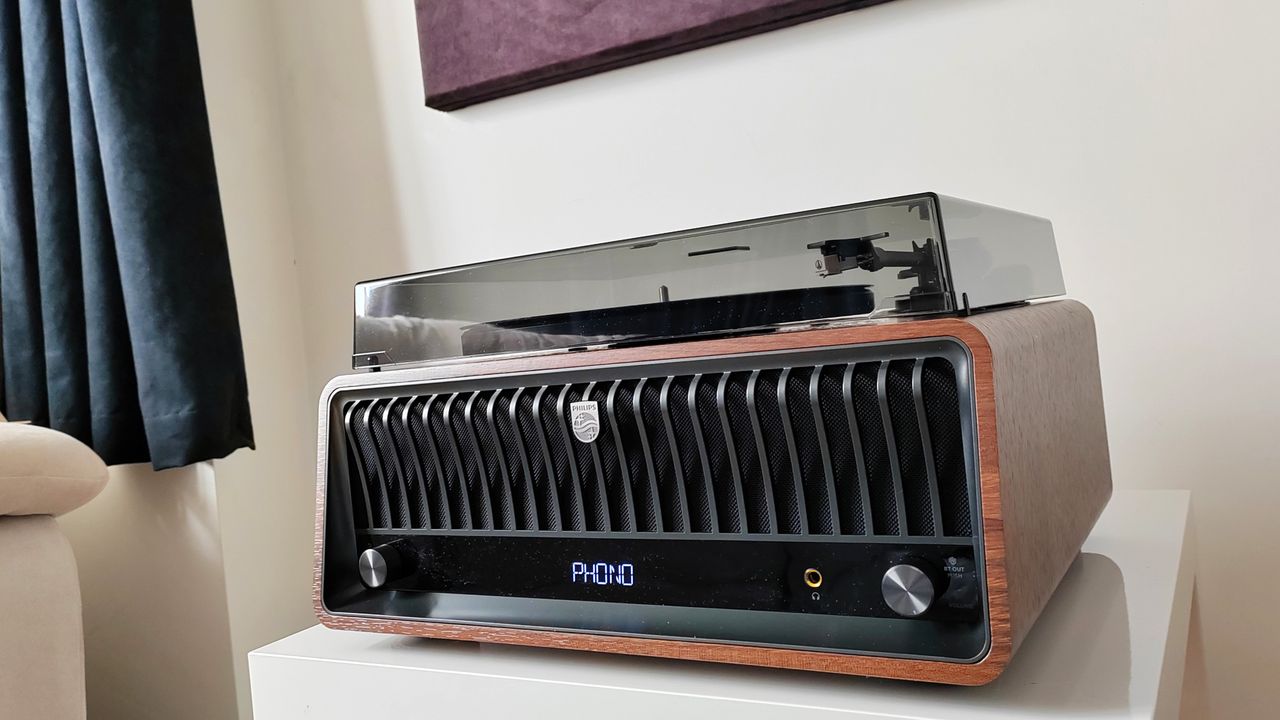
The Tina is clearly designed to be noticed. Measuring a substantial 448 x 245 x 399mm, and weighing 11kg, it plays its role as high fidelity furniture with some conviction.

The walnut-effect finish is convincing, not tacky, while the fabric grille and stylised ribs are an elegant nod to heritage radio design. The classic Philips ‘stars and waves’ badge anchors the look.

Two rotary controls flank a nicely clear display that shows source information or the time of day.

A front-mounted 6.3mm headphone jack is provided for private listening, while the rear panel accommodates a telescopic DAB aerial (which admittedly does rather SNAFU the retro illusion when raised).

There’s no physical remote control included, which I found rather annoying. While the Philips Home Entertainment app covers most functions – input selection, sound modes, volume – it’s definitely not as convenient as a traditional zapper, particularly with what is so clearly a cross-generational device.

Philips The Tina review: Verdict

(Image credit: Future)

It won’t be for everyone, but The Tina hits the mark if you’re after for an all-in-one music system that’s willfully vintage.

The wood-effect cabinet and classic detailing give this system real presence, although the lack of a supplied remote and the absence of Wi-Fi streaming may give some pause for thought.

There was always the danger that going full throwback like this might come across as a bit naff, but Philips' design team have pulled it off.

Given the confines of its brief, the record deck puts a decent budget foot forward – and I certainly enjoyed playing albums on it – while Bluetooth and DAB sound clean and consistent.

Ultimately, the Philips 'The Tina' TAV9000D is a well-built example of lifestyle audio that won’t break the bank. Plus, it’s a bit of a one-off.

Also Consider

The Lenco LS-570K strikes a similar pose to the TAV9000D, integrating record deck and Bluetooth into an Oakwood chassis with 80W amplification and quartet of speakers. It comes with wooden legs and sells for a comparable price.

The Ruark R410 system also appropriates vintage design cues, but gives them a more overt modernistic edge. Unlike The Tina, it’s not predicated on vinyl playback, instead majoring on wireless sources. Built quality and performance are high, but so is the price tag.

Sign up to read this article
Read news from 100’s of titles, curated specifically for you.
Already a member? Sign in here
Related Stories
Top stories on inkl right now
Our Picks
Fourteen days free
Download the app
One app. One membership.
100+ trusted global sources.