If you want a decent pair of active stereo speakers, you’re not short of options. The compact and affordable Ruark MR1 Mk3 (£399 / $579 / AU$899) and Onkyo GX-30ARC (£339 / $349 / AU$649), not to mention the more costly KEF Coda W (£799 / $1000 / AU$1450), have delivered ably on the promise of that signature stereo speaker sound and design combined with built-in amplification, Bluetooth streaming and plenty of physical connections.
Now it’s the turn of Philips and its active Fidelio FA3 speakers to see if it can muscle in on this market. At around £349 / $399 / AU$499, the FA3 cost around the same money as their Onkyo and Ruark competitors, and while the Ruarks derive much of their appeal from their compact size and engaging musicality, the Onkyo earned a five-star haul thanks to their solid performance and outstanding versatility. The bigger KEF Coda W, meanwhile, are for anyone wanting a significant step-up in sound quality for a more sizeable sum.

Lots of bases covered then, and all leading to one important question: do the Fidelio FA3 offer anything that their class-leading rivals don’t already have covered?
Build & design
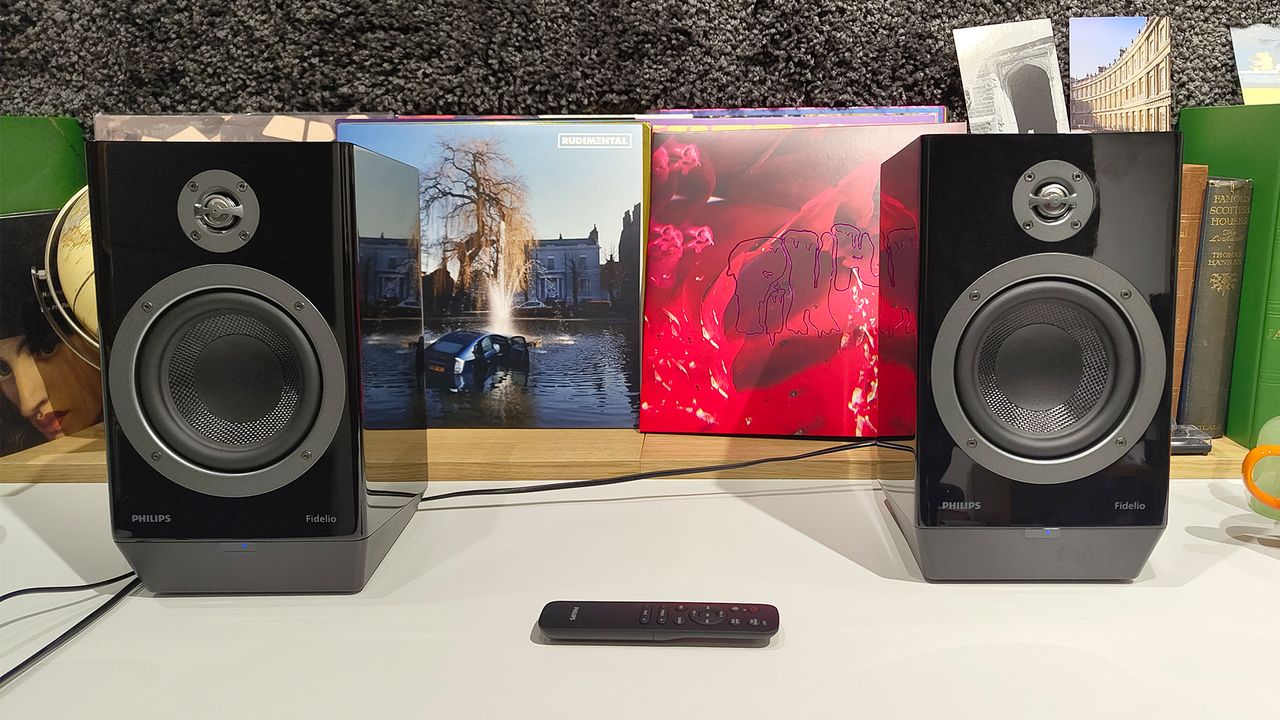
The Fidelio FA3 are on the larger side of what you’d generally find from a pair of active speakers at this price – if anything, they could pass for a pair of dedicated hi-fi standmounts.
Standing around 30cm tall, they dwarf their 22cm high Onkyo GX-30ARC rivals, all while making the 18.5cm Ruark MR1 Mk3 look titchy by comparison.
While you can just about fit them on a large desktop, Philips recommends placing these larger active speakers on dedicated speaker stands for the best performance.
Philips Fidelio FA3 tech specs
Bluetooth? Yes (5.4)
Bluetooth codecs supported SBC, AAC, LDAC
Inputs RCA line-level, Optical, USB-C, HDMI ARC
Outputs: N/A
Dimensions (hwd) 30 x 17 x 21cm
Weight 3.4kg (each)
Finishes x 1 (black)
They’re big beasts, but not poorly made. The overall standard of construction feels admirable, while the main body of the speakers shines proudly thanks to its glossy black finish. That gloss black exterior gives the FA3 a somewhat flashy aesthetic, even if it leaves them susceptible to the ignominy of grubby fingermarks. Oh, and we hope you like that colourway, because it’s the only one currently available.
Unlike their key competitors, the Fidelio FA3 eschew a master and slave configuration – whereby one speaker takes the power and shares it through a wired cable connection to its companion – in favour of both units receiving power via two separate sockets. That can cause its own issues, as you’ll need two available plug sockets to keep your speakers firing, and the provided power cables are a little on the short side at around 140cm each.
The primary speaker houses the lion’s share of the inputs and buttons, including a power button, volume dial and source selector, with both speakers sporting a small LED indicator at the bottom. It’s nice to have those colour-changing LEDs displaying which source you’ve selected, but wouldn’t it have been more user-friendly to have mounted the volume dial at the front of one of the boxes? As it is, it’s just a small dial hidden on the primary speaker’s back panel.
The FA3 speakers come with a dedicated remote control for selecting your desired inputs, adjusting volume, managing playback and tweaking levels of treble and bass, and while that remote is a little plasticky, it’s about what we’d expect for this price. There’s also a set of magnetically attachable oval grilles which cover the core drive units rather than the whole of each speaker’s frontage, a smart decision which preserves the FA3’s overall aesthetic.
Inside, each speaker is fed by 50 watts of Class D power, with dedicated internal amplifiers powering a 25mm titanium dome tweeter and a 12.7cm glass-fibre mid/bass unit in pursuit of “breathtaking dynamics and soundstaging”. Bass performance, as you’ll discover when you turn your speakers around, is tuned by a large rear port on each unit.
Features
For simple convenience, Bluetooth is the only way you’ll get a wireless connection going from your system to your source device, with standard AAC and SBC living alongside the higher quality LDAC codec if you have a compatible source.
Physical connections include RCA stereo inputs alongside an optical input, as well as a USB-C option if you want to connect directly to your laptop or smartphone. For integration with a television, the Fidelio FA3 also feature an HDMI ARC port.
That’s a reasonably solid variety of connections, even if a lack of a standalone 3.5mm aux input, a sub out or any phono stage for connecting a turntable means Philips lags behind the comprehensive suite provided by the do-it-all Onkyo GX-30ARC.
The speakers themselves can be connected to each other wirelessly or via a coaxial cable. All digital input sources will be able to handle files up to 24-bit/192kHz, but regardless of input, note that the Philips speaker will downsample all incoming hi-res files to a maximum of 24-bit/96kHz resolution.
For taking charge of your Fidelio FA3 and tinkering with the finer points of your experience, you’ll want to get a hold of the latest version of the Philips Entertainment app. Here, you’ll discover a reasonably wide range of handy boons, including an in-depth seven-band equaliser and a digitally mapped alternative to the physical remote control.
Sound
When we first had a taste of the Fidelio FA3 speakers earlier this year [original review published 10 March 2026], the first thing we noticed was their heavy-handed bass reproduction, which we dubbed “as overbearing as a strict mother turning up to her daughter’s first disco”.
Whether we placed them on our dedicated hi-fi stands or on a desktop table, that rumbly low end threw off their entire balance, leading us to feel frustrated by speakers that seemed to lack proper self-control. They originally received three stars for their sound quality.
Philips checked our initial sample and found there was a problem with some of their earlier production units – there had been software glitches in the early production run, and our original review sample was one of the ones affected. This has now been fixed, and we’re trying a revised version of the Fidelio FA3 for this review.
The replacement speakers we hear are far less rumbly in the bottom end than our original samples, granting more shape and definition to the deep bass plucks at the start of Goose’s So Ready. Their bass is still a little on the soft side, and they don’t have the same lower-end precision as the rival Ruark MR1 MK3, but this is a far more acceptable performance.
Elsewhere, the sound we receive is powerful, meaty and reasonably detailed, with a punch and enthusiasm that makes the Fidelio FA3 hard to dislike. Voices come through with ample expressiveness, and we detect a real keenness and full-bodied bite through what is an admirably expressive midrange.
This isn’t quite the crispest or most nimble audio you’ll hear – again, the Ruarks and Onkyo GX-30ARC are better in that regard – but the Fidelio FA3s’ weighty and impressively cinematic approach does give genuine muscle to Hans Zimmer’s Why Do We Fall?, giving the titanic track a real feeling of epic drama.
Those qualities are augmented when a physical connection comes into play. We dig out a USB-C cable to put some further pep into the Fidelio FA3s’ step, and while their core character remains, we find that they sound more composed and confident with a good old-fashioned wire connecting them to our Lenovo Thinkpad laptop.
Everything sounds tighter and clearer, allowing what is an admirably detailed midrange to shine more brightly than before. There’s more space around the notes played, with music hanging together in a more organised and convincing manner.
Encouraged by that USB-C performance, we recruit the services of our trusty Cyrus CDi CD player and connect it to the Philips’ RCA stereo input, discovering that the system is capable of accommodating a far more talented source player than a standard work laptop.
Moving over to the optical input shows the Philips’ DAC is a respectable one, even if we still discern a noticeable drop-off in performance when switching from the talented Cyrus’s DAC to that of the Philips. That’s not entirely surprising, as the Cyrus CDi, while advancing in its years, will still set you back around £1000.
Regardless of source, the Fidelio FA3 aren’t quite capable of overcoming the absolute best in class at this level. Admittedly, the powered Ruark MR1 Mk3 speakers sound smaller than the FA3, but they’re also a subtler, more expressive proposition than their larger rivals, bending and flexing to accommodate the mood and feel of a wide musical spectrum and making the Philips seem a little route-one in their approach.
Similarly, the Onkyo GX-30ARC don’t have the sonic brawn of the Fidelio FA3, but those shortcomings are remedied by a clearer, cleaner sound and a more dextrous handling of those key bass frequencies.
Still, the Fidelio FA3 are a fun, undemanding listen, and there’s rarely a moment during our test time when we find ourselves nodding off, thanks to the speakers’ powerful sonic reproduction. They’re not as musical as the Ruarks or as crisp and clear as the Onkyos, but they are easy speakers to live with.
Verdict
We’re glad that Philips has rectified the initial issue it had with its earlier batches of the Fidelio FA3.
Our final test samples aren’t quite in the same league as their rivals from Ruark or Onkyo, but if you want a pair of easy to use active speakers with a bold, powerful sound and a solid array of connectivity options, the Fidelio FA3 could well be just what you’ve been looking for.
Original review published: 10th March 2026; review updated 1st July 2026.
SCORES
- Sound 4
- Build 4
- Features 4
MORE:
Read our review of the Ruark Audio MR1 Mk3
Also consider the Onkyo GX-30ARC
Best active speakers: our experts pick the top pairs with integrated amplifiers