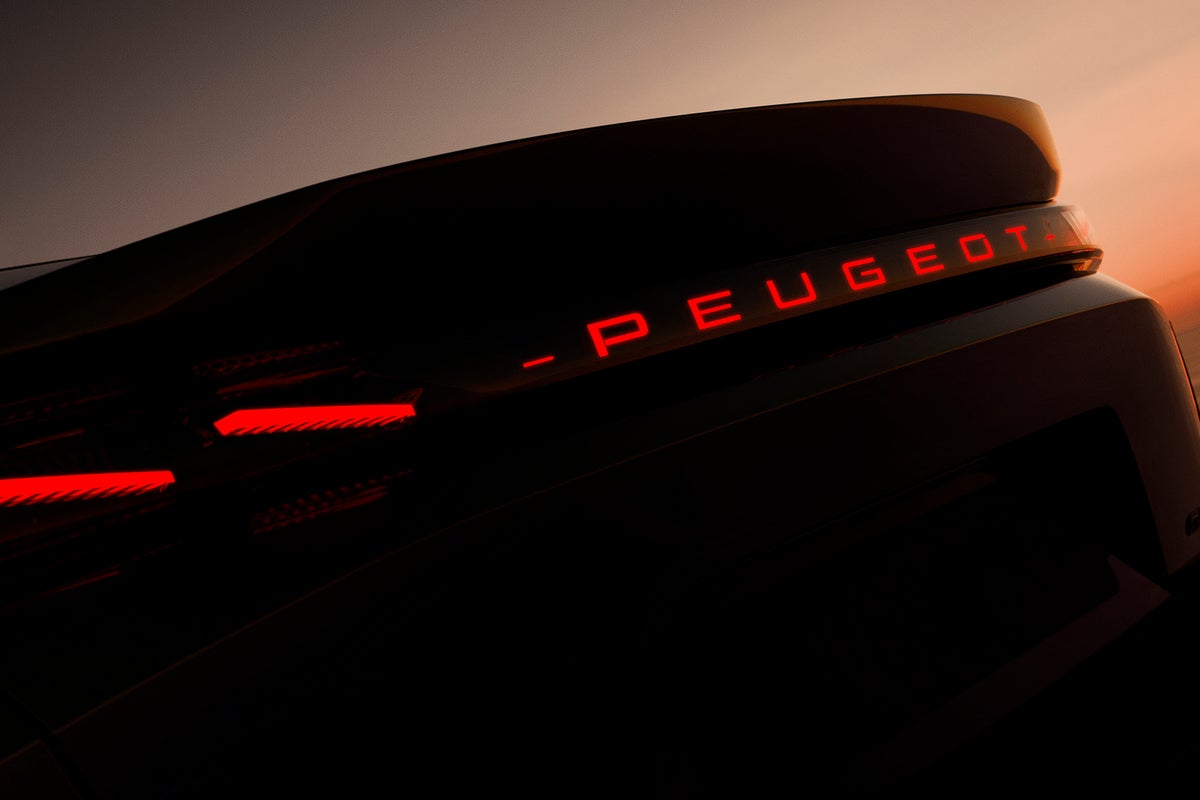
Peugeot has given the 408 a glow-up rather than a full makeover, putting lighting technology firmly centre stage for the model’s mid-life facelift. The fastback crossover becomes the first Peugeot to feature illuminated brand lettering at the rear, paired with an illuminated lion badge at the front – creating a sharper visual identity without touching the car’s underlying mechanical package.
The facelifted 408 marks the first time Peugeot has rolled out illuminated brand lettering on a production model. At the rear, the glowing name is integrated into a glossy black strip that runs the full width of the tailgate, flanked by the brand’s familiar three-claw LED light signature.

Peugeot has also reworked the daytime running light signature – it now consists of three slim, slanted LED claws on each side, which double as scrolling indicators. These are visually linked by a horizontal LED strip stretching across the nose of the car above the illuminated badge on higher trims. The main headlamp units have been repositioned lower in the bumper to preserve the visual impact of the signature lights and are split into two ultra-thin modules for dipped and main beam.
The revised 408 is equipped with either full LED headlights or matrix LED technology. Peugeot has also hidden the previously slightly incongruous proximity radar behind the front badge, keeping it out of sight while maintaining the functionality of the car’s driver assistance systems.
Other than the changes to the lighting, more pronounced 3D sculpting and a mix of gloss and matte black finishes are used to give the nose a stronger stance. The lower bumper has been tweaked, too, with a new trapezoidal shape plus body-coloured and black elements, which Peugeot claims smooth the transition into the rest of the bodywork.

At the back, the illuminated lettering is the headline change, but Peugeot has also made the three-claw LED light signature, previously reserved for top-spec models, standard across the range. The result is a more distinctive night-time appearance intended to underline the 408’s positioning as a more premium mid-range model.
A new exterior colour joins the range, too. Flare Green makes its debut on the facelifted 408, offering a finish that shifts noticeably with changing light conditions. Peugeot says the colour moves towards brighter yellow tones in direct sunlight and deeper green shades in shadow, helping to emphasise the car’s sculpted surfaces and fastback silhouette. New wheel designs round off the external changes.
Inside, the focus is on refinement rather than reinvention. All versions get a revised digital driver display with updated graphics, while GT Exclusive models (and GT cars as an option) gain a 3D digital display designed to improve readability. New fabrics and trim materials have been introduced across the cabin, with Alcantara, genuine aluminium and Nappa leather available on higher-spec 408s.

The familiar i-Cockpit layout remains unchanged with a compact steering wheel sitting low to supposedly give a clear view of the 10-inch digital instrument display, while a 10-inch central touchscreen is angled towards the driver – that’s small by today’ standards. Five customisable i-Toggles continue to provide shortcut access to frequently-used functions such as climate controls, navigation destinations, phone contacts and media.
Mechanically, the facelifted 408 is unchanged. The fully electric E-408 uses a 207bhp motor producing 343Nm of torque, powered by a 58.2kWh battery. Peugeot quotes a maximum range of up to 283 miles, with average energy consumption of around 4.2 miles per kWh. DC rapid charging is supported at up to 120kW, allowing a 20 to 80 per cent charge in around 30 minutes. Neither the range nor charging speed are spectacular these days.
New EV-specific features include battery pre-conditioning, vehicle-to-load capability delivering up to 3.5kW to power external devices, simple ‘Plug & Charge’ functionality at compatible public chargers, and an 80 per cent AC charging limit designed to sprotect the battery and suit daily use.
The plug-in hybrid 408 combines a 176bhp petrol engine with a 123bhp electric motor through a seven-speed dual-clutch automatic gearbox. Peugeot quotes an electric-only urban range of up to 53 miles.
A mild hybrid version remains available too, pairing a 141bhp petrol engine with a six-speed electrified dual-clutch transmission. Peugeot says this allows up to 50 per cent of urban driving to be completed in electric mode.
Practicality is unchanged. With its 2,790mm wheelbase, the 408 offers 183mm of knee room in the back seats, while boot capacity stands at up to 536 litres, expanding to 1,611 litres with the rear seats folded.
The new 408 will be covered by Peugeot Care, which includes an eight-year or 100,000-mile warranty on the vehicle and, in the case of the E-408, the battery, too. UK pricing and on-sale dates are expected to be confirmed closer to launch later in 2026.
Tesla’s cheapest Model 3 yet lands in the UK
Geely’s £29,990 Starray EM-i gets 618-mile range and handling by Lotus
EV charging boom reshapes Britain’s cities as Coventry leads the way
Best plug-in hybrid cars 2026: the top PHEVs to buy in the UK
Best electric cars 2026: Top 13 EVs to buy
Best used electric cars 2026: Top 10 second-hand EVs recommended by our EV Editor
Tesla Model Y Standard review – first UK drive of new cut-price Model Y