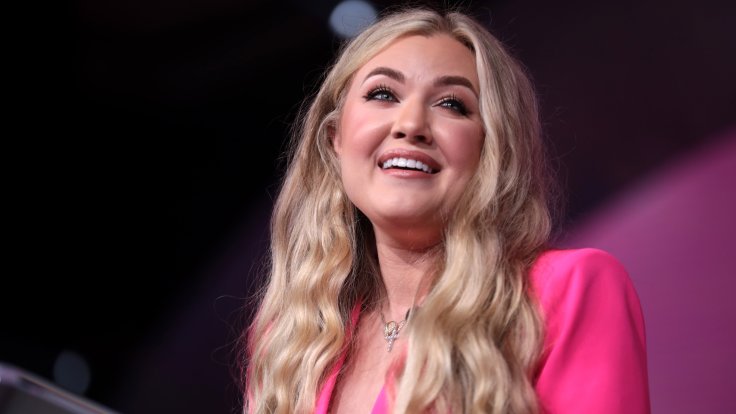
Four months after her husband's assassination, Erika Kirk posted a tender New Year tribute on Instagram, a brief but poignant reflection on grief that exists outside the tyranny of the calendar.
'Time cannot age what is sacred,' she wrote on Tuesday, 6 January 2026.
'My heart didn't cross the threshold with the calendar. 2025, you'll always be untouched.'
The post was accompanied by intimate family moments: Charlie and their two children enjoying a beach day, a tender shot of father and daughter gazing across a serene lake, the family standing together atop a hillside.
It was meant to be a quiet remembrance. Instead, it ignited a firestorm that exposed the growing fractures within the conservative movement itself—particularly regarding how Turning Point USA, the organisation Kirk founded, has chosen to memorialise his death.
The backlash came swiftly and unexpectedly. Rather than sympathetic responses, critics—many of them longtime conservative allies—accused Erika of performative grief.
'I'd believe these posts if you weren't doing a mega tour. I feel sorry for Charlie. He deserves better,' one commenter wrote.
Another added, more bluntly: 'Next step in mourning: merchandise.' The accusations stung deeper because they didn't come solely from the political left. They came from within the MAGA movement itself, from people who had long supported Charlie Kirk's vision.
The AmericaFest Crisis: When Memorial Became Spectacle
The real catalyst for the backlash, however, wasn't Erika's New Year post alone. It was Turning Point USA's decision to recreate the exact tent where Charlie Kirk was shot and killed—complete with merchandise, selfie opportunities, and attendees posing beneath it during the four-day AmericaFest conference in December 2025.
At Utah Valley University on September 10, 2025, Charlie Kirk, aged 31, had been speaking at his 'Prove Me Wrong' debate booth when a single shot rang out from approximately 430 feet away. Tyler Robinson, a 22-year-old, was arrested and charged with aggravated murder. The assassination shattered not only Erika's life but the entire conservative youth movement.
Three months later, Turning Point USA erected a replica of that infamous tent at AmericaFest. Attendees lined up to pose for photographs beneath it.
Merchandise tables overflowed with t-shirts reading 'Make America Charlie Again' and 'I Am Charlie.' The installation, framed as a tribute, instead became a flashpoint for criticism that extended far beyond the traditional political divide.
Even MAGA-aligned commentators recoiled in disgust. 'This is a disgusting and satanic macabre display,' wrote investigative journalist @SwordTruth. Another MAGA voice, @DiligentDenizen, declared it 'something very sick, morbid and dark.'
Conservative commentator @unhealthytruth admitted it 'made me sad and a little disturbed.' Perhaps most damning was the assessment from those questioning whether the installation had crossed from memorial into exploitation.
'Charlie deserved real respect, not this deranged, exploitative circus,' critics stated, questioning the ethics of turning a murder scene into a photo opportunity booth.
The Wider Reckoning: Grief, Grift, and the Future of Turning Point
What the controversy ultimately reveals is a fundamental tension within the conservative movement about how to honour tragedy without commodifying it. Erika Kirk herself recognised this tension, addressing critics head-on in an Instagram post shared in early January.
'Their words, accusations, assumptions, and slander don't land, they don't burn,' she wrote. 'Never will. I owe the world nothing.'
Yet her defiance doesn't erase the legitimate questions that have emerged. Erika has stepped into a leadership role at Turning Point USA—effectively inheriting her late husband's political empire—at precisely the moment when significant internal criticism suggests the organisation has lost sight of its original mission.
Comments flooded social media questioning whether Turning Point had 'sold out,' whether it had become 'performative,' whether the ideals Charlie Kirk championed were being exploited rather than honoured.
The tension is particularly acute because Erika, who was devastated by her husband's death and publicly forgave his killer during his memorial service, is now expected to steer an organisation grappling with its own identity crisis. The woman who told the world, 'My husband's voice will remain,' is now tasked with ensuring that voice isn't drowned out by merchandise tables and photo opportunities.
What Erika Kirk's New Year's tribute ultimately revealed is that grief in the public eye is never truly private. Every post, every appearance, every decision becomes fodder for interpretation.
For someone navigating the impossible position of mourning whilst leading, the stakes are exponentially higher. The question isn't whether her tribute was heartfelt—those intimate family moments suggest genuine pain. The question, perhaps, is whether the institutions surrounding her grief have remained worthy of the legacy she's trying to preserve.