Get all your news in one place.
100's of premium titles.
One app.
Start reading
The Economic Times
The Economic Times
Piyush Shukla

Perdue Farms invested $300,000 in Chesapeake Conservation in 2023. The project reached 40 farmers and cut Nitrogen, Phosphorus and sediment pollution

A farm in Pennsylvania can be part of the Chesapeake Bay story without being anywhere near the bay. Rain does the connecting. It falls on fields and around farm buildings, moves through drainage systems and streams, and carries whatever it picks up along the way. Soil can travel with it. So can nitrogen and phosphorus.

That's what a 3 year partnership between Perdue Farms and the Alliance for the Chesapeake Bay wanted to crack.

The project worked with poultry farmers in Pennsylvania, Maryland and Delaware. They put money and technical support behind conservation work.

Forty farmers participated. Thirty went on to install conservation practices, for a total of 44 projects across their farms.

The funding for this came from several places. Perdue contributed $300,000, the National Fish and Wildlife Foundation provided $1 million, and another $1.2 million was brought in by other partners.

The farmers did not all need the same fix

The project did not begin with a standard list of measures for every farm.

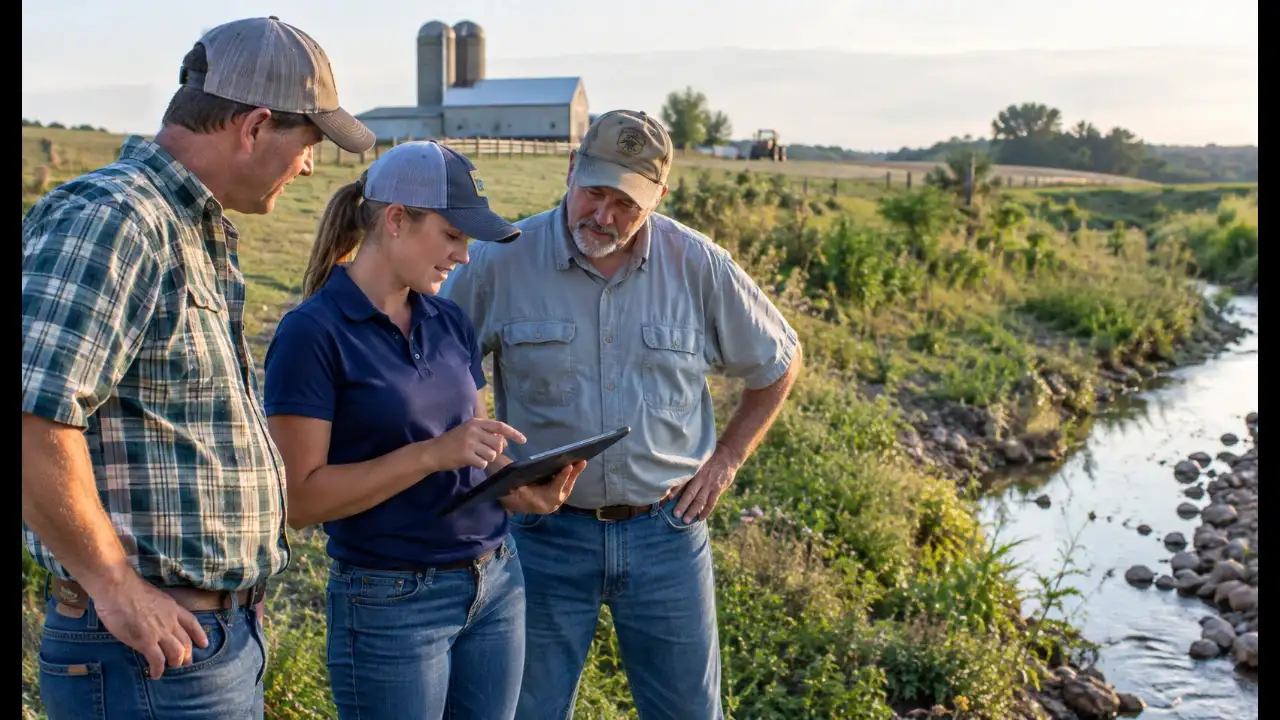
Instead, the Alliance worked with individual producers to understand how their operations functioned and where conservation work made sense. That led to different solutions from one farm to another.

Some farmers installed vegetative environmental buffers around poultry houses. Others made changes to manure management or upgraded stormwater systems. The projects addressed different ways that water, nutrients and soil can move off agricultural land.

That may sound straightforward. On a working farm, it is not always so simple.

Equipment has to get through. Labor has to be available. Weather can change plans. Manure has to be managed around crop and soil conditions. A conservation measure that looks good on paper still has to work when the farm is busy.

The technical assistance was meant to help with that part. Farmers were not simply handed funding and left to decide what to do with it. The Alliance worked with them on the practical choices, while financial support helped cover the cost of putting those changes in place.

For Tommy Gearhart, a participating farmer in Hollidaysburg, Pennsylvania, the work had a direct connection to manure management. He said the support helped streamline the process and allowed nutrients to be used when his farm needed them.

The environmental gains come from keeping material out of the water

The project's estimated numbers give a sense of what those individual changes add up to.

The conservation practices are expected to reduce more than 15,000 pounds of nitrogen, 900 pounds of phosphorus and 184,000 pounds of sediment each year.

Those materials can move with runoff when rain falls on agricultural land. Once they enter waterways, they become part of a much larger system that eventually feeds toward the Chesapeake Bay.

Nitrogen and phosphorus are not pollutants simply because they are present. Farms need nutrients, and plants need them to grow. The problem comes when too much reaches waterways. Excess nutrients can contribute to water-quality problems.

Sediment follows a different path. Soil washed from land can settle in streams and affect aquatic environments.

The project also estimates that the conservation work has resulted in about 93.17 tons of carbon being removed from the watershed through plant uptake. Vegetation installed on farms can take up carbon while also helping hold soil and filter water.

Those figures need some context. They are estimates tied to the practices supported by this particular project. They do not represent the environmental impact of every farm in the Chesapeake watershed, nor do they measure the entire bay restoration effort.

What they do show is the expected effect of a defined group of conservation changes on 30 participating farms.

Seventy-five percent of participating farmers moved from planning to action

One figure may say as much about the project as the pollution reductions: 30 of the 40 farmers involved ultimately installed conservation practices.

That is a 75% participation-to-action rate within the project.

Brittany Smith, senior agricultural project manager at the Alliance for the Chesapeake Bay, said farmers were willing to make changes when they had access to both funding and the support needed to work through the process.

The people making these decisions still have to manage livestock, equipment, labor, weather and production schedules.

The project's approach was built around that reality. Rather than asking every farmer to make identical changes, the partnership allowed conservation work to be shaped around individual operations.

Sign up to read this article
Read news from 100's of titles, curated specifically for you.
Already a member? Sign in here
Related Stories
Top stories on inkl right now
One subscription that gives you access to news from hundreds of sites
Already a member? Sign in here
Our Picks
Fourteen days free
Download the app
One app. One membership.
100+ trusted global sources.