Get all your news in one place.
100's of premium titles.
One app.
Start reading
The Guardian - US
The Guardian - US
World
Rachel Leingang

‘People are pissed off’: anger at the elite and the establishment is fueling this year’s midterms

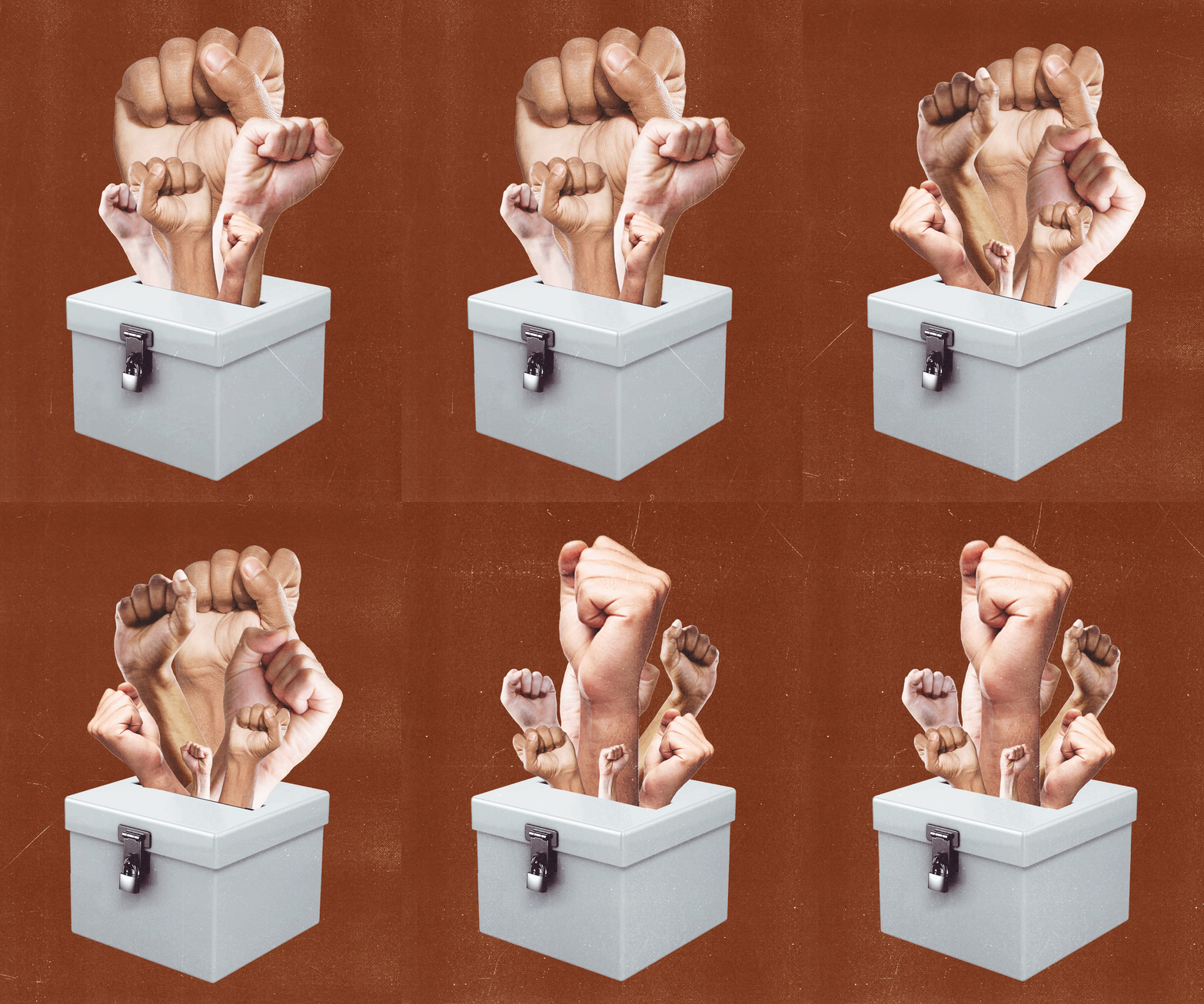
Animated collage of raised fists emerging from a ballot box
The rage of angry voters is reshaping American politics. Photograph: Guardian design

Brian Leeland, a 79-year-old Democratic voter in Detroit, had enough. Frustrated by the way the US media covers this febrile political era, from Donald Trump’s Washington to political campaigns across the country, he contacted the Guardian.

“Your decision to frame the race here as a simple progressive versus establishment choice is overly simplistic verging on lazy,” he wrote to this reporter, after our coverage of progressive Abdul El-Sayed’s campaign in the Democratic US Senate primary in Michigan. “As an electorate, we are not binary for the convenience of the media.”

His was a complaint I heard often as I traveled across the midwest to cover a host of contested Democratic primaries. So I called him up.

Leeland’s list of frustrations is long: grifters, liars, the two-party system, money influencing elections, the US’s standing in the world, the growing national debt and a fixation on cultural issues, not just the larger problems that plague the country.

He is one of many angry voters whose rage is reshaping American politics. It could decide the balance of power in Washington this November and stymie the president’s final years in office – and help determine what comes next for the left after Trump.

Headlines from this year’s midterm primaries have ping-ponged back and forth – between major wins for progressives and moderates in Democratic races, defeats and victories for big money, and tests of Trump’s power over the Republican party. But on the campaign trail in contested Democratic primaries throughout the midwest, I found that attempts to tease out ideological trend lines obscured a deeper reality. More than any factional battle between one wing of a party over another, this year’s midterm primary elections is punctuated by a profound dissatisfaction with the political status quo.

American voters are mad – at pretty much everything. I live in Minneapolis, and the anger at the Trump administration over Operation Metro Surge and the killings of Renee Good and Alex Pretti still dominates most political conversations many months later. In Michigan, multiple people described themselves to me as more moderate, then railed against the status quo. At a coffee shop near the Canadian border, a man emotionally injected himself into my conversation with a local leader to say how upset Canadians are.

Voters can’t afford healthcare or childcare. Grocery and gas prices keep rising while the richest people keep lining their pockets. Farmers and small business owners are contending with tariffs and a trade war. Small town residents are beating back datacenters and tearing down Flock cameras. They don’t want the US to be involved in wars overseas. Women’s rights and access to abortion care are on a backslide.

A “pissed-off majority” is finding its voice, according to Maurice Mitchell, the national director of the Working Families party, a progressive third political party that’s seen its endorsees winning bigger than ever this year. “Most people around the country, many of whom don’t even identify as Democrat or Republican or whatever, are 10 out of 10 pissed off, angry and willing to take that anger into action against the status quo.”

Trump, of course, himself rode a wave of voter anger at the political establishment – both in 2016 and again in 2024. He sought to stir up anger at his enemies, immigrants, trans people, the so-called “deep state”.

But in his second term – with material conditions deteriorating for many Americans as wealth accumulates at the top, disruption caused by the rapid adoption of artificial intelligence, an unsanctioned war in Iran, failed accountability on the Epstein files and trade wars with friendly nations – Trump is now a target of the very anti-establishment anger he stoked.

Trump’s political project has sought to harness anger and apportion blame. The administration’s common argument that the reason people can’t get well-paying jobs is because of immigrants is a central example, said Anat Shenker-Osorio, a progressive political consultant. It’s a common story that authoritarians tell – that “those people” are standing in the way, she said.

But Mitchell, of the Working Families party, said this scapegoating playbook is falling flat after a decade. “If you’re claiming that the source of my pain [is] trans people and DEI and immigrants, and now you have the ball and you’ve used that power to make those people’s lives hell, but my life isn’t better, then the jig is up,” he said. Who’s left to punch down at?

Democrats relied on disgust at Trump to carry them to victory in 2020. But this election year, voters are asking for more. The candidates who have run on that hunger for a different vision of politics have been rewarded by voters in their party’s primaries.

Rob Sand, the Democratic contender for the Iowa governor’s seat, regularly calls out the two-party system. He has framed his quest to win over red-state voters not as left versus right, but “well-fed versus the fed-up”.

Angie Nixon, the Democratic nominee for a US Senate seat in Florida, and a democratic socialist, said voters have not cared about any intraparty label. They care more that she cares about people, she suggested.

“I’m actually going to look out for just regular, everyday people and put them first and put forth policies that will positively impact them,” she said. “And so, yeah, I’m getting hit from all different sides, but I know I’m on the right side of history because I’m resonating with people, and they’re realizing that in the next 250 years, what’s been happening doesn’t have to continue to happen.”

The final test in November, however, will reveal if their message resonates across the board, with voters of all political backgrounds.

“They want to see you fighting for the things you said you would fight for, and doing the things you said you would do,” said El-Sayed. “And too often, the very people who tell them they’re fighting for them turn around and do the same exact thing that they swore they’d never do.”

***

The laundry list of issues enraging voters is long – so long, in fact, it can be harder to find areas in which people think the country is headed in the right direction than spots where there is broad dissatisfaction.

Phil Verges, a 65-year-old farmer from Spring Valley, Wisconsin, recently became old enough to qualify for Medicare. As a farmer, he struggled with healthcare costs much of his life, as he watched his parents do for much of theirs. While he’s glad to have the coverage, the whole thing has been “bittersweet”. He recalled being in his 20s and thinking that by the time he would be old enough for Medicare there would be some kind of universal coverage in the US.

“So that hit me kind of hard,” Verges. “Four decades have gone by and we’re still not doing the right thing, at least in my opinion, with healthcare.”

The US is the only nation with GoFundMe campaigns for hospital bills – or before that, a spaghetti dinner to raise funds in small towns like his, he said.

“People are getting sick and tired of being sick and tired,” Verges said.

Sarah Agnew, a 56-year-old Democrat in Minnesota, said her party hasn’t done enough to stand up to Trump. But she has faith in some candidates this year who she really believes in, including the Minnesota US Senate candidate Peggy Flanagan and the Texas US Senate candidate James Talarico. For her, accountability for the Trump administration is most critical right now.

“I want to see accountability for Alex Pretti and Renee Good, and I want to see accountability for Kristi Noem and everybody who is responsible for what happened here in our state and our city,” she said.

Milan van Dam, the 17-year-old national chair of the High School Democrats of America, will be just shy of voting age this November. He was in second grade when Trump was elected. Trump has always been part of politics for him, but he and other young voters aren’t craving a return to the pre-Trump status quo they never knew. They want something better.

It’s not that all young people are suddenly interested in socialism, he said, a common diagnosis from political pundits: they just don’t accept an incremental approach to politics. “The vast majority of people voting for these candidates, who in some cases happen to be democratic socialists, aren’t democratic socialists.”

The mounting sentiment against the system has been building since at least the 2008 recession, when voters felt the government did not do enough to help everyday people while banks and big businesses got bailed out, according to AJ Simmons, research director of the Center for State Policy and Leadership at the University of Illinois Springfield.

National elections have vacillated back and forth between the two major parties, but many of the Americans who voted for them have concluded that neither can actually fix the underlying problems.

At a time when it feels as if the country is in freefall, Simmons suggested many of its citizens are craving both authenticity and competence. “People are getting [to] a point of ‘I don’t know how much I care about the culture war – I can’t eat blueberries, I can’t eat lettuce, I can’t get healthcare. Will you do one of those things?’” he said.

***

Seth Bodnar, an independent running for US Senate in Montana, shot a Flock camera with a gun in a recent campaign ad that railed against the mass surveillance, saying big tech was using them to track “our every move” then storing the data in datacenters they want to build “in our back yards”.

“They are all getting rich and we’re getting screwed, and nobody is holding them accountable,” Bodnar said, as Trump simultaneously spent the week advocating for unfettered growth of the tech sector.

The current crop of candidates challenging the status quo are running on “solidarity populism”, Mitchell said – giving voice to the anger and calling out the villains who deserve to see it directed at them, instead of blaming people who don’t have power.

Flanagan, the Minnesota US Senate candidate, said one of the things Trump did well was to talk about how the economy was rigged. What’s become clearer, as Trump built a gilded ballroom and billionaires lined their pockets, she said, was that the president and his friends were the ones doing the rigging.

The rage is even more crystalized when the impact is felt close to home. Flanagan went to the iconic Minnesota state fair on opening day. Imagery of the Trump administration’s immigration crackdown dominated the artwork made of locally grown seeds and plants – a sign, she said, that the state’s voters have not moved on from the trauma and disruption caused by Operation Metro Surge.

“Folks have had it, and they want people who are going to push back,” she said.

At a county fair last month, Rebecca Cooke, the Wisconsin congressional hopeful, said she had spoken to a man who told her he had voted for her opponent, Republican Derrick Van Orden, twice, but wouldn’t be doing so again because of “this goddamn war”. Cooke wants to point such anger and ire at the ultra-wealthy, the tech billionaires, the people making record profits off American workers.

In Ohio, Nan Whaley, the 2022 Democratic contender for governor, had beers in recent days with a former Republican turned independent. The voter was worked up, she said, about healthcare costs, rising government debt and billionaires like Elon Musk not paying their fair share of taxes. Whaley said she hears other complaints from young people about the quality of available jobs and the affordability of raising kids. A cab driver recently told her he had voted for Trump, she said, but didn’t realize the president was “going to steal everything that wasn’t nailed down”.

“People are very, very angry that there have been people in office that are viewed as the establishment and nobody seems to care about the problems they’re having in their daily lives,” Whaley said.

William Lawrence, the Democratic nominee in Michigan’s seventh congressional district, said the first step to dealing with voter anger is acknowledging and affirming it. He’s 36, and has spent his entire life seeing aspects of the American dream diminish.

“People are pissed off and incredulous that our leaders could have allowed it to get this bad,” he said. “It’s Republicans and Democrats, independents and those who don’t even know what to call themselves any more, because they’re just so fed up with it.”

But his goal is to make sure they don’t drop out of the political process altogether.

***

The mad-as-hell faction will decide the midterms, as it often does, Shenker-Osario said, and that is a “plague on both your houses” vote, not an embrace of Democrats. The scale of this phenomenon later this year will depend on whether enough voters view the election as marquee enough for them to turn out. “There could be a not merely blue wave, but a blue tsunami,” she said.

Stephanie Matejka, a 46-year-old insurance agent in Lincoln, Nebraska, first got involved in politics during Bernie Sanders’ presidential run. She finally saw someone who she felt was speaking to issues that matters to her as a single mom. She now volunteers with the local Democrats, and thinks deep red Nebraska could elect Democrats to Congress and the governor’s office, and an independent to the US Senate, this year.

As she’s driven through Nebraska, she can tell which communities saw their schools closed, consolidated into other towns’, because the small towns wither. They have to drive 100 miles (160km) away to see their grandma in a nursing home because it was the closest option. They’re contending with gas prices that make the driving even harder.

“I think that’s what’s really happening is the current administration, both statewide in Nebraska and countrywide, they do not care about people’s quality of life as long as it fits their pocketbook,” she said. “And people hate that. They’re resentful of it.”

Whatever happens, governing is much harder than campaigning, Simmons said. “It’s really effective to be a challenger,” he said. “It’s real hard to govern right now because you also look at Congress and how conflictual that is, how non-governing Congress is. And nobody seems to be really solving anything.”

Democratic candidates insist they can work in a divided government – potentially controlling Congress, if not the White House – to build consensus positions using an “inside-outside” strategy to engage voters in pushing for positions outside the government while they advocate for them inside.

But they’ll have to reckon first with their own mistakes, including their subservience to big-money donors and an often poorly articulated vision of what the party stands for, especially during the age of Trump.

“Things are going to get worse before they get better, because the imbalance of power right now is so severe,” Lawrence said. “After the damage that’s been done, it’s going to be a long road back.”

Leeland, the Michigan voter who emailed the Guardian, is tired of a system he believes is failing people. But he’s hoping there is a different road ahead.

A generation ago, when the Republican president Ronald Reagan was in power, “I was never this angry about it”, he said. “I didn’t like it much, but I wasn’t angry about it.”

Sign up to read this article
Read news from 100's of titles, curated specifically for you.
Already a member? Sign in here
Related Stories
Top stories on inkl right now
One subscription that gives you access to news from hundreds of sites
Already a member? Sign in here
Our Picks
Fourteen days free
Download the app
One app. One membership.
100+ trusted global sources.